In a video game created by Alvard and her friends, Tsovinar assumes the role of superhero
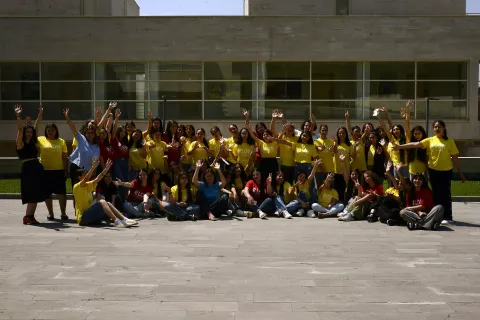
Girls aged 12-24 from Syunik, Lori, and Gyumri delved into the world of IT through video games, all thanks to the Gamechangers: Girls for Girls initiative.

- Հայերեն
- English
Princess Tsovinar, a central character in the Armenian epic ‘Sasna Tsrer’ (‘The Daredevils of Sasun’), has found a new role as a video game superhero. Possessing otherworldly powers, Tsovinar was introduced to the world of video games by a group of girls from Shirak.
Sixteen-year-old Alvard Charkhifalakyan, one of the game's creators, shared that the team engaged in lengthy discussions before deciding that Tsovinar embodied the strong female character they were searching for.
"We made a few alterations to the storyline in the game. [In our version,] Tsovinar adamantly declines to marry the caliph of Baghdad. Instead, she takes possession of the talisman, a repository of both the Sailor's power and the peace of the entire nation, and conceals it within the pyramids, one of the world's Seven Wonders. To retrieve the talisman, Tsovinar must confront two distinct challenges: navigating a labyrinth, arming herself, mustering her strength, and then, within the Egyptian pyramids, correctly answering two historical questions,"

According to Alvard, this is the game's premise, often called the game's ‘world.’ The group of girls has opted to select different heroes from the epic for subsequent worlds, transporting them to both familiar and enigmatic wonders, as part of their creative vision.
The girls seized the opportunity to develop a video game through the Gamechangers: Girls for Girls initiative, a program supported by UNICEF in collaboration with the Enterprise Incubator Foundation (EIF), alongside the Gyumri and Vanadzor Technology Centers.
A total of 120 girls, aged 12 to 24, hailing from Syunik, Lori, and Shirak, were provided with the opportunity to explore the realm of Information Technology (IT) through video games, recognizing their potential within the IT sector.
Following several months of intensive training in various essential areas, including Soft Skills and Idea Generation, Digital Skills, and Project Management and Implementation, a group of 70 participants came together to form teams and successfully developed their own video games.

"STEAM (Science, Technology, Engineering, Art, and Math) education provides the opportunity to develop various life skills: critical, problem-solving, innovative thinking, and more," stated UNICEF Adolescent Development Officer Hasmik Aleksanyan. She emphasized the importance of understanding how to use, create, and operate digital technologies in the digital age, noting that it is "vital for the success of young people and even more important for the education, participation, and empowerment of girls and women."
Even though Alvard had been passionate about IT for four years, the world of computer games was uncharted territory for her. During the game's development process, Alvard assumed the role of a storyteller and character creator.

"In addition to digital skills, we aimed for the program participants to contemplate the representation of women characters and delve into the lives and achievements of prominent women,"
"During the brainstorming phase, a significant number of the girls strongly emphasized Armenian history and mythology," noted Bella Harutyunyan, head of the Gyumri Technology Center project at the EIF. Our projects include an environmental game and another titled 'Time Machine,' where players can journey into the past to witness how people lived in the past. Additionally, we have drawn inspiration from Japanese mythology for one of our games. The girls also generated a number of ideas for detective-style games, as well as games where the game world, environment, and rules adapt based on player decisions and chosen responses. Overall, the girls aspire to create characters that are changemakers. However, it is noteworthy that the youth tend to concentrate more on the past and less on the future."
Alvard reveals that she has had a deep-seated fascination with ‘Sasna Tsrer’ for a while now; she has even participated in conferences and workshops dedicated to the epic. Alvard and her fellow team members were deliberate in their choice of Tsovinar as a character. "Our primary objective was to underscore that Tsovinar, as a female character, bore the weight of Armenia upon her shoulders, for the nation's peace lived within her talisman. She exemplified resilience in overcoming numerous challenges, exhibiting strength throughout her journey. Ultimately, it was her intelligence that allowed her to restore peace to Sasun and the entirety of Armenia," Alvard explains.
Before participating in the program, Alvard had no exposure to video games. Even today, she finds more satisfaction in the role of a game creator rather than a player. Although the path to her new vocation presents challenges, she welcomes these difficulties. Alvard expresses her optimism:

"In the field of [video] game creation, there are more than 200 professions. I strongly believe that one of these professions will become my calling. I aim to collaborate with my team to craft a game that could garner worldwide acclaim. While it may still be a dream, I am growing ever more confident that it is an achievable one."