Gamechanger Nare and her video game character are redefining the rules for women in community
A story of Nare, her fearless spirit, and the two women who shaped her - her mother and grandmother.

- Հայերեն
- English
With her short, curly hair, yellow jacket, and sneakers, Nare Tovmasyan from Gyumri looks like any other 15-year-old. That is until she starts talking about her interests. It’s hard to believe she’s a teenager - not because of the words she chooses, but because of the depth of her passion.
A devoted fan of video games, Nare dreams of studying abroad. At just 15, she has already created a video game featuring Tsovinar, one of the most powerful characters from the Armenian heroic epic poem Daredevils of Sassoun.
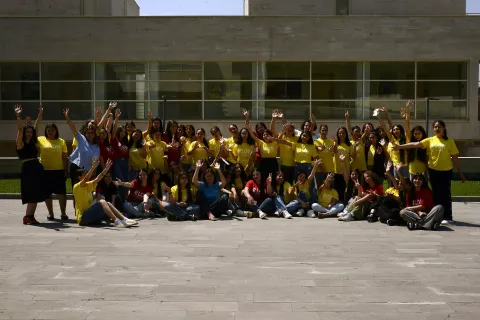
Nare is one of the 70 girls who participated in ‘The Game Changers: Girls for Girls’, a joint initiative of UNICEF and the Enterprise Incubator Foundation. Through this programme, adolescent girls and young women honed their game development and storytelling skills, creating their own characters and narratives. In 2024, Nare had the opportunity to attend the programme’s international forum in Geneva, where she presented her game and shared her insights on the initiative.

UNICEF Armenia/2025/Ghazaryan

UNICEF Armenia/2025/Ghazaryan
“I have loved video games since I was little. I was fascinated by the process of creating characters, exploring different worlds, overcoming challenges and becoming more adaptable,” Nare says, her eyes shining with excitement.
But she admits that even when the boys in her class would discuss a particular video game that she often understood better than they did, she would still hesitate to speak up. “I felt self-conscious because I knew they would say, ‘You’re a girl? Go play ‘girly’ games instead.’”
Even in the virtual world, Nare sees a persistent stereotype: that girls should only dress up dolls and models, bake cakes, or wash the dishes. She strongly disagrees.
“There is a game where you build houses with geometric blocks, fight zombies, and search for gold in caves,” Nare explains. “One day, the boys in my class were discussing it, assigning characters to the girls. Not surprisingly, all the roles they picked fit the usual stereotypes: weak, timid, and lacking adaptability. When it was my turn, I named a completely different character. They were stunned. “How do you even know about this game?” they asked, as if it was something I wasn’t supposed to be interested in.”

Nare also dislikes how video games and advertisements often emphasize women’s physical features, highlighting specific body parts. As a teenage girl, she believes these stereotypes shape perceptions and contribute to their reinforcement; if you don’t look like the character, then you’re not good enough.
“Seeing those ads and game characters at 13, I remember thinking, “Why don’t I have a perfect body like that? Does that mean I’m ugly, that I’ll be alone, that I won’t be loved?” she recalls. “But in those moments, my parents were there to help. They talked to me, explained that my body would go through changes at this age, and reassured me that it was completely normal.”
There are eight girls in Nare’s class. They all do well in school and have their interests, she says. Yet, even when boys perform worse academically, they still seem to get preferential treatment. One of her friends once shared that, at home, her younger brother had no household responsibilities, while she was always expected to help with cleaning and chores. Nare believes this needs to change - household duties should be shared equally, and boys should be involved, too.
Nare doesn’t react with anger when faced with these inequalities. Instead, she channels her frustration into creative expression. Through art, comics and video games, she raises awareness about the stereotypes surrounding her and the challenges faced by girls of her generation. “I used to have emotional outbursts and react immediately,” she admits. “But now, I think about how to embed my ideas into my games and reach even more people.”
“I try to surround myself with friends who don’t just stand on a rock and assume it can’t be moved,” Nare says. “Having friends with critical thinking skills, who analyze everything, recognize that while we are biologically different from boys, we still deserve equal opportunities, is incredibly motivating.”
One of her friends from Etchmiadzin once shared a troubling experience: During class, a teacher openly declared that women exist only to have children. When she challenged this statement, she was dismissed and silenced. “I don’t want us to be forced into silence just because we have different opinions,” Nare insists.
Nare lives with her mother and grandmother, who initially struggled to understand her deep fascination with video games. But she took small, deliberate steps to introduce them to her world, explaining how games are about more than just passing time. She showed them how games foster human connections, problem-solving, and creativity. Slowly, they began to see her passion differently.
This unwavering love for gaming led Nare to Gyumri’s Technopark, where she brought Tsovinar to life. When the 15-year-old starts describing how she meticulously studied the Daredevils of Sassoun epic to develop her character, it’s clear she knows exactly what she’s doing.

“We often talk about the male heroes in our [Daredevils of Sassoun] epic, but at its core stands a woman - strong, courageous, and thoughtful,” Nare says. “Tsovinar inspires me deeply. That’s why I designed a wooden puzzle game about her before creating the video game. I’m still refining the digital version. I want it to challenge players, spark creativity, and encourage them to generate new ideas.”
Nare admires her generation for being free-spirited and bold but hopes they will also embrace education and the drive to create meaningful change in the world.
Her mother, Gohar Smoyan, is an artist who uses her projects to address various social issues. She believes art can be a powerful tool for breaking stereotypes, sparking conversations, and influencing change, offering boundless freedom for expression.
Born and raised in Gyumri, Gohar reflects on how different things were when she was Nare’s age. “The contrasts - in mindset and social norms - are striking,” she says.

“At the university, my grandfather would take me to class and bring me back home, something that continued until I was 23. My father was very strict and never allowed me to go out alone. When I pursued a second degree at the Academy of Fine Arts, I was lucky - the university was close to our place,” Gohar explains. “I tried to be understanding with my father. He came from a deeply traditional environment where few things were considered acceptable for girls. Standing out didn’t just put you at risk, it could affect the entire family. In a society like that, holding your ground and pushing back was extremely risky.”
Yet, behind her father’s rigidity, Gohar saw an undeniable love that revealed itself in his unwavering support for her education. He valued learning but refused her request to study in Yerevan, as she would be far away from the family. She was only given more freedom once her father felt reassured that her male classmates were ‘good’ and could be ‘trusted’ to look after her.
“At first, it didn’t bother me,” Gohar says. “But when I started reflecting on it, I realized that the trust should have been placed in me, not my male classmates. They were kind and genuinely tried to help, but the irony was that, as artists, they supported me not because they saw me as their equal but because they didn’t. I was one of them, but not on the same level as them.”
Gohar recognizes that Nare is in a phase of exploration, learning to navigate right from wrong. And no matter what, her support for her daughter remains unwavering.

“So much has changed in Gyumri since I was 15, and I’m sure even more has changed since my mother was that age. Our city is still quite traditional and slow to embrace change,” Gohar says. “As an artist, I try to address these issues through my work. I even have a comic book that explores the transformation of women in Gyumri, its history, challenges and progress, and Nare contributed illustrations to it.”
Despite the ongoing challenges, Gohar admires Nare’s generation and finds hope that they have so many opportunities and are not denied the right to express their opinions. She firmly believes there is no such thing as a ‘right’ or ‘wrong’ opinion - children should be encouraged to speak their minds and freely engage with the world. After all, creativity is born from that freedom.
At 70, Roza is the eldest in the household, but the 55-year age gap between her and Nare has never been a barrier to their bond. On the contrary, she is one of Nare’s biggest supporters, encouraging her, accompanying her to classes, and even trying her hand at video games from time to time.
“I once dreamed of becoming a judge,” says Roza. “But I failed the university entrance exams and had to enroll with a different major. My husband was my classmate, and he did not agree for me to have a career after we got married, so I only worked for six years.”
Having lived in a large household with her in-laws and husband, she takes pride in the fact that she was the one in charge of managing the family’s finances; they trusted her with that responsibility.
But stepping beyond the gates was not an option since her husband wouldn’t allow it.
Nare will not live that way, Roza is certain. She takes comfort in knowing that her granddaughter thinks maturely and is determined never to be dependent on anyone. Roza is confident that they are instilling values in Nare that will make independence a priority while also teaching her the importance of family responsibility - two values that, in her view, do not contradict each other.
She pulls out an old photo of herself as a young woman, wearing a short skirt. “I have no regrets about not working,” she says. While raising four children, she still pursued her education. But after losing her eight-year-old son to the 1988 Spitak earthquake, spending time with her children and ensuring that they get education became her top priority.
“I believe something always suffers when you try to balance too much,” Roza reflects. “For a working woman, the family pays the price. That’s why a choice has to be made. I don’t know, that’s just how I see it.”

Nare jumps in, saying that having a working mother is inspiring. Even when she needs her mum but knows that she is busy with work, Nare understands and is mature enough to appreciate it.
The mutual respect and solidarity among these three generations of women are remarkable. Despite their differences, they are bound by a shared vision: a world of equal opportunities.
As we bid farewell to these extraordinary women, we look ahead to the day when Nare’s Tsovinar, with her sea-blue hair, unwavering determination, resilience and wisdom, might one day captivate the world.
Nare’s Tsovinar is free from stereotypes. She embodies the persistence and courage of her generation, unafraid to dream big.