Tatev's dream: Propelling an Armenian video game onto the global stage
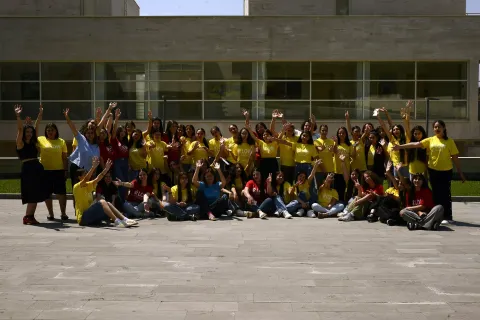
Participants in the Gamechangers: Girls for Girls programme discover STEM through video games.

- Հայերեն
- English
"Another one? But will you make it in time?" Tatev's parents anxiously inquire each time the 16-year-old girl fills out an application to participate in another programme. "No worries, I will figure it out," she replies.
Tatev Amiraghyan hails from the city of Vanadzor, in Lori. She seizes every opportunity to learn new things and meet different people, even though she is already set on pursuing a career in IT, specifically in video games.
"I have decided to specialize in games, but as an 'outsider,' I have never had the chance to see how it is done or to understand whether my knowledge and abilities are relevant to that field," she explains.
Tatev seized that opportunity when she participated in the Gamechangers: Girls for Girls initiative alongside 120 girls from Syunik, Lori, and Shirak. The initiative aims to uncover the potential of teenage girls in the field of video games. The project is implemented by UNICEF in cooperation with the Enterprise Incubator Foundation, as well as the Gyumri and Vanadzor Technology Centers.
"I never would have thought that boys make more games than girls, considering how many girls are now into programming. During the discussions, when I learned that only 25 percent of girls are in the field, I asked myself: how? And I am still trying to understand the reasons. Maybe women are preoccupied and burdened with various responsibilities, or perhaps they stop working after getting married,"
After several months of training, the girls were divided into groups and tasked with creating their own video games. Tatev's team focused on developing a game related to science. Recognizing that the STEM field (science, technology, engineering, and mathematics) can be challenging for teenagers to grasp, Tatev and her friends aimed to spark interest in scientific subjects through their game, Amnyut:

"Our objective was to design a game that is not only fun and engaging but also educational. In the first level, our hero embarks on a quest to find gold. Along the way, when encountering different elements, players are introduced to Mendeleev's periodic table and provided with brief information about each element,"
"Our schools have no laboratories for conducting experiments while studying science subjects. Our game provides us with the opportunity to engage in activities that are not feasible at home, allowing us to visualize concepts beyond the naked eye's perception," she says.
During the programme, the girls explored some of the over 200 professions in the field of video games. For instance, Tatev selected storytelling—the art of creating and telling a compelling narrative. However, over time, she realized that to fully realize her idea, it would be beneficial to acquire knowledge in other fields as well.
"I was pretty surprised when they stressed the importance of describing the character I created in such detail—presenting their background and age, deciding their tools, strengths, and advantages. Some games offer multiple characters, and players must understand why they choose a particular one. For those of us who focused on storytelling, it was challenging to depict our envisioned characters because we could not draw the sketches well enough for the other group to transfer them to the computer," she says.
Tatev also highlights how effective teamwork can be, particularly when people of different ages are included in the group.

Gamechangers: Girls for Girls mentor Vahe Asloyan says his main goal was motivating the girls. "I constantly reiterated that it does not matter if your project does not win, or the jury does not give it a high score—there is no need to feel discouraged. I used my journey as an example, sharing how I have participated in various competitions since my teenage years, experiencing numerous failures. I stressed that failures are normal; winning every time is impossible," Asloyan says.

"Girls participating in the programme also gained soft skills: communication, leadership, and emotional intelligence. These qualities are crucial for crafting the storyline, writing the script, and creating illustrations. In other countries where this project is implemented, the focus is often more on technical skills. However, since this is a pilot programme, we decided to incorporate our approach, emphasizing the importance of soft skills to complement the technical aspects," Aleksanyan says.
The Gamechangers: Girls for Girls programme has reinforced Tatev's commitment to specializing in video games. She hopes that this experience will also allow her to realize her dream:

"When I asked my friends from abroad about games produced in Armenia, many of them had not played them or even heard of their names. In the future, I aim to create an Armenian game with my team—something fantastical yet rich in knowledge—that will captivate the world."