UNICEF improves education conditions in 11 public schools in Ararat, Armavir and Kotayk
Over 8600 students have restarted classes in an improved school environment with the support of the Government of Japan.

- Հայերեն
- English
“We are happy to inform that one of the buildings of our school was replenished with new furniture and has a renovated bathroom. Encouraged by that, school administration found the resources to also install new windows in the building,” shared Abovyan school #8 on its Facebook page in October 2021, thanking UNICEF and partners for the support, and symbolizing yet another milestone in UNICEF support for public schools in Ararat, Armavir, and Kotayk marzes that host displaced children from Nagorno-Karabakh.
With the funding of the Government of Japan, UNICEF has now provided school furniture and materials to establish three new classrooms at 11 schools and renovated bathrooms in 10 schools in these three marzes. In Abovyan, the building is now used by 535 students, while around 8620 students have benefited from the programme.

“Following the conflict in and around Nagorno-Karabakh, UNICEF studied the needs in public schools, giving a priority to those schools that had admitted new students from Nagorno-Karabakh and hence needed additional support. Many needed to set up additional classrooms to integrate new students as well as needed improvements to provide students with adequate hygiene and sanitation, which was important to us especially taking into consideration the spread of COVID-19,”
“We have not had the means to renovate this building in the past 41 years. School property was also pretty worn out. After the Nagorno-Karabakh conflict in 2020, we welcomed 40 new students at our school, and the new furniture was an absolute necessity,”

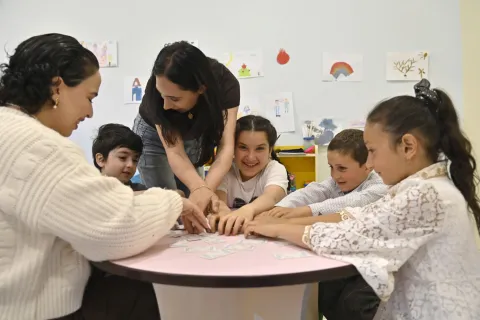
When we last visited Abovyan school #8, the fifth-class students showed us all around.

“Previously, we had to keep our textbooks on the unused desks in the classrooms. Now we put them in our new bookshelf. Look, we also store our artwork here,”shared Eva, 11.
“When they brought our new chairs, desks and bookshelves, we decided amongst ourselves that we will clean, take good care and refrain from doodling on the desks,” told us Samvel, 11.
“Now it is more pleasant to come to class.”

Abovyan school welcomes 520 students five days a week in a single shift. “Each of our five buildings has its own bathroom, but the one in this building has not been used for over 15 years now. It was closed, so students in this building had to go to another building to use the toilet,” noted Lusine Baghdasaryan, the school principal.
“In August 2021, UNICEF visited the schools and saw that the water, hygiene and sanitation facilities are in a very deplorable condition, whereas the pandemic requires proper observance of sanitary rules. By renovating the toilets, we are also preventing the further spread of COVID-19, thus making the school safer both for students and their families,” added Alvard Poghosyan.
“Thanks to cooperation with the Government of Japan, the educational environment is now improved for 8,620 students across Armenia. We must continue to give priority to children’s education and support schools to be safe, respond to children’s needs, including academic standards, physical conditions, as well as psychosocial wellbeing and health.”

The Government of Japan funding allowed UNICEF to also address psychosocial and academic needs of displaced children in these marzes. As the conflict in and around Nagorno-Karabakh escalated during the fall semester, school-age children experienced psychological distress and had to face considerable disruptions in their schooling. Once displaced, they needed to confront social differences in an unfamiliar environment and adjust to their new situation.
To support that process, in 2021, UNICEF and the Child Development Foundation, trained 85 teachers in Armavir, Kotayk, Ararat and Syunik marzes in quality child-centered education in emergencies and enabled the provision of additional classes for children displaced from Nagorno-Karabakh who had missed classes due to the conflict. As a result, over 250 children had the opportunity to improve their knowledge and supplement the missed curricula by participating in additional educational courses.
In the next five years, UNICEF will continue working with the Ministry of Education, Science, Culture and Sports and partners in the education sector on the planning and implementation of education in emergencies programmes, including learning recovery programmes and enhancing teacher practices to address learning loss. The social-emotional learning will be in our focus too to ensure that mental health needs of students and teachers are acknowledged and nurtured.