From Breakdown to Breakthrough: Strengthening Zambia’s Immunisation System One Technician at a Time
A Government-led initiative, supported by Gavi and UNICEF, is equipping frontline technicians to safeguard vaccine potency and bring life-saving immunisation closer to every child.

In Solwezi District of Northwestern Province, a broken refrigerator can mean more than a technical fault. It can mean missed protection for children. Across Zambia, reliable cold chain systems form the backbone of immunisation delivery, protecting millions of vaccine doses each year and ensuring services reach even the most remote communities.
For 42-year-old Lloyd Andrew, Provincial Cold Chain Officer for Northwestern Province, equipment breakdowns once carried a heavy emotional weight.
Before the training, I would feel bad. You are seeing children growing up missing vaccines they are supposed to receive at the due time because there is no fridge that can accommodate them.
Lloyd recognizes what was at stake. Without reliable cold chain systems, vaccines cannot be safely stored and children cannot be protected. He is now among the 126 district and provincial cold chain technicians who completed advanced refrigeration and solar system maintenance training at Northern Technical College (NORTEC), forming part of a newly strengthened national technical workforce.


When Systems Fail, Children Miss Out
Before receiving advanced training, Lloyd often faced technical challenges beyond his scope. “My work before had a lot of challenges,” he explains. “With basic knowledge, it was very challenging to troubleshoot a system. Sometimes we had to engage someone more specialised, and it would take a while.”
Those delays had immediate consequences. “If the fridge is not functioning, it means no immunisation coverage will be conducted because there is nowhere to store that vaccine,” he says.
Power disruptions sometimes cut electricity for extended periods, placing vaccines at risk. In remote communities, service interruptions meant immunisation activities could not proceed as planned. Andrew notes that in some cases, this has led to children having missed vaccines.
The issue was not simply equipment failure. It was also about equity and ensuring immunisation services reach children in the last mile.
A reliable immunisation supply chain should not be a technical luxury. It is fundamental to Primary Health Care.

Investing in Skills to Strengthen Systems
Recognising these gaps, the Ministry of Health Zambia, with financial support from Gavi, the Vaccine Alliance and technical support from UNICEF Zambia, launched a national advanced refrigeration and solar systems training initiative at Northern Technical College (NORTEC). The programme includes a nationwide maintenance campaign, launched alongside the graduation ceremony, targeting non-functional cold chain equipment across the country.
Since the launch of the initiative:
- 126 district and provincial cold chain technicians have completed advanced training in refrigeration and solar system maintenance, forming a ready-to-deploy national technical workforce.
- More than 800 cold chain units will benefit from preventive and corrective maintenance across the country.
- Approximately 400 obsolete units will be safely decommissioned in line with technical and environmental standards.
- 130 maintenance toolkits are being procured and will be distributed to strengthen district-level response capacity.

The programme aims to train and build the capacity of the cold chain technicians in all districts and at provincial levels to improve immunisation service delivery.


The campaign now sets the stage for scaling up future training cohorts and continuing the safe removal of outdated cold chain equipment. Sustaining this momentum will require additional partner support to strengthen training infrastructure, modernise laboratories, expand digital learning platforms, and build the technical capacity needed to meet growing national and regional demand.
For Lloyd, the training marked a turning point. “When equipment has broken down, how do I troubleshoot it? How do I identify the defect before I start working on it? That is what I learned,” he says. With strengthened skills in refrigeration, solar systems and preventive maintenance, he can now take a more proactive approach, identifying faults early and restoring functionality more efficiently.
“Protecting vaccine potency is not only about improving and modernising equipment It is a matter of equity, trust in the health system, and the survival of children,” Dr. Saja explains while highlighting that this training and campaign mark a clear transition from projects to systems and from dependency to sustainability.
From Breakdown to Breakthrough
In Northwestern Province, Lloyd is now better equipped to respond to equipment breakdowns.
“Now that we have acquired this skill, we will be able to work on most of the equipment that has been broken down,” he says.

Lloyd explains that with the new knowledge gained from the training, technicians can now revisit and repair cold chain equipment that can still be fixed. Restoring these systems will help strengthen immunisation coverage, ensuring that children and mothers receive the vaccines they need at the right time.
Reduced downtime means preserved vaccine potency and more reliable service delivery.
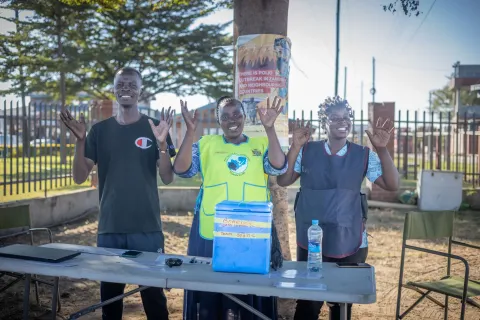
At the graduation ceremony, Dr. Lawrence Mwanza, Provincial Secretary – Copperbelt Province, representing the Ministry of Health, reminded the graduates of the importance of their role. “The technicians graduating today are not merely maintaining equipment,” he said. “They are safeguarding vaccine potency, ensuring service continuity, and protecting children's lives.”
Lloyd’s dream reflects that shift:
My dream is to see that most of this equipment is working so immunisation coverage can increase in the province.
Strengthening Systems, Protecting Children
For Lloyd, the shift is deeply personal.
“For me, this training has enhanced my knowledge. It has been long overdue.”

Where there was uncertainty, there is now stronger technical capacity. Where there were delays, response times are improving. Where refrigerators once failed, systems are becoming more reliable.
Through the leadership of the Ministry of Health Zambia, with strategic financing from Gavi, the Vaccine Alliance and technical expertise from UNICEF Zambia, technicians like Lloyd are helping bring life-saving vaccines closer to children across Zambia.
UNICEF extends its appreciation to the Government of Zambia and Gavi, the Vaccine Alliance for their continued partnership in advancing immunisation equity nationwide.
Sustained collaboration and investment will be essential to ensure that every technician is equipped, every facility is functional, and every child is reached.
In Northwestern Province and beyond, each repair brings Zambia closer to a resilient immunisation system and closer to protecting every child.