SUN II Partners under the Leadership of the Government of the Republic of Zambia Launch Nyamuka Campaign to Address Malnutrition
A key highlight of the launch is the distribution of Multiple Micronutrient Supplements (MMS) for pregnant and breastfeeding women in Monze

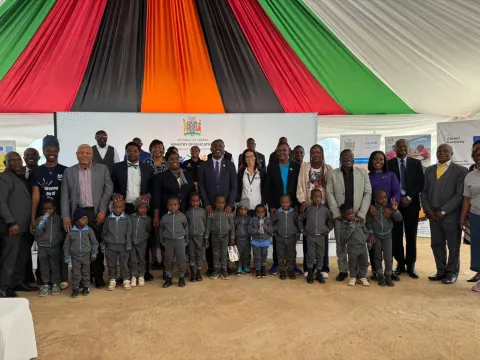
MONZE, Zambia, 6 March 2025 – The Permanent Secretary for Technical Services at the Ministry of Health, Dr. Kennedy Lishimpi, officiated at the launch of the Nyamuka Campaign today, witnessing firsthand as pregnant and breastfeeding mothers received Multiple Micronutrient Supplements (MMS) for the first time. The community-based event, attended by women and children- the key beneficiaries of the intervention, marks a major step in Zambia’s efforts to combat maternal and child malnutrition through increased awareness and access to essential micronutrients.
The Nyamuka Advocacy Campaign launches at a crucial time when Zambia, despite recent heavy rainfall, is still facing the effects of last year’s drought particularly among pregnant and breastfeeding women and young children. This requires sustained efforts to tackle prevalent micronutrient deficiencies and undernutrition, promote early intervention, and advocate for increased investment in lifesaving supplies.
Speaking at the event, Permanent Secretary for Technical Services at the Ministry of Health, Dr. Kennedy Lishimpi, reaffirmed the Government’s commitment to tackling malnutrition through a multi-sectoral approach. “I am delighted to grace the launch of the Nyamuka Nutrition Advocacy Campaign, an initiative aimed at increasing the uptake of MMS and MNPs by the target population. We are all encouraged to support and be part of this campaign to ensure that women and children can access these supplements. To the women receiving these supplies, I want to encourage you to follow the instructions from the health care providers on how to use them. The Government of the Republic of Zambia, through the Ministry of Health will always ensure that your health and nutritional status is given priority,” he said.
A key feature of the launch is the distribution and flag-off of Multiple Micronutrient Supplements (MMS) for pregnant and breastfeeding women. This intervention aims to combat micronutrient deficiencies and improve maternal and child health and nutrition outcomes, within the Scaling Up Nutrition Phase II (SUN II) programme. For the past five years, SUN II has been instrumental in addressing malnutrition and food insecurity in Zambia. Thanks to repurposed funds for drought-affected SUN II districts and additional funds from the European Union, 71,639 pregnant women and children will receive targeted micronutrient supplementation support in Monze, Shangombo, Kalabo, Kaoma, Mongu, Choma Zambezi, Chipata and Lundazi Districts.
UNICEF Deputy Representative, Dr Nejmudin Kedir Bilal, on behalf of UN Partners (FAO, WFP and FAO) underscored the need for continued investment in nutrition, especially during emergencies. “While we are grateful for the rains, the nutritional crisis caused by last year’s drought remains. Children and mothers continue to face deficiencies in essential nutrients, and we are still seeing cases of acute malnutrition. The lean season is not over yet, and we have yet to reach the next harvest. This means that the messages we are driving through this campaign and the distribution of these commodities remain just as urgent as they were a few months ago,” he said.
The Nyamuka Campaign, meaning "Rise!" or "Get Up!" in local languages, aims to raise awareness, drive advocacy, and mobilize communities in response to worrying findings from key assessments on nutritional status of women and children. These reports highlight severe food shortages that can lead to micronutrient deficiencies, rising malnutrition, and widespread child food poverty.
The campaign promotes key nutrition interventions such as breastfeeding support, increased access to multiple micronutrient supplements (MMS) for pregnant and breastfeeding women and expanded provision of Ready-to-Use Therapeutic Foods (RUTF) for malnourished children. It also focuses on early malnutrition detection, engaging caregivers, volunteers, health workers, and male family members in screening, while advocating for better water, sanitation, and hygiene (WASH) practices.
National Food and Nutrition Commission Executive Director, Dr. Muntanga Mapani, emphasized the urgency of sustained action to prevent and treat malnutrition. “We have seen the devastating effects of inadequate food, in the form of increasing malnutrition among pregnant and breastfeeding women and young children. The expansion of MMS in Zambia is a significant step forward in ensuring better health outcomes for women and their babies. The Nyamuka Campaign will help drive awareness and encourage communities to take proactive steps in seeking nutritional support,” she noted.
As the SUN II programme under Zambia’s Most Critical Days Programme Phase II (MCDP II) initiative comes to an end this year, its impact will continue to be felt through initiatives like the Nyamuka Campaign, which calls on a whole of society approach to prioritize maternal and child nutrition and ensure that every child gets the best start in life. The SUN II programme, which is coordinated under the leadership of the National Food and Nutrition Commission, has laid a strong foundation for continued action in community-based nutrition programmes, early screening for malnutrition, and improved access to life-saving supplements.
Notes to editors about MCDP II programme
The First 1000 Most Critical Days Programme Phase II (MCDP II) is the Government of the Republic of Zambia’s flagship programme to reduce stunting. Childhood stunting is an irreversible outcome of growth failure in the first 1000 days of a human being’s life, from pregnancy through a child’s second birthday. Stunting is the result of poor nutrition over prolonged periods of time. Undernutrition is caused by many factors beyond just the food children eat, and MCDP II is a multi-sectoral response aimed at addressing the many underlying drivers of stunting.
Contact details
Dr Kalangwa Kalangwa, Spokesperson, Ministry of Health, [email protected]
Mainza Kawanu, Communication Officer UNICEF Zambia. Email:[email protected]; Telephone: +260969100157
Ms. Idah Chama, Head of Advocacy and Communication, National Food and Nutrition Commission. Email:[email protected]; Telephone: +260977634856
Media contacts
About UNICEF
UNICEF promotes the rights and wellbeing of every child, in everything we do. Together with our partners, we work in 190 countries and territories to translate that commitment into practical action, focusing special effort on reaching the most vulnerable and excluded children, to the benefit of all children, everywhere.
For more information about UNICEF and its work for children in Zambia, visit www.unicef.org/zambia.
Follow UNICEF Zambia on Twitter, Facebook and Instagram