Zambia marks the International Day of Play with a call to protect childhood and support parents and caregivers
Government, UNICEF and partners commemorate the day by championing play-based learning, safe spaces for children, and stronger support for parents and caregivers
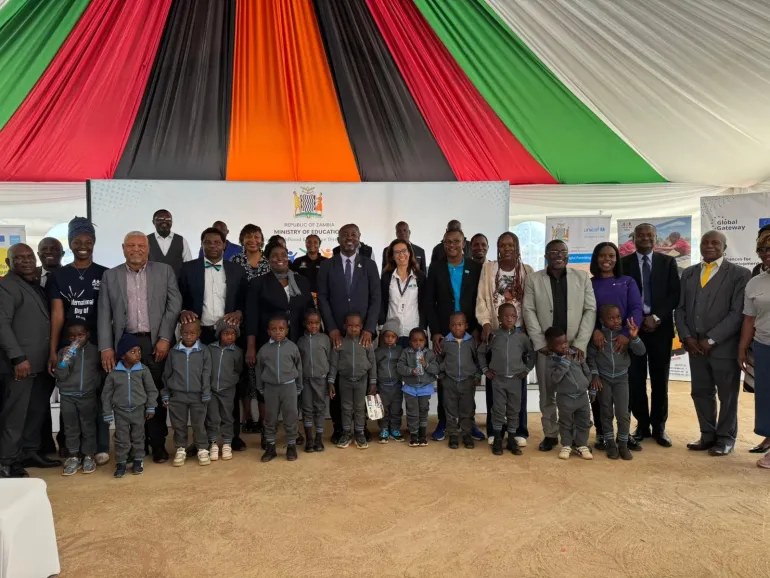
Lusaka, 11 June 2026 – The Government of the Republic of Zambia, through the Ministry of Education and Her Royal Highness Chieftainess, Nkomeshya Mukamambo II, together with the European Union, UNICEF and partners, including Join for Joy, Care- Zambia, World Vision, Childfund and the Zambia Association of Musicians today marked the International Day of Play with a renewed call to protect every child’s right to play and to strengthen support for early childhood education teachers, parents and caregivers as children’s first teachers.
Commemorated globally on 11 June, the International Day of Play recognizes play as a fundamental right of every child and a vital part of healthy development, learning and wellbeing.
“If we want children who can read with understanding to think critically and contribute to national progress, then we must invest early, and we must invest well. That is why play-based learning matters. Through play, children build language, confidence, curiosity, self-control and creativity which are building blocks of learning and life, and greatly contribute to end learning poverty. Today are not only commemorating a global day. We are taking practical national action to improve what happens in classrooms and in children’s lives,” said Dr. Kelvin Mambwe, the Permanent Secretary, Education Services, Ministry of Education.
According to a new UNICEF report released on this important date, more than 80 million children aged 2 to 4 – around 1 in 5 worldwide – do not have opportunities to play with a parent or caregiver at home. Three quarters of them live in Sub-Saharan Africa and South Asia.
Against this backdrop, Zambia continues to champion the importance of play through an annual National Playful Parenting campaign, while the Ministry of Education demonstrates a deliberate and sustained commitment in policy documents to leverage play as an effective pedagogical tool for early childhood education.
The findings of the Insaka Endline Study conducted by UNICEF Zambia indicate that 100 per cent of caregivers polled believe that play is essential for their child’s overall wellbeing, and participation in playful parenting interventions was high at 62 per cent.
This year’s observance at national level brought together government representatives, development partners, educators, community leaders, media, children and young people to celebrate the power of play in building strong foundations for life.
Held at Chalimbana University in Chongwe District under the global theme “Protect Play, Protect Childhood,” the event highlighted how play helps children develop creativity, confidence, self-control, problem-solving skills, foundational literacy and numeracy, and strong social and emotional connections.
“Play is one of childhood’s greatest gifts. When children play, they are doing much more than having fun. They are learning how to communicate, express emotions, solve problems, share and defining who will they become. In Zambia, play is a powerful tool in supporting children’s development,” stated Sonia Godinho, Education Specialist, European Union Delegation to Zambia and COMESA.
The commemoration also marked the official launch of the Harmonised Play-Based Pedagogy Guide and the Zambia Early Childhood Education Library and E-Catalogue (ZECELEC), two important resources designed to strengthen quality early learning and advance play-based pedagogy across the country.
The International Day of Play recognizes play as essential to children's cognitive, social, and physical development. When poverty, conflict, and lack of caregiver support limit children's access to play, they miss out on critical opportunities to build confidence, empathy, communication, and problem-solving skills – gaps that can affect learning, well-being, and social development well into adulthood.
“Play is not a luxury; it is a necessity for every child’s development and wellbeing. When children have time, space and encouragement to play, they learn, build relationships and develop the skills they need to thrive. Supporting parents and caregivers to bring playful, nurturing interactions into everyday life is one of the smartest investments we can make for children,” said Tinkhani Msonda, acting UNICEF Representative in Zambia.
UNICEF and partners are calling on government, business and key stakeholders to:
- Scale up services, including parenting programmes, that promote play and attachment.
- Enable access to pre-school and learning through play for every 3- to 6-year-old.
- Ensure every child has access to safe, inclusive, and well-maintained play areas.
== ENDS==
Note to Editors:
The Power of Play: A global data story is the most comprehensive global analysis to date of children’s access to play at home, drawing on data from almost 100 countries over 15 years through 2024. It examines whether young children take part in stimulating activities with a caregiver – including playing, reading, singing, and drawing – and whether they have playthings at home. It also looks at how access varies across regions, income levels, and household circumstances. The findings show persistent and unequal gaps in experiences that are critical to children's development and well-being.
Link:https://data.unicef.org/resources/the-power-of-play/
Parenting Hub at UNICEF
We know that a strong parental is the single biggest protective factor in the life of any child. That’s why we’ve teamed up with some of the world’s leading experts to provide science-backed parenting tips.
The Global Parenting Hub in Arabic, English, French and Spanish:
👉 https://www.unicef.org/parenting
Discover the global parenting content to translate and adapt for your channels:
👉 https://unicef.sharepoint.com/sites/GCA-CommAdvocacy/SitePages/Parenting-resources.aspx
Interested in launching a local Parenting Hub? Here's a starter guide:
👉 https://unicef.sharepoint.com/sites/GCA-CommAdvocacy/SitePages/Parenting-Hub.aspx
Media contacts
About UNICEF
UNICEF promotes the rights and wellbeing of every child, in everything we do. Together with our partners, we work in 190 countries and territories to translate that commitment into practical action, focusing special effort on reaching the most vulnerable and excluded children, to the benefit of all children, everywhere.
For more information about UNICEF and its work for children in Zambia, visit www.unicef.org/zambia.
Follow UNICEF Zambia on Twitter, Facebook and Instagram