Voices of Care
How Local Volunteers Support Mothers and Children in Yemen

- English
- العربية
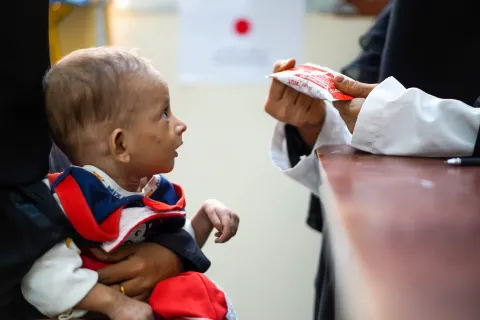
When Maryam saw the feet of four-month-old Ibtisam and noticed her weight loss, she screened her for oedema, a swelling of the limbs that indicates severe acute malnutrition. As soon as the problem became obvious, Maryam started educating the girl’s mother about the importance of breastfeeding and methods that can help her increase the natural milk supply.
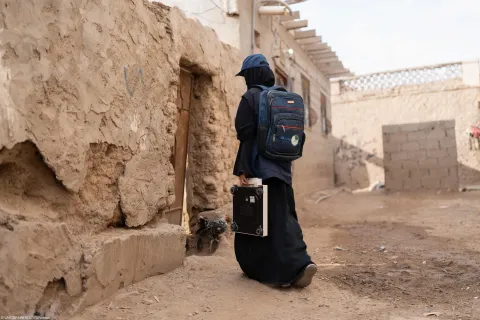
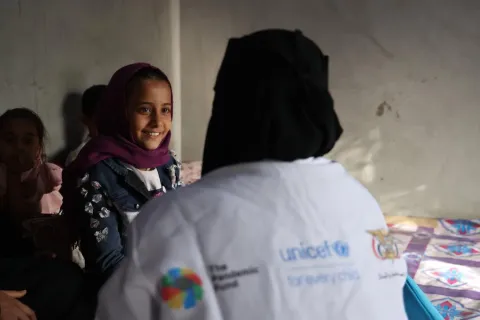
Maryam is a community health and nutrition volunteer (CHNV) from Yemen. In the remote villages of Yemen, where the healthcare system has been nearly destroyed by years of conflict, dedicated volunteers like Maryam provide more than just basic medical help. They bring hope to mothers and girls and boys.
"I firmly believe this work is very important. I seek to change my village's situation for the better," says Maryam Omar, a 38-year-old resident of Al-Hajel village, Lahj, Yemen. Maryam has been a community health and nutrition volunteer since 2021.
Hard living conditions for mothers in Yemen
The mother of the little girl is Fawzia, a 35-year-old from Lahj. Fawzia’s husband, a local teacher, earns a meager salary of 50,000 rials (approximately $35 USD), which is often delayed, forcing the family to live “day by day” and sometimes making harsh choices about who will be able to eat today and who will go hungry.
"This amount is not enough to cover even our basic expenses," Fawzia explains. "Sometimes we do not have food to eat when we are hungry,” said Fawzia.
This chronic hunger followed her through her pregnancy with her youngest daughter, Ibtisam.

"My daughter suffered from malnutrition, and the reason for this goes back to my own personal struggle," Fawzia shares. Weakened by hunger, the mother was unable to breastfeed naturally, leaving the 4-month-old Ibtisam vulnerable to the horrible threat that is claiming the lives of thousands of Yemeni children.
UNICEF key health and nutrition programme
Thanks to CHNV Maryam, little Ibtisam is constantly improving. The CHNV program, supported by UNICEF, was created precisely for vulnerable people like Fawzia and her daughter. For most of them, counselling and a qualified advice, timely medical help, even the most basic one, makes all the difference between life and death.
Maryam’s approach to work is a unique blend of standard clinical screening methods and a human touch. She doesn't just provide theoretical medical advice, but adapts her guidance to the actual needs and situation of every family she visits.
UNICEF is grateful to the government of Norway, for their contribution to support the transportation allowance for the volunteers in 2025. Mariam and the other volunteers were able to continue playing a crucial role in delivering essential health and nutrition services at the community level, particularly in hard-to-reach and conflict-affected areas. CHNVs do household visits to screen children under five and pregnant and lactating women for malnutrition, referring severe and complicated cases to health facilities, and supporting follow-up for children enrolled in nutrition programs. They also undertake active case finding, provide nutrition and health education on infant and young child feeding (IYCF), hygiene, and disease prevention, and encourage the uptake of key services such as immunization, antenatal care, and micronutrient supplementation.
CHNVs also support community mobilization during campaigns by the Ministry of Health including serving as a critical link between communities and health facilities to improve access to lifesaving services.
Exclusive breastfeeding, a key message
One of the CHNV program’s main goals is reintroducing the idea of exclusive breastfeeding, as unfortunately 20 per cent of babies are exclusively breastfed for their first six months, and less than half of the children under 2 years of age get enough meals each day[1]. This is far below recommended levels needed to ensure that children survive and grow up healthy.

"My advice to all mothers is to return to breastfeeding," Maryam explains. "It is not only best for the child’s health and immunity, but it is a mercy for families under these difficult circumstances".
"Even though there is still a slight deficiency in the child's weight, her condition is constantly improving".
Moving house-to-house, volunteers like Maryam identify cases that would otherwise go unnoticed until it is too late. Once a child is diagnosed with severe malnutrition, Maryam registers their data and refers them to the nearest health center for life-saving therapeutic treatment. They would never be able to receive such help on time without the dedicated efforts of the CHNV program volunteers.
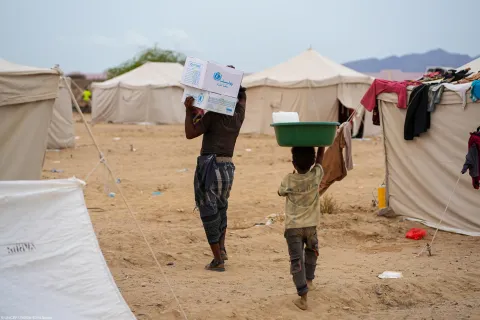
As Maryam continues her rounds through Al-Hajel and nearby displacement camps, checking on children and offering guidance to their parents, she remains a true lifeline for her people.
"I am proud of what I provide," she says, "and I will continue to ensure a healthy future for our children".
[1] Ministry of Public Health and Population and Central Statistical Organization, The Report of Nutrition and Mortality Surveys, conducted between August 2021 and January 2022 following SMART methodology.