Justice for children in Yemen: Ali makes it home to his family
UNICEF works to provide legal aid, rehabilitation and reintegration services to enable children to return to their families and communities and resume their normal lives.

children in Yemen continue to be exposed to violence and are at ever increasing risk of exploitation and abuse, particularly as conflict and the humanitarian crisis continues across the country.
In response to the growing needs of vulnerable children, UNICEF is working in partnership with the Justice for Children (J4C) Technical Committee with membership from all relevant authorities and Non-Governmental Organizations (NGOs_. With the support of UNICEF, the J4C Technical Committee has developed an Action Plan for 2019 focused on building the capacity of law enforcement personnel, community sensitization of children and their families and promoting restorative justice, diversion and alternatives to detention. The Action Plan also includes the provision of legal aid and rehabilitation and reintegration services to enable children to return to their families and communities and resume their normal lives.
Crucial to UNICEF’s child protection work is the development of standard operating procedures with different sectors, especially the social welfare sector, to ensure that children are properly identified and referred and subsequently protected from ongoing risks. This is a crucial aspect of enhancing cross-sectoral coordination to help best serve the needs of vulnerable children.
In cooperation with the J4C Technical Committee, an individual assessment was conducted with all 558 children in detention. As a result, diversion, rehabilitation and integration plans were developed and have been implemented for each child. Children’s judicial cases were accelerated with 336 children receiving legal aid. From this case load 81% received diversions and 171 children went through a rehabilitation program and returned to their families.
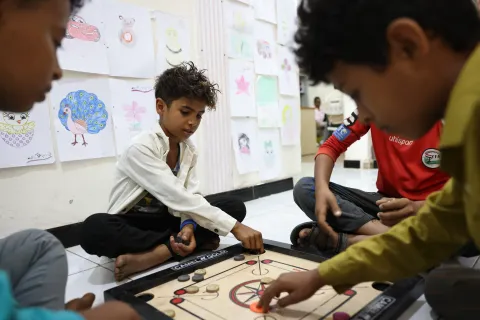
Ali*, 13 years old, is one of these children. He was staying in a care centre, away from his family in another governate, for 7 months, while waiting for trial. A social worker was able to conduct a comprehensive assessment and recommended to the judge to explore an alternative to detention. This request was subsequently approved. His family were consulted and advised on set of actions to be implemented to ensure full protection for their child.
Ali’s father was very happy that Ali was released, saying; “I cannot believe that Ali will come back to his family. (When he was gone) I was disappointed. Thank you all for your efforts.”
When Ali saw his father, he exclaimed; “my father came, my father came, my father came to take me.” The happiness the two felt was clear as they left the care centre together.
UNICEF advocates, where possible, for alternatives to be found for children in custody. The Action Plan, which demonstrates a clear commitment to the needs of vulnerable children in prisons and other places of detention, is implemented in Yemen by UNICEF, through the United Nations Peacebuilding Support Office. The Government of Japan is a generous supporter of this programme as well.
*name has been changed to protect the identity of the children.