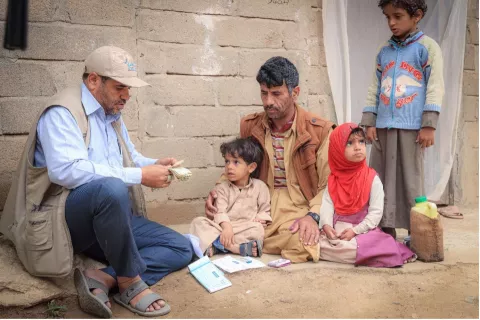
Hope Amidst Hardship: Cash assistance helps Abdullah face economic challenges
Securing basic needs

- English
- العربية
Abdullah Mohammed Mar’i, a 50-year-old resident of Bawta in Yemen’s Abyan Governorate, shares his story of resilience and the transformative impact of unconditional cash transfers (UCT) during challenging times.
“I work as a donkey cart driver because there are no other jobs available,” Abdullah says. Like many Yemenis, he witnesses the daily erosion of livelihoods amidst a deepening humanitarian crisis. Job scarcity is a pressing issue, and Abdullah’s family of nine feels its weight acutely.
Abdullah’s family is one of more than 1.4 million families benefitting from the Unconditional Cash Transfer Project implemented by UNICEF since 2017 with funding from the World Bank.
The money Abdullah receives from the UCT project helps his family secure basic necessities. “I use the money to buy food, medication, and pay rent. I also help sick friends or neighbors when I can. I believe it’s my duty,” he adds.
But caring for a disabled family member adds to Abdullah’s challenges. “I have a family member who needs a CT scan, but I can’t afford it. He can’t speak, hear, or comprehend, and there’s nothing I can do to help,” he sighs.

Despite his struggles, Abdullah remains hopeful and resilient. He dreams of a better future for his children.
“I hope my children will have their own house, get educated, have a steady income, and not rely on anyone else.”

As Yemen continues to face crises, stories like Abdullah’s remind us of the enduring spirit of hope. Millions of Yemeni families like Abdullah’s hold onto hope and believe in a brighter future for their children and their country.
Funded by the World Bank, UNICEF, in partnership with the Social Fund for Development (SFD) provides cash assistance to over 1.4 million vulnerable families in Yemen. The Unconditional Cash Transfer project, which has been implemented since 2017, reaches more than 9 million people, including women, children, disabled, Internally Displaced Persons and the elderly.
The story is based on an interview conducted in 2023. The new payment cycle is set to start on week 3 of September 2024.