Resilience in the face of adversity: A remnant of war survivor’s steps to making a difference
Wesam’s story is a powerful reminder of the strength and resilience within us all
- English
- العربية
In the heart of Yemen, where the echoes of unending conflict are a daily reality, a young man named Wesam stands as a testament to resilience and determination. At just 11 years old, Wesam’s life was irrevocably changed by unexploded ordnance in the guise of an abandoned phone explosion that claimed his right eye, left arm, and left leg. Despite these devastating injuries, Wesam’s spirit remained unbroken, and he embarked on an extraordinary journey to pursue his education and life dreams. Since the onset of the conflict in Yemen in 2015, the landscape has become perilous, with landmines and explosive remnants contaminating 20 out of 22 governorates. The statistics show that 56% of all child casualties can be attributed to explosive ordnance[1]. More recently, at least 74 children were among the 164 people killed or injured by landmines and unexploded ordnance between July and September 2022 alone.
[1] [1] Civilian Impact Monitoring Project, UNHCR, 2023.
The fateful EiD Al-Adhah day
It was the morning of Eid Al-Adhah in 2015 when the incident happened to Wesam. He was conscious but gravely injured. He was rushed to Al-Thawra Hospital. specialized doctors were called in, and Wesam underwent surgery to amputate his severely damaged limbs and end the excessive bleeding. “I remember being transferred to Al-Thawra hospital and there weren’t any doctors because of the Eid holiday,” Wesam says. “I heard them saying that I can only survive two more hours only, then I would pass away.” Doctors eventually arrived in time and saved Wesam’s life.
To save lives and provide vital information for children and their caregivers on how to identify mines and unexploded ordnances, UNICEF in partnership with Yemen Executive Mine Action Center (YEMAC) is working across the country to carry out Mine Risk Education (MRE) activities focusing on areas aligned to active frontlines, where there have been many landmine casualties amongst children.
The painful road to recovery
Although the physical pain from the explosion was so immense, the emotional and psychological scars ran even deeper. Wesam’s recovery was a long and painful process. He spent two weeks in the hospital before returning home to continue his treatment with the help of his family. Wesam’s resilience shone through as he adapted to his new reality, eventually receiving a prosthetic leg and a glass lens for his eye with the support of the Prostetics Center in Aden- supported by UNICEF. “I couldn’t move because my other leg was also broken below the knee because of shrapnel,” Wesam explains. “My mother and father were helping me to move.”
A New dream emerges, but with numerous challenges
Despite the physical and emotional challenges, Wesam’s passion for learning never waned. He completed his primary and secondary education and developed a keen interest in cybersecurity. “My hobby was to play and fix electronics such as phones and others, and I liked programming,” Wesam shares. “Then I liked the idea of studying programming and cybersecurity as a new major.”
Wesam faced numerous challenges in his pursuit of higher education. Navigating the physically inaccessible university environment was very exhausting. However, Wesam’s endurance and determination and the support of his peers and professors helped him overcome these obstacles. “I never faced any bullying or disrespect from other colleagues,” Wesam says. “Even if I faced such things, I do not get affected by what people say.”
Looking ahead to making a difference
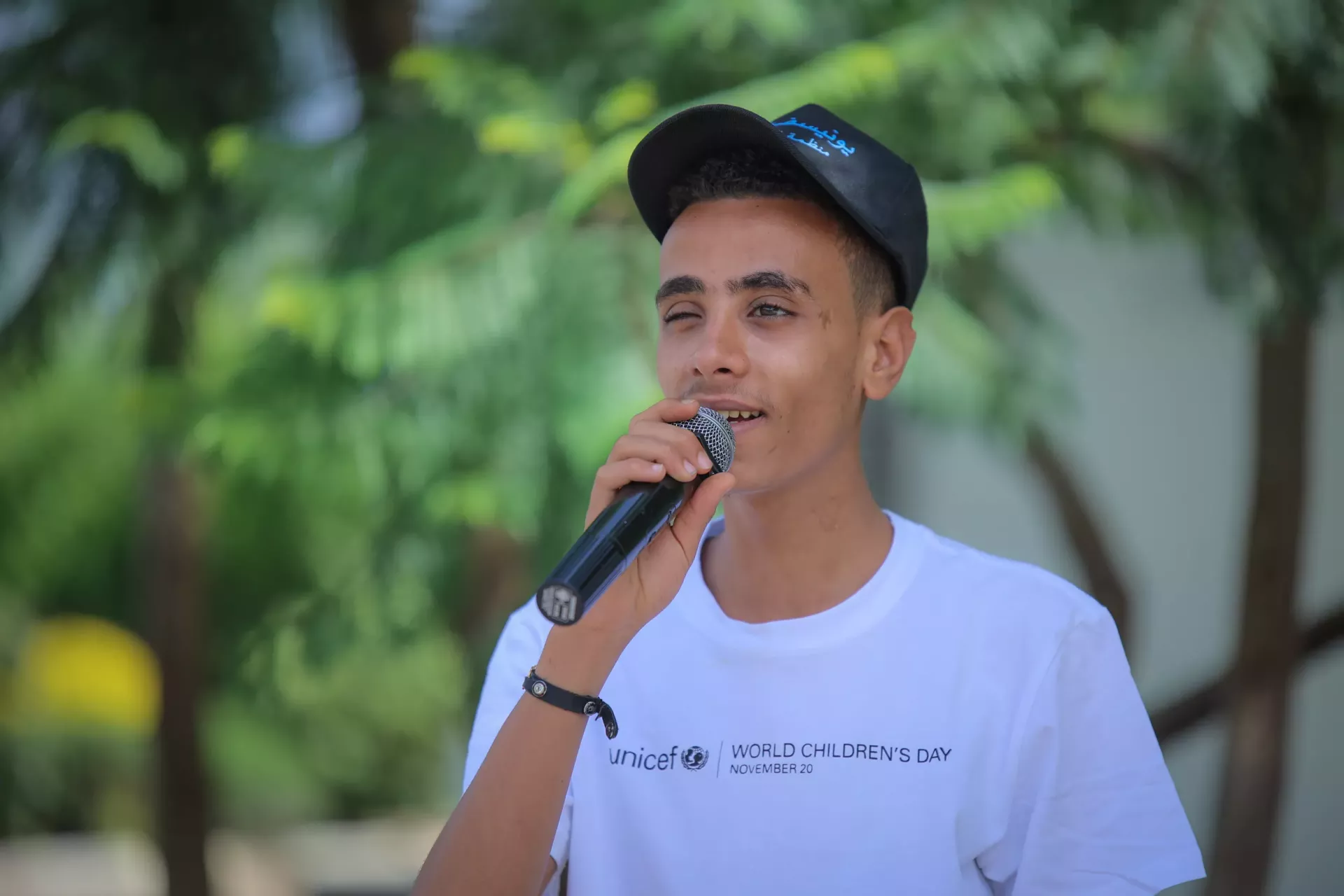
Wesam’s journey is not just about personal triumph but also about making a difference in the lives of others. He has become a role model for other survivors. He would also take part in community activities and UNICEF activities for children to inspire hope. Wesam’s message to others is: Never stop pursuing education, be patient, and believe in yourself. “My advice to them is to not stop their education and to be patient and believe in God,” Wesam advises. “Also, to believe that the disability is not in the body but it’s in the mind.”
As Wesam nears the completion of his second year at college, his aspirations extend beyond personal success. He dreams of using his knowledge to protect companies, banks, and organizations from cyber threats. Wesam’s story is a powerful reminder of the strength and resilience within us all, illustrating that even in the face of unimaginable adversity, one can rise, rebuild, and inspire others.