“The existence of soap and water in hospitals, shelters, and schools, is vital”
Experiences of the UNICEF WASH chief during the COVID-19 pandemic from Táchira and Apure, border states between Venezuela and Colombia.

- Español
- English
June 2020. Venezuela. - The COVID-19 pandemic took us by surprise as a globalized society; in addition to overwhelming our health care services, it has challenged us as social beings. It made us miss hugging one another, taught us to communicate in other ways, to relate, to prioritize, to connect, and to reinvent our way of working. As the chief of the Water, Sanitation, and Hygiene (WASH) section of UNICEF in Venezuela, my team and I are working intensely to implement solutions that allow us to decrease the risks of contagion despite the circumstances.
Since the very first day of the quarantine, we have been supporting key prevention measures, such as washing hands, hygiene, providing supplies, and technical support to prevent intra-hospitals infections.
Part of the UNICEF team has moved to the state of Táchira to reinforce the response by including the rehabilitation pumping systems and plants that supply water to the population, the same as we are doing in other points in the country.
Saying “stay at home” or “go to the hospital” has many implications for the most vulnerable people. Many times, leaving the house is the only way they have to get soap and water. In other cases, like the first-line response and humanitarian workers, nurses, and doctors, staying at home is not an option.
In mid-May, I traveled by highway to the state of Táchira, approximately 800 kilometers from Caracas, the capital of Venezuela, to provide support to colleagues in the local office and to reinforce our response so that communities, shelters, schools, and health care facilities have access to water, sanitation, and hygiene.
It is essential to go into the field, get first-hand information, and always work as a team. It is also genuinely admirable to see how, despite all the difficulties, doctors, nurses, drivers, and social workers remain committed to finding viable solutions. For me, sharing with these people was key to understand the needs and define workable solutions together.
In the field of humanitarian cooperation, we join the efforts carried out by social workers, doctors, water service providers, authorities, families, and others. In my eyes, their resilience is awe-inspiring. I keep thinking a lot about the stories and the struggle behind this resilience.


We must build every solution based on the knowledge and the perception of the people we work with, combined with our own experience.
On the ground, we can see that essential needs are on every corner, in every conversation, in every gaze. Our projects are implemented based on finding the pathways, the will, and the connections that create the most significant impact in the shortest time possible. Right from the beginning, I worked to support my colleagues in the Táchira field office in speeding up the implementation of COVID-19 prevention projects. We worked to get more water and more soap out there where it’s needed. But we are also working on repairing and maintaining the infrastructure, which will allow for more sustainable solutions.
Places like hospitals, shelters, and schools cannot lack water or soap.

This journey also brought me twice to Guasdualito, in the state of Apure. As a border city, Guasdualito is the center of movement and cultural and commercial permeability. In addition to the previously existing challenges concerning water, health care, protection, education, and nutrition, the response to the pandemic has required opening temporary shelters where Venezuelans returning to their country must spend time in quarantine.
We must face previous hard conditions when intervened to help prevent COVID-19 and to improve public health. Our aiming was to strengthen maternal and child health and to promote dignity and equality; for doing so, it is essential to reinforce the water, sanitation, and hygiene conditions. We at UNICEF work along with our partners to be able to face these challenges in the shelters.
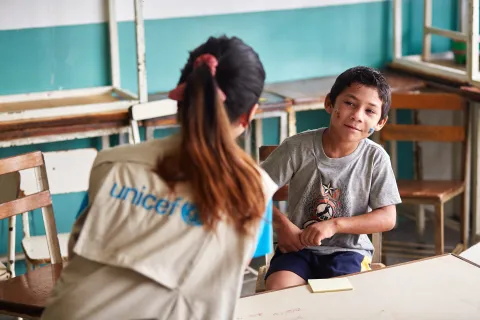
I have been able to speak with parents, with boys and girls, with teenagers, and with workers. They have many concerns about when the COVID-19 pandemic will let them return to their home and how their permanence in the shelter will be. Many public service providers work tirelessly around these people to help alleviate their difficulties. In situations like these, UNICEF intervenes to help solve issues.
Behind each number and each case, there is a story. And each story, each situation, each number needs to be heard and told. Our responsibility as humanitarian cooperation professionals is to produce change, to work beyond the numbers, and through these stories.