

The Journey: Guaranteeing Access to Drinking Water in Venezuela
UNICEF works with authorities and partners to provide clean and safe water to children and their families.

- Español
- English
Water, sanitation, and hygiene are essential for the survival and development of children and their families. In the most vulnerable communities in Venezuela, access, quantity, continuity, and quality of water are the main concerns. This situation is aggravated by power outages in recent months.
One of those communities is Petare, located on the outskirts of Caracas, the capital.
“If it rains, we drink rainwater. Sometimes the water comes out clean and sometimes it gets dirty. We collect it from the pipes and I help my father take it home so that we can store it in a tank, ”explains 9-year-old Duglianis González Sánchez with pride. "We boil it and then we can drink it."
Duglianis has lively eyes and a beaming smile. He lives with his brothers and parents in a building in one of the sectors of the Petare neighborhood, known as Cacagüita.
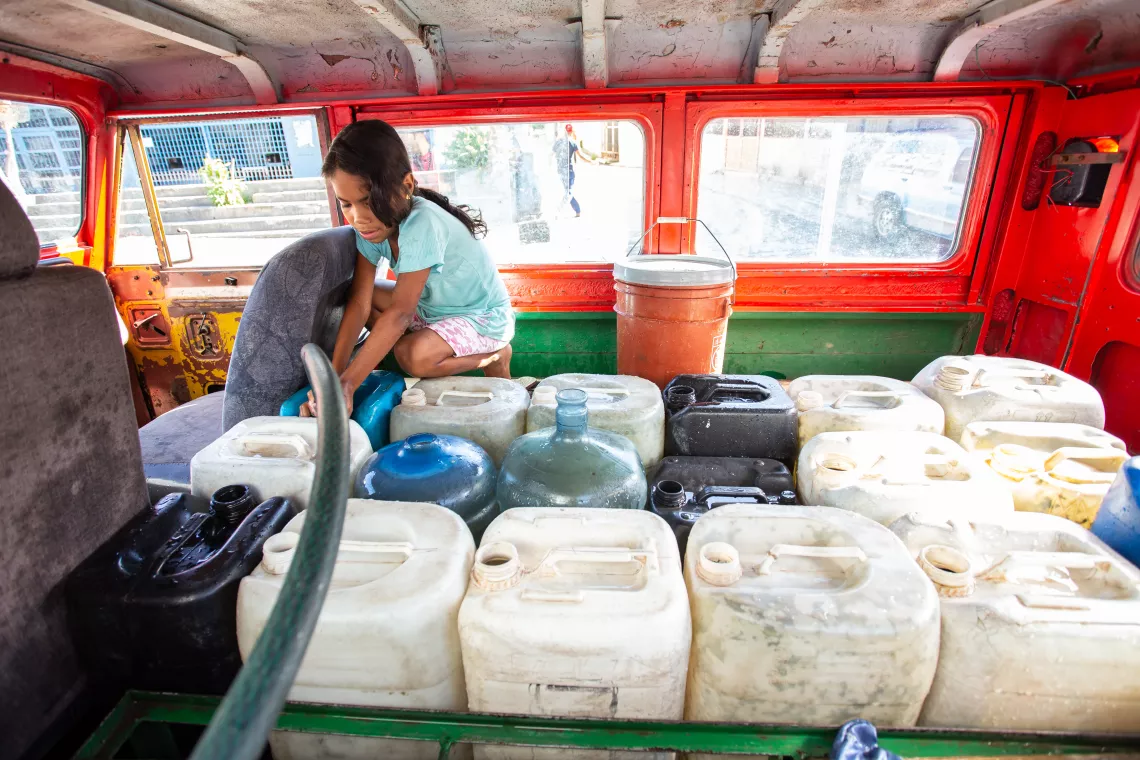
Like many other families, Duglianis' family has been without running water for months, which is a daily struggle for them.
Adults and children carry empty bottles and buckets through the streets and in vans to public fountains, urban wells, and pumping stations.

Petare rises in the far east of Caracas as a massive expanse of narrow and intricate alleys, filled with makeshift homes and tall buildings where nearly a million people live. It is considered the largest neighborhood in Latin America and also one of the most vulnerable.
Getting around Petare requires familiarity with the complex dynamics of the neighborhood, which changes from one street to another.

From early in the morning, the water trucks begin to arrive at the pumping stations in Caracas to fill their tanks. Once full, the trucks continue their routes to different parts of the city, where families wait anxiously with their cans.
In coordination with authorities and partners, ensuring access to clean and safe water for children and families is a priority for UNICEF.
“Children are at the greatest risk. Unsafe drinking of water causes diarrhea, amoebiasis, and other illnesses. That is what we want to avoid at all costs,” says Amilcar Espluga, UNICEF's Water, Hygiene and Sanitation Officer in Venezuela.

“I go to communities, schools, health centers, outpatient clinics, and hospitals. I speak with the families every day to assess the water, hygiene, and sanitation situation, "explains Amilcar, who is also in charge of ensuring that the water treatment tablets are available at the El Carmen and Urbina pumping stations, both in the neighborhood. from Petare, and that no truck leaves its destination without clean water in its tanks.


Currently, the El Carmen and Urbina pumping systems are being repaired, which provide running water to 65 percent of the Cacagüita sector. Meanwhile, the Municipal Water Institute of Sucre is responsible for supplying the tanker trucks, while UNICEF guarantees the chlorination of the water.

“The water truck is coming; The truck is coming!" shouts Duglianis.
When the tanker truck arrives in their neighborhood, little Duglianis helps her mother and father load the jerrycans.
“When the water doesn't come, I have to go to my aunt's house. She has running water in her house. When I get home, I am tired because the drums are very heavy and I have to go up and down the hill,” she says.


Access to clean water is essential to prevent disease in children and reduce infant mortality throughout the world, including Venezuela.
"Once I wanted to drink water and did not realize that the water in the drum was dirty. I drank it. I had a fever and pits (a rash) all over my body. I got very sick," admits Duglianis.

"With clean water, we can safely drink, brush our teeth, and shower, my brothers and I," she says. "I help my mother at home, washing clothes, dishes, washing..."
Together with national and local authorities, UNICEF's work will gradually enable the rehabilitation of underground and surface water sources, the repair of pipes, the distribution of water at strategic points such as hospitals, and the rehabilitation of pumping stations in the country.

As part of an agreement with the Ministry of Water, UNICEF is working to expand the supply of drinking water through the repair and extension of systems, transportation of water and other alternative sources, the strengthening of priority sanitation systems, and the provision of technical assistance and cooperation on water and quality control, so that no child is left behind.


