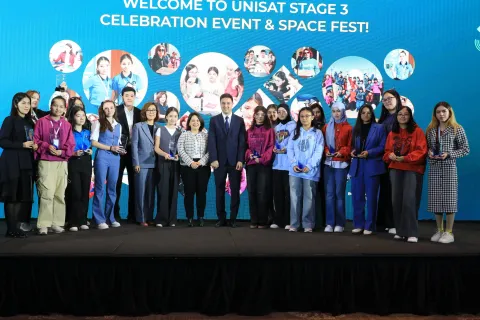
Girls participating in the UniSat 3.0 program assembled and launched nanosatellites into the stratosphere

SHEGE, Karakalpakstan, October 4, 2025 – From the grounds of School No. 11 in the village of Shege, Muynak District, participants in the UniSat 3.0 educational program successfully launched two nanosatellites into the stratosphere, which they assembled with the support of a team of national and international experts, scientists, and engineers.
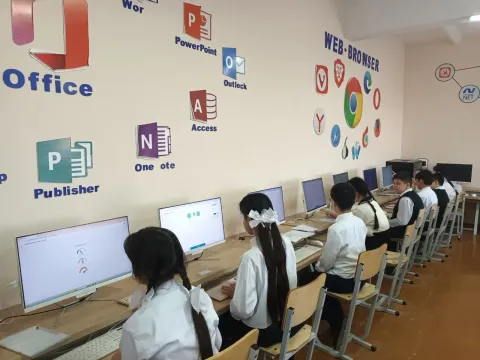
Prior to the launch of the nanosatellites, 845 girls aged 14 to 25 from all regions of Uzbekistan who applied to participate in the project had the opportunity to take the UniSat online course. They were trained in modules such as satellite construction, programming, radio electronics, data analysis, astronomy, 3D modeling, and engineering. In addition to classes in classrooms and laboratories, the girls met with aerospace engineers, astronauts, IT specialists, and science communicators to learn about modern technologies and the professions of the future.
Nodira Tillayeva and Diyora Daminova, participants in the first UniSat 1.0 project, also acted as mentors and lecturers. They continue their studies in aerospace technology and data analysis and have completed an internship at the UzCosmos agency.
September 30 — October 3, 20 finalists worked in the laboratories of the American University of Technology to design and assemble two three-unit nanosatellites. They equipped them with sensors to measure air quality, temperature, ozone density, and radiation in the stratosphere, as well as cameras capable of taking high-quality images of Earth from the stratosphere, useful for environmental and geophysical research. They will also study the collected information, in order to build a data library on the temperature regimes of the stratosphere over the Aral Sea region.
Together with a biodiversity specialist, participants also developed a series of scientific experiments with biological materials — fungal spores, protein, worms, and mold.
The UniSat program is implemented jointly by partner organizations—UNICEF, Tech4Impact NGO, and the Space Research and Technology Agency under the Ministry of Digital Technologies. Its goal is not only to provide girls with knowledge in the field of STEM, but also to develop teamwork, public speaking, and time management skills. The organizers seek to draw public attention to the importance of gender equality in science, technology, engineering, and mathematics.
The UniSat program has been implemented in Uzbekistan since 2021. More than 700 girls from all regions of Uzbekistan have gained access to new knowledge and skills in science and technology through this program. Detailed information is available on the program's official website www.unisat.uz
For more information please contact:
Nodirbek Mukimov Press Secretary Space Research and Technology Agency Tel. 99893 548 03 15 Email: [email protected] | Elena Selezneva Media Relations Coordinator Tech4Impact NGO Tel: +998909897257 Email@ tech4 impact. uz |
Inna Wolfson Youth and Adolescents Development Officer UNICEF Uzbekistan Tel. 99893 505-5256 Email: [email protected] | Nargiza Egamberdieva Communication Officer UNICEF Uzbekistan Tel. 99893 380 34 19 Эл.почта:[email protected] |