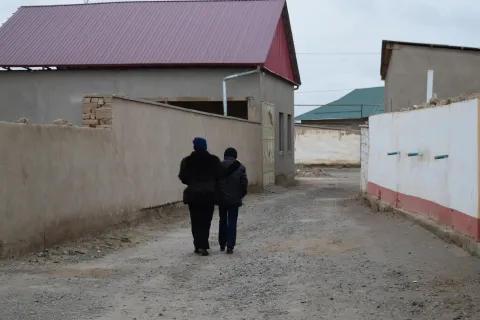
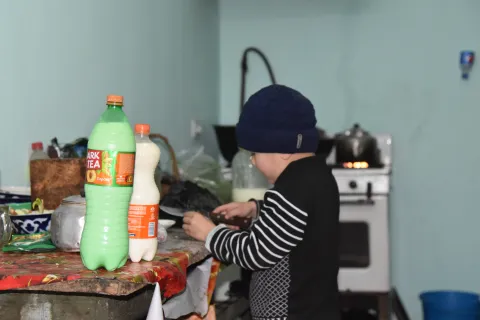
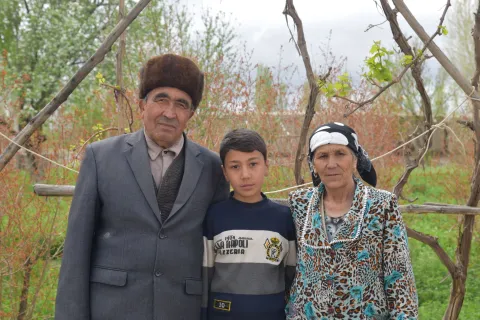
Calling my mom gives me hope that she will be back soon
Story of Soliha, 17-year-old girl from Surkhandarya

(Name changed to protect identity)
I was only five when my mother left for Russia in search of work. I was too small to understand what happened, but I do remember all the details of that day.
My parents had a lot of fights because my father was an alcoholic. Therefore, my mom used to come to her parents’ place very often, and every time they would send her back.
When my mother left us, I was at our neighbor’s place. She did not even say goodbye to me and my brother, who is one year younger to me. When I got home, mom was gone. I could not stop crying. I started looking for her, knocking at all the neighbors’ doors. She was nowhere to be found.
Soon my grandparents took me to their place. My brother stayed with our dad. My granny used to help me with my homework. She was often strict and did not allow me to play with my friends in the neighborhood. Unlike her, my grandfather was very kind to me. He used to take me to the market. Once he took me even to Tashkent, the big city!
After some time, my father got married again, and my brother came to stay with us. Since then, we have not seen our father anymore. He does not help us, perhaps because he has other kids.
When I was in the 7th grade, my grandma passed away. Last year I lost my grandfather too. So, we were almost alone. There is only my uncle, my mom’s brother. He is 30 and he too wants to leave for Korea to get a job.
The household chores are now on my shoulders. I clean, cook, wash and take care of my brother. I like to sing when I do housework.
Almost 13 years have passed now, and I can call my mom myself and do it every day. Thanks to the internet, I can see her too. Whenever there is no connection, I worry about her. I think something bad could happen and days feel like ages.

Now, I understand why my mom left us. Probably she did not have any choice and had to migrate to support us. She regularly sends us money so that we can go to school, have food and other important things.
When I finish school, I want to enter a university to become a psychologist. I have seen psychologists on TV. They give advice to people who need it the most. I want to help people to change their lives for better. To me, the most important point is to understand others.
I am not sure when my mother will be able to return. If she cannot come back, then I will go to see her. When I look at stars on the sky, I imagine that at this moment she must be thinking of me. And I dream of meeting my mom someday.
Many cases like Soliha’s were part of the study entitled “Effects of migration on children of Uzbekistan” that was financially supported by the European Union, as part of the EU-funded cross-regional project ‘Protecting children affected by migration in Southeast, South, and Central Asia.’
According to the report, “children tend to understand the reasons for their parents’ migration. They usually recount that they miss them, and yet they emphasize the importance of why their parents did not have a choice. They believe that parents are doing it for the benefit of their family.”
Among the surveyed children, 98 per cent of them communicate with their parents frequently: 71 per cent every day, 27 per cent each week, about 2 per cent less than every week. International research says that the use of modern communication technologies such as social networks and social support seem to compensate for some of the negative impacts on the emotional well-being of children left behind.
Nevertheless, other studies also show that young children may develop negative emotions which disrupt attachment bonds during extended parent-child separation since the physical presence of parents and care and interaction with parents are the major factors for maintaining attachment relationships.
Furthermore, children whose parents leave when they are young have a higher likelihood of suffering from anxiety and depression. Some surveyed caregivers noted that children often exhibit changes in behaviour due to the separation and negative emotions they feel when migration continues for one year or more.
Children may become self-contained, nervous, and even aggressive, rarely making contact and not wishing to discuss their condition. Indeed, 45 per cent of boys and 34 per cent of girls do not talk to anybody when they get emotionally upset.
One of the report’s recommendations suggests: “Since migration has the biggest toll on children’s emotional well-being it is crucial to develop and expand professional psychosocial support services for children affected by migration in schools, colleges and local communities. This support must be age-sensitive, and tailored to the needs of young children, who are affected by parental migration to the greatest extent.”
“Psychologists working in schools should be provided with additional training in how to work with a particular target group, such as migrants’ children. A psychosocial support hotline could be useful for both caregivers and children in migrant households,” the report confirms.