School windows in Ukraine strengthened with shatter-resistant film
UNICEF and the Education Cannot Wait have installed shatter-resistant window film at 23 schools in the Mykolaivska and Odeska regions

- Українська
- English
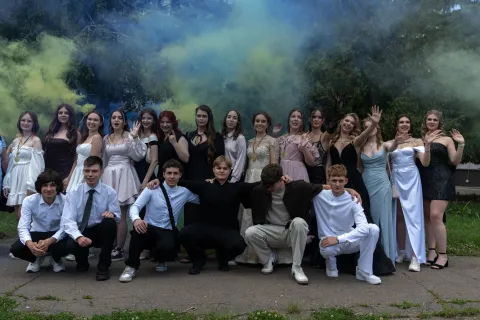
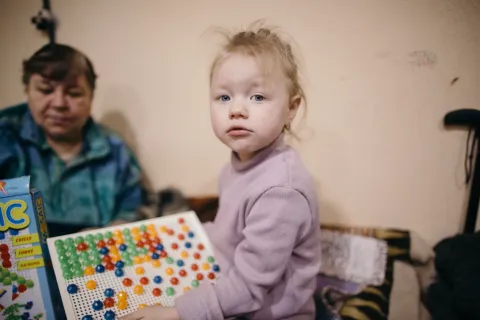
During the first few weeks of the war in Ukraine, one school in the Mykolaivska region became a haven for more than 4,500 people forced to flee the violence. Families from Kyiv, Mykolaiv, Kherson and Mariupol found safety in the school shelter.
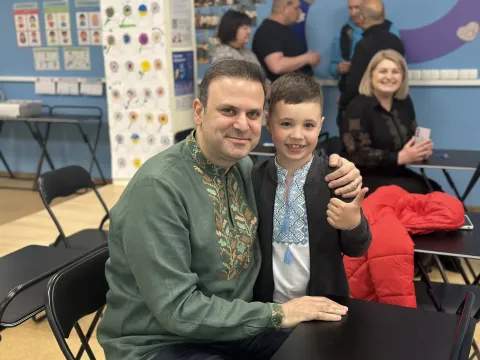
"On the first day, it felt like numbness,” says Yevheniy, the principal of Lyceum No.1 in Kryve Ozero. “Everything was quiet. But the following day we started getting ready, collecting product boxes and weaving camouflage nets. People who came were accommodated in a school shelter. We brought benches and beds there. Approximately two to three hundred people arrived in just the first fifteen minutes.”

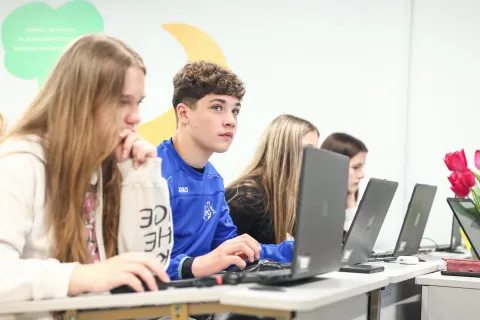
Today, Lyceum No.1 is one of the few educational institutions in the Mykolaivska region that is fully operational. Currently, more than 700 students study here, including children from neighboring villages and internally displaced children from areas where shelling continues.
To help ensure their safety, the United Nations Children's Fund (UNICEF) and the UN global fund Education Cannot Wait (ECW) have installed shatter-resistant film (SRF) on the windows. It is one of 23 schools in Ukraine’s Mykolaivska and Odeska regions to have received the SRF, which is vital amid the daily threat of shelling and unexploded ordnance.


In case of a shock wave, this thin, clear, durable and impact-resistant film contains the glass fragments, protecting children and teachers from injuries.
"UNICEF's humanitarian response to education challenges is focused on establishing a safe education space,” says Anatoliy Ihnatovych, the Education Officer at UNICEF Odesa Field Office. “Shockproof film is a crucial element for the safety in schools. Without it, a school cannot be considered a safe place in the face of sporadic bombardment and rocket attacks. In this way, we significantly reduce the risk of injury from flying glass fragments.”

After consultations with communities, UNICEF has prioritized the schools across Ukraine where the installation of SRF is most needed. Thanks to the SRF, children will be able to learn and develop without the risk of injury.
"When parents know that their child is safe at school, they are calm. This is a whole range of security measures – a warning system, shelters and protective equipment. Our task is to preserve children's health, both physical and mental.”


"At first, I was scared during air raid alarms, but now it's kind of normal. When we go to the shelter, it's harder to sit in class. It's hard to hear, it's hot and it's harder to memorize information, but I feel safe at school.”
Anastasia is in the eleventh grade at Lyceum No.1 and dreams of becoming a doctor.
As the war continues, Lyceum No. 1 in Kryve Ozero is now systematically preparing for possible power outages similar to those that occurred last year due to missile attacks on Ukraine's energy infrastructure. As part of its response, the Kryvе Ozero community has introduced a six-day school week, with children studying every Saturday until the end of December to cover the school curriculum and reduce learning gaps caused by air raids, blackouts and other difficulties faced by students due to the war.

UNICEF is working with the Government of Ukraine to support learning recovery and remove barriers to education to ensure lifelong learning for all. This includes rehabilitating schools and providing much-needed catch-up classes in core subjects, with the aim of supporting 300,000 children at risk of learning losses in Ukraine over the coming school year, while providing longer-term support through the strengthening of early childhood education systems and services at scale.