Surviving winter underground
How Viktoriia’s family, forced to live in a bomb shelter, endured the freezing winter months

- Українська
- English
“We spend almost all our time in the shelter. Milana has grown up here, since she was just a few months old. It’s already her third year here,” Viktoriia, a 34-year-old mother of four, says.
Her family stays in Kherson city. Because of its proximity to the frontline, it is nearly deserted. Torn asphalt, damaged buildings, gaping windows, some crudely boarded up with plywood, tell a story of destruction.
A children’s playground is encircled by gabions, tall wire cages filled with stones. Despite everything, children still play on the swings inside.

Growing up in a bomb shelter
For nearly three years, Viktoriia, her mother Tamara, and the children have been living between their flat, which was damaged by a blast wave, and a bomb shelter in the basement of a neighbouring building. Their home has been without electricity for over a year. All the windows are boarded up, with only small cut-out openings letting in some light.
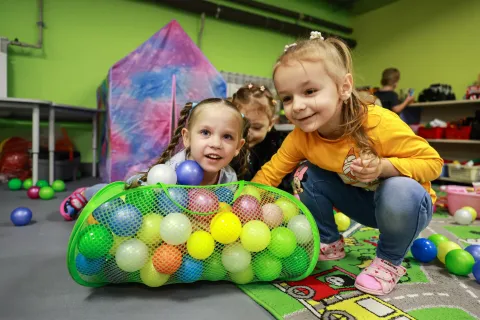
The family has been given a separate room in the basement. In this room, the children study online, play, draw and spend time with their pets. It is their safe space. But even here, the sounds of explosions outside carry through. At the faintest noise, Milana, the youngest child, says, “Mummy, let’s go.”

“We go home just to cook and wash, then quickly come back. We do everything by torchlight because there’s no electricity. There’s no hot water. The boiler doesn’t work. We heat pots on the gas stove. It’s calmer in the basement,” says their grandmother, Tamara.
Cash assistance for winter needs
As part of UNICEF’s winter emergency response to help mitigate the impact of the harsh winter on children, UNICEF provided a one-off cash assistance of 19,400 UAH (USD 485) to 58,560 vulnerable families with children living within 30 kilometres from the frontline in Chernihiv, Dnipro, Donetsk, Kharkiv, Kherson, Sumy and Zaporizhzhia regions.
This vital support helped families to prepare for winter and get through it, by enabling them to meet their priority needs, such as purchasing heaters, stocking up on food and fuel, and covering other essential expenses.
For Viktoriia, the cash assistance became an additional lifeline, helping her pay for utilities and buy warm clothing for her four children.


Dreaming of a normal childhood
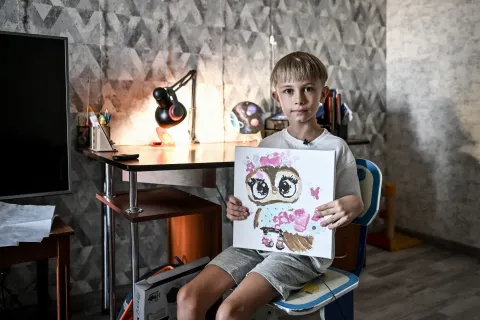
Dmytro, the eldest son, wishes he could just focus on his interests and to be with his friends again.
“I really love drawing, but now there’s hardly any time for it,” Dmytro shares. “I have to study and help mum with the younger ones. We’re always together. When mum is at the shop or cooking, I look after them,” he says.


Viktoriia doesn't allow him to go outside, except when it is quiet enough to visit a nearby playground. Occasionally, Dmytro helps his mother and takes the dog for a walk.
“I just want the war to end soon. To go to the seaside with the whole family. That’s my biggest dream – for there to be peace and calm for everyone around us. So people don’t have to walk in fear, be afraid or hide,” Viktoriia says with a sigh.
###
UNICEF’s 2025-2026 winter emergency cash assistance for vulnerable families was made possible with support from the European Union, the governments of Denmark, Germany, Norway, Sweden and the United States, as well as private sector partners through UNICEF National Committees in Ireland and Switzerland.