“We are like a family with them”: home-visiting nurses come to help families with children
Home-visiting nurses not only advise the families on the children's health and feeding, but also support them psychologically

- Українська
- English
At the end of April 2023, a chemical plant in Pavlohrad, Dnipropetrovska oblast, caught fire as a result of shelling. At that time, the local maternity hospital took expectant mothers and women in labour into a bomb shelter for their safety. Yulia was among them.
“I was expecting my third child, a baby girl named Raya. My first C-section was ahead,” she recalls.
During the first days after giving birth, Yulia had almost no milk, but she tried to establish breastfeeding. Alla Stepanenko, a home-visiting nurse, came to help her: she calmed her in labour and developed a special nutrition system for her to stimulate lactation.


Alla is a child nurse with 38 years of experience. The primary healthcare centre where she works has joined the Home Visiting Programme, the joint initiative of the United Nations Children's Fund (UNICEF) and the Ministry of Health of Ukraine. The nurse says she has always worked with children, but after the project's training, she began to pay attention to parents and their psychological state.
“At the training session, we were imagining that we visited a family, tried to realize what our goals are, and communicated with parents,” Alla's colleague Olha Olhovik, a nurse with 29 years of work experience says.
During training for home-visiting nurses, a lot of attention is paid to the social and psychological support for families with children. For example, the nurses learned how to draw up an ‘ecomap’ of the family, which shows how these people are connected to relatives, neighbours, and social services and suggests where they can get the necessary services and support.
“Before the delivery, we come and look at the conditions in which the child will live, advise on how best to arrange the children's area in the apartment,” Oksana continues, “We make sure to get to know the family and establish contact.”
During the first month after delivery, nurses visit a family twice, then less rarely or on parents' demand. Before the Home Visiting Programme was implemented, a nurse visit used to last 15 minutes on average, while now it can last up to two hours if needed.
Olena Dudnikova, a paediatrician who curated the Home Visiting programme in Pavlohrad, recalls a story of a woman who had difficulty communicating with her husband after giving birth, not realizing how much her life had changed. The nurse spent her entire weekend talking to her. For another young mother who was afraid to eat something that could harm her baby, the nurse personally bought marshmallows and explained that nothing bad would happen from only one sweet.


Nurses are always available for calls, since mothers, especially internally displaced persons (IDP), often just need someone to talk to.
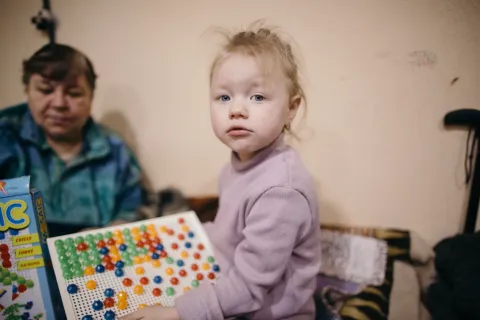
“When I was 8 months pregnant, a maternity hospital in our town was closed. So, we came to Pavlohrad to give birth to our baby Vladik, and so we stayed here,” Valeria, a mother of three from Dobropillia in the Donetska oblast says.
Home-visiting nurse Oksana not only advises the mother on the children's health, but also supports her psychologically and helps her adapt to the new city. Oksana and her husband also helped the family with basic needs.
“We are like a family with them,” Oksana smiles.


The Home Visiting Programme is a joint project of the Ministry of Health of Ukraine and UNICEF which aims to implement a universal and progressive model of home visits to improve the provision of medical and social care to families with children aged 0 to 3 years in the primary healthcare system.
The programme is currently being piloted in the Donetska, Zhytomyrska, Kirovohradska, Dnipropetrovska, Kyivska, Lvivska regions, and the city of Kyiv. In 2023, it will be expanded to four more regions of Ukraine, including Vinnytska, Odeska, Poltavska, and Rivnenska oblasts.

The programme is currently being piloted in the Donetska, Zhytomyrska, Kirovohradska, Dnipropetrovska, Kyivska, Lvivska regions, and the city of Kyiv. In 2023, it will be expanded to four more regions of Ukraine, including Vinnytska, Odeska, Poltavska, and Rivnenska oblasts.
Learn more about the work of home-visiting nurses in Zhytomyrska oblast.