Hospitals in Ukraine to benefit from boreholes
UNICEF and partners are drilling boreholes at hospitals in southern Ukraine to ensure regular access to clean drinking water.

- Українська
- English
Eighteen months after the full-scale war broke out in Ukraine, the country’s water supply remains under threat, with over 4 million people still without regular access to drinking water.
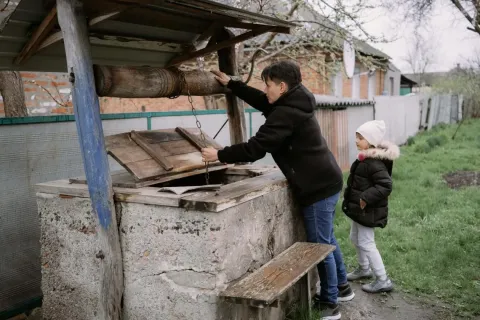
Over 1,000 kilometres of water supply and sewerage networks have been destroyed since the beginning of the war. As well as 4.6 million Ukrainians, agricultural land and critical infrastructure are also suffering, and pumping stations and sewage treatment plants have been damaged by the fighting. Furthermore, some wells have become shallow or flooded as a result of the Kakhovka Hydroelectric Power Station dam destruction.
Now, the United Nations Children’s Fund (UNICEF) with support from USAID Bureau of Humanitarian Assistance (BHA) and the French Government to drill boreholes that will provide five hospitals in Odesa and Mykolaiv with a continuous water supply.


Odesa City Hospital #11 is one of the medical facilities that will benefit from the project. It has 16 clinical and five diagnostic departments that require up to 100 cubic metres of water every day. Every year, 40,000 people visit and there are currently more than 500 patients.
"During the missile attacks in the fall and winter, the hospital faced water supply interruptions, but we managed to cope with it thanks to our own stocks in barrels,” says Mykola Ivanovych, the hospital director. “The only thing is it was non-potable water. With the well, we will be sure that we have both drinking and industrial water, even in emergency situations. It will make us fully autonomous.”

The well will be connected to the hospital's network, and water will be supplied directly to the wards. After purification, the drinking water will be supplied to a pump room and stored in tanks. This will allow 50-60 cubic metres of water to be stored in case of emergencies.
Drilling works have already been completed at the Odesa City Infectious Diseases Hospital, where a well at a depth of 120 metres provides five cubic metres of water per hour. The next stage is to install a water storage point and pump room.

"During incidents on the city's networks, the water supply was cut off for several hours and a water truck came to us,” says Svitlana Yakovlevna, Chief Medical Officer of the Odesa Infectious Diseases Hospital. “These were isolated cases, but it may happen in the future. And any hospital, especially an infectious disease hospital, needs a lot of water.”
Restoration of water supply systems is one of the key areas of UNICEF's activities during the war in Ukraine. Drilling boreholes in hospitals is part of the humanitarian response to support medical facilities, since the fighting has disrupted basic infrastructure and deprived some parts of the population of access to clean water.

"An independent water source helps guarantee continuity of health services, maintains hygiene and sanitation standards, increases emergency preparedness, reduces vulnerability and enables hospitals to effectively serve their communities," says Tetiana Karavaieva, Water, Sanitation and Hygiene Officer at UNICEF.