Giving birth on the first day of the full-scale war
Memories from the Chernihiv maternity hospital

- Українська
- English
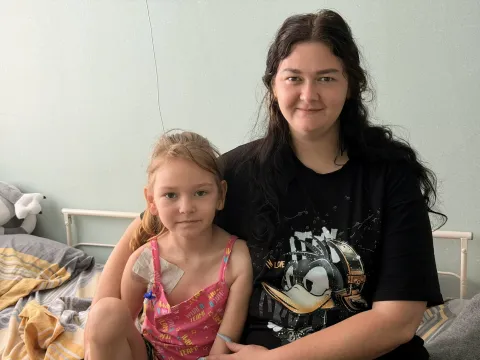
Maryna and her three-year-old daughter Angelina walk into the courtyard of the Chernihiv maternity hospital. This place is special for both of them — Angelina was born here on the first day of the full-scale war.
She was welcomed into the world in a dark, cold and damp bomb shelter.
“It was frightening, tense, physically difficult — I had to sit in a chair all night long, holding the baby in my arms. There was nowhere to lie down. I wanted to sleep, but we stayed awake all night. These were not the conditions you would want to give birth in”.
She explains that the women did not know what was happening in the city. Nurses went upstairs in turns, called their families, and then relayed the news. Only in the morning did the mothers manage to sleep for a few hours.
Today, the shelter is unrecognizable. WIith UNICEF support, the space has been renovated and equipped with medical and diagnostic equipment, and the hospital now has an ambulance to ensure that babies can be born and transported in safety and comfort.

Feeling safe underground
Maryna and her daughter are back at the hospital seeing the rehabilitated shelter for the first time. They meet Vira, the hospital’s head midwife, who was there in 2022 and embrace like old friends.
“No one believed this could happen, not until the very last moment".
The women heard the first explosions of the war from inside the shelter. Still, they felt safe there.
“We realized it was better down here. Deep underground. I worried about what was happening in the city, because my older child was there. There was no mobile signal in the shelter, so we had no idea what was going on outside.”
“It was difficult, the uncertainty weighed on us, but most importantly, there was medical staff who helped with the babies. They kept us clean, supported us emotionally. The doctors were very professional,” Maryna recalls.

The first birth in the shelter
Vira has been working at the maternity hospital for 35 years.
“As the head midwife, I had to prepare all the necessary equipment in case women had to stay in the bomb shelter. When I went down there for the first time, I decided I had to stay in the hospital”.
She became the lead in the shelter and spent 42 days there. Later, she published a book of memoirs based on her personal diary from those times.
On the evening of 24 February 2022, Vira organized a line of medical workers who carried patients’ belongings and guided them into the shelter.
“Anyone who needed help — carrying their babies, clothes, bags — we helped them all. That’s how we evacuated to the bomb shelter very quickly.”

She remembers the first days as especially difficult. Both patients and residents from nearby houses stayed in the shelter. Altogether, there were about 100 people inside.
“Whenever I remember it, I cry. Normally, childbirth is filled with happiness. But at that moment, the feelings were completely different: fear and uncertainty. I announced to everyone that our first baby had been born — people clapped and cried.”
An explosion near the hospital
“We realized it was very difficult to organize proper work in the bomb shelter because the temperature was below zero, and babies are supposed to be born in warmth. At that time, it was impossible to maintain such conditions there. Soon, there were no utilities left: no light, no electricity, no heat,” says Vira.

The scariest moment came a month into the war when an explosion struck right on the hospital grounds. Windows and doors were blown out in the hospital, but fortunately, everyone in the admissions ward survived.
“One of the women with us had a premature baby, who was in the neonatal intensive care unit on special equipment. She had a breakdown. As a woman, I completely understood her. She was terrified for her child,” recalls the midwife.
A bomb shelter in a border city is vital
Since Chernihiv is close to the border, having a proper shelter at the maternity hospital is critically important, including with delivery rooms and intensive care, as well as facilities for longer stays.
The shelter can now accommodate about 100 mothers with their children at the same time.


“Now there are comfortable beds, good renovations, everything is arranged: an operating room, a children’s room, delivery wards. This is a completely different shelter from the one I experienced back then,” Vira says.
She notes that war affects everyone differently, but both staff and patients endured enormous stress. As for herself, the senior midwife says that in 2022 she held on and tried to control her emotions.

“One thought came to me: ‘I don’t have the right to panic.’ I held myself together, because if I showed weakness — how would the women and everyone else there look at me? Even now, when I remember, sometimes I cry”.
After the tour of the renovated shelter, she closes its heavy, wide doors. She remembers doing the same in 2022 — back then, it meant shelling had started, and no one could go outside without her permission.
“Still, I hope this beautiful bomb shelter will never be needed again,” says the midwife.