The workers on the frontline nurturing every child for Ukraine’s recovery
Across Ukraine, whilst the war continues to rage, a remarkable network of dedicated professionals works tirelessly to protect and prioritize children as Ukraine’s most precious resource for the country’s recovery.

- Українська
- English
Even as war continues to devastate parts of Ukraine, the educators, social workers, health professionals, emergency responders, water technicians demonstrate extraordinary resolve through their daily actions—whether teaching in bomb shelters, delivering babies in basements, or rescuing families from danger. Every day, they go to work with a single goal: to make life better for children—the future of the nation.
Hanna - Teacher, Zaporizhzhia
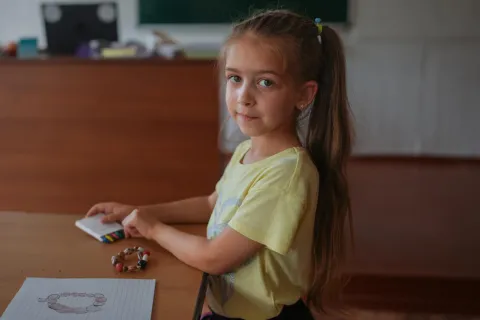
In Zaporizhzhia, education is being reimagined through innovative learning recovery centres that prioritise emotional safety along with educational recovery. What makes the learning recovery centre special, Hanna Lehutska, a teacher, adds, is that it focuses not on grades, but on giving children the freedom to try, make mistakes and grow without fear.

"We offer free supplementary classes for pupils in Years 5 to 7. One of the greatest needs among our learners is live communication, both with peers and with teachers".
"We see how important it is for children to communicate freely—without interfering with each other—and to interact with the teacher without the pressure of formal assessment," explains Hanna. "It really helps them overcome the learning losses caused by the war. You can see the difference: they now take on even unfamiliar tasks more confidently. And since I also teach some of them at their regular school, I can confirm that their academic results are improving there too."

Liubov - Child Psychologist, Zlatopil, Kharkiv region
Inclusion becomes even more critical during wartime, when vulnerable children face compounded challenges. Barrier-free and safe inclusive spaces have been created for children with disabilities in the Kharkiv region and provide sessions with a developmental specialist, speech therapist, psychologist and rehabilitation therapist.

"Thanks to these developmental classes, many children are making progress," says child psychologist Liubov Pohretska, who coordinates the project in Zlatopil. "We are very pleased that children who did not speak at all are gradually starting to speak. And the parents are very grateful. They tell us: 'Thank you!' And you say to them: 'Thank you!' Because it inspires you to move on."
"Before, parents of children with autism spectrum disorders had to travel far for sensory integration. And the main problem is that these classes are very expensive. During the war, local residents, especially internally displaced people, simply do not have the money for this."
Iryna - Literature Teacher, Odesa
Educational institutions serve as more than places of learning—they become sanctuaries of emotional support during times of crisis. Iryna Sukhinina, a Ukrainian and world literature teacher and form tutor at the Odesa lyceum, has become a vital source of emotional support for her students.

"They've become more anxious, unable to concentrate," she says. "Sometimes they come to class and nearly fall asleep. And I understand—when they haven't slept all night, spent it in a shelter and still have to come to school in the morning… They can't absorb the material. They're just trying to hold themselves together."
Despite her own grief following the death of her parents and the tragic loss of some students, Iryna finds the strength to remain a pillar of support for her pupils.
"I always greet them with 'my sunshine, good morning, no rush'. If there's an alert, we wait for the all-clear and then make our way to school. I wait for everyone, so I can give them a hug."
Oleksandr - Water Utility Manager, Kramatorsk
The heroes of wartime are often found in the most unexpected places. Oleksandr Khaliava works as the head of the emergency department at the Kramatorsk Water Utility. He is a hero to his four children. Whilst the children study online to the sound of air raid sirens, Oleksandr and his team repair pipes.

"We do our best to ensure a round-the-clock water supply," says the specialist. "If there's an accident, no one leaves work until the water supply is restored. We work in extreme conditions, eliminating the consequences of missile attacks. One of our workers was seriously injured but returned to work after six months. The most important thing for me is to keep people safe."
Despite the challenges, Oleksandr Khaliava loves his job. For him, all 270 of his water utility colleagues are one big family.
"The war has united us all. I know all the relatives, children and grandchildren of my colleagues. And I also know that after work, my family is waiting for me—that's my main motivation."

Alla - Neonatal Intensive Care Unit Head, Kharkiv
In the most critical moments of life, medical professionals like Alla demonstrate extraordinary dedication. Alla Ivanivna serves as the acting head of a neonatal intensive care unit in Kharkiv. The medical facility handles over 1,000 births every year. It specialises in assisting women with pregnancy complications. Care is provided not only to pregnant women from Kharkiv and the region, but also to displaced women and residents of neighbouring regions, including those living under constant shelling.

"We have patients from Kramatorsk and Sloviansk in the Donetsk region," says Alla. "These women arrive in critical condition because only the most complicated cases are referred to us."
Alla says that despite the ongoing war, the medical facility has never stopped providing care over the past three years.

"At the beginning, our newborns, along with their mothers, were moved to the basement, where we organised full-scale intensive care. Even though we were unprepared for the new challenges that war brought, we did not have a single fatality".
"Today, our maternity hospital continues to provide full medical care. We have generators, a backup water supply, all necessary medications and the required equipment. Without these conditions, we would be paralysed and unable to manage complex neonatal cases requiring mechanical ventilation," she explains.
Iryna - Headteacher, Kehychivka, Kharkiv region
Physical wellness becomes even more crucial during wartime, when children's mental health faces unprecedented challenges. In Kehychivka hromada of Kharkiv region, more than 700 children are finding respite from the war in their school gymnasium.
Iryna Yusova, the lyceum's headteacher, says that nearly all of them are involved in physical education classes and around 200 attending sports clubs.

"Since 2020, children have essentially been cut off from normal education systems due to the pandemic, and now they've had to study remotely during the war," she says. "This situation is made even harder by the fear of what tomorrow may bring, or whether something might happen on the way to school".
"Being involved in clubs and activities gives children the chance to feel part of a group, to be close to their friends, to experience teamwork and to understand what it means to win. There is a vibrant sporting life at our lyceum."
Tetyana - Preschool Teacher, Sumy
The youngest victims of conflict require specialised approaches that honour their developmental needs whilst addressing their trauma. Through the innovative '2 by 2' programme, UNICEF is helping preschool children in Sumy return to in-person learning in a specially-equipped shelter.

"At first, the children were more withdrawn," says teacher Tetyana Kolesnikova. "They were afraid of sudden noises. Even when a car passed by on the street, you could feel the anxiety in the air."
Each session begins with a special warm-up exercise called 'You and Me', developed by UNICEF and Ukrainian singer Svitlana Tarabarova, which the children affectionately call 'We Are Searching for Peace'. Tetyana Vasylivna also teaches in the shelter.
"When they arrive, some are still sleepy, whilst others are excited after a restless night. They immediately ask, 'Tetyana Vasylivna, when are we going to search for peace?'"

"Our sessions are not just games. They are a real path to new knowledge, skills and friendships".
The children here didn't know each other before, but through these sessions, they became real friends. They are craving social interaction. They love exercises where we talk, sit in a circle or hug. I have really noticed that they miss hugs and communication, so we try to make up for it here," she continues.
Olena - Case Manager, Kharkiv Region
When tragedy strikes, swift intervention can mean the difference between despair and recovery. Thirteen-year-old Nazar from Kharkiv region was injured by unexploded ordnance that detonated whilst walking with a friend in his village in November 2024.

"When we first arrived to see Nazar, he was not really willing to talk," says Olena Hunchenko, a case manager from the International Rescue Committee. "Probably, it was a child's reaction to what had happened".
"During the next visits, Nazar became more open, talking about his studies, hobbies, and even sharing some moments of the incident."
Olena says she learned about Nazar's injury from the news and then found Yevheniia's contact information the same day and called to offer support. Unfortunately, Nazar is not the only child in the Kharkiv region who she has supported after an injury. "I have many cases of injured children, more than 30," says Olena. "These are injuries from various unexploded explosive devices including from shelling in Kharkiv itself."
Vladyslav - Emergency Service Head, Kherson
When immediate danger threatens, emergency responders provide the critical first line of defence that makes all other support possible. Since the war in Ukraine escalated in 2022, the State Emergency Service of Ukraine has faced many challenges. But Vladyslav Horetsky, the head of a rescue station in Kherson, and his colleagues are determined to help those in need.

"It has become much more difficult to work, especially during the repeated attacks, when SES workers get a call about the shelling and then there is another shelling," says Vladyslav.
"And it's really hard to see how vulnerable children are in Ukraine. But I've never thought about changing my job. I'm 100 per cent sure this is where I'm needed. During the war, I see even more sense in what we do."
Valeriia - Art Therapist, Dnipro
Creative expression offers powerful tools for healing and connection when traditional educational settings are disrupted. In Dnipro, where most educational institutions are closed due to the war, UNICEF is providing classes in art therapy, storytelling and DJing for children.
Art therapist Valeriia Biletska says it is essential to teach young children basic skills, such as holding a pencil, learning colours and using their imagination.
"They also communicate during the lessons," she says. "With some kindergartens and schools closed, and learning conducted in remote or mixed formats, children lack opportunities for social interaction".
"If this continues, they might struggle with communication as they grow up. During classes, they play, learn interesting things about each other, and experience friendship and togetherness."

"After the classes, the children are happier. They forget about the terrible things, they are distracted and they even support adults who might not expect it."