The village health worker who became a mother
"We give the children on outpatient therapeutic care RUTF for one week, and they always come back for review or further screening to see how they are progressing on the programme."

Uwase Christine knows and understands how to use the Mid upper arm circumference (MUAC) tape. She has wrapped it around hundreds of small arms of children, reading the coded colours like a language only she and other Village Health Team (VHT) members understand. Green means safe. Yellow means watch closely. Red means act now.
One morning, she found red twice in the same household.
Two children sat in the corner of a compound, their arms thin enough that Christine could see every bone. She measured the first child, red zone. The second child, red zone again. The woman watching said she was their stepmother had no food to feed them sufficiently.
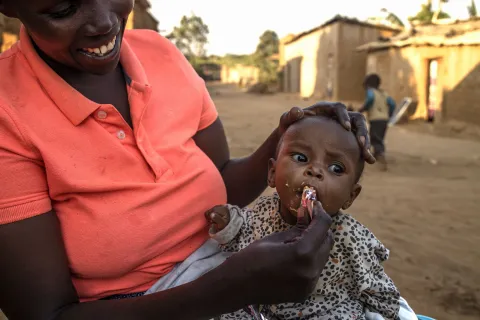
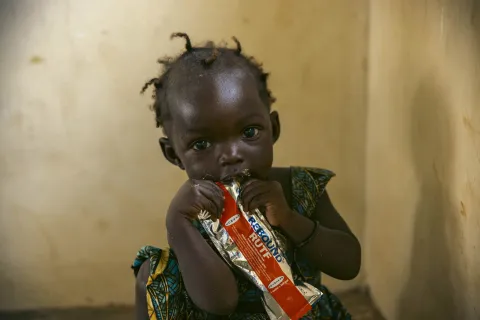
Christine filled out a referral form, the same form UNICEF had trained her to use during her VHT orientation and walked the children to Kabazana Refugee Reception Centre that afternoon. By evening, both were enrolled in outpatient therapeutic care, each receiving a week's supply of Ready-to-Use Therapeutic Food (RUTF).
Three weeks later, Christine returned for a follow-up visit. The compound was empty. Neighbours said the stepmother had disappeared in the night. The children were wandering near the roadside with half-finished RUTF sachets and nowhere to go.
Christine found them before dark and made a choice that was not in any protocol. She took them home.
"I couldn't leave them there," Christine says. "They were so small, and they had nowhere to go. When I brought them to my house, they didn't even know how to ask for food. They just sat quietly and waited."
She already had two children of her own to raise. Her husband works in Kampala and visits when he can. But she kept them anyway.

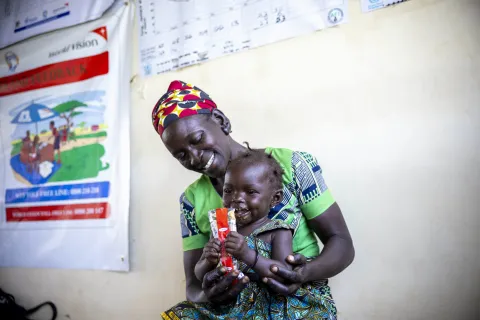
Every morning now, Christine wakes up to four children instead of two. She prepares breakfast for all of them, makes sure the RUTF sachets are finished to the last gram, walks them to school, and then begins her screening rounds. MUAC tape in hand, moving from household to household in her community.
"My day starts at 5 a.m. now," she says. "I prepare the children for school, tend to my home and after I do my VHT work: screening, referring, and following up. When I come home, I cook for all four of them. It's tiring, but when I see them playing together, I forget the tiredness."
The system that trained Christine is the same system that has kept her foster children alive. UNICEF, with funding from the Uganda Humanitarian Fund (UHF) managed by OCHA, supports the network of Village Health Teams across Isingiro District. The training taught her how to spot malnutrition early, fill referral forms correctly, and link families to care support.
At Nyarugugu Health Centre in Nakivale, nutritionist Wasswa has watched hundreds of mothers bring malnourished children through the doors.
"We give the children on outpatient therapeutic care RUTF for one week, and they always come back for review or further screening to see how they are progressing on the programme," Wasswa explains. "Every week, they return. We give them a week's ration each time."
The work doesn't stop at the health facility door. When malnutrition cases surge, often linked to new refugee arrivals or seasonal food shortages, UNICEF support allows the district to scale up. Additional staff are deployed during peaks to ensure no child falls through the cracks.
"We don't just leave them in the community," Wasswa says. "With support from UNICEF in the district, we are able to conduct outreach services and put on demonstrations to teach these mothers and caregivers more about infant and young child feeding practices. We bring them on board so we can prevent the nutrition situation from getting worse and help them bring their children back to normal during the rehabilitation phase."
The RUTF sachets distributed at Nyarugugu are part of a supply chain funded by the Uganda Humanitarian Fund through UNICEF and delivered to health facilities across Isingiro District. The programme targets both refugees and host communities.

"When mothers come here, some of them are very fast to understand what we teach them," Wasswa says. "They learn quickly. But some need more time, more visits. That's why the follow-up is so important. We track every child, every week, until they recover."
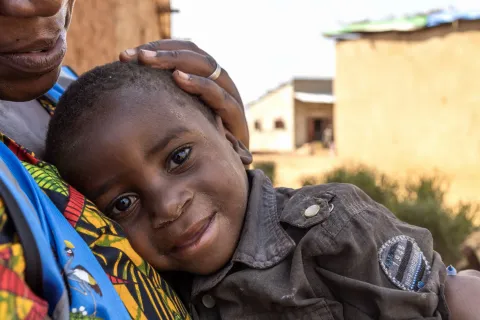
Six months after Christine brought the children home, she measured their arms again. Green zone. Both call her mother now.
"They are part of my family," Christine says. "When I look at them, I don't see abandoned children anymore. I see my children. They are growing well. They go to school. They play with my other children. I don't regret bringing them home."
But Christine wonders what happens to the next VHT who finds abandoned children. She wonders if other health workers will have the same support she received.
"I hope the programme continues," she says. "Because there are many children out there who need this help. I was trained to spot them, but without the RUTF, without the health centres, without the follow-up, I don't know what would have happened to these two."
Marion Alowo, the Assistant District Health Officer and District Nutrition Focal Person for Isingiro, says Christine's story reveals both the strength and the limits of the system.
"Village Health Teams are our eyes and ears in the community. UNICEF's support through UHF funding has made it possible to train these VHTs, to keep RUTF supplies stocked, and to bring in extra staff when we need them most. But Christine's case also shows us that sometimes medical treatment alone is not enough."
For now, Christine continues her work. Every Tuesday, she walks through her village with a MUAC tape. She screens children. She fills out referral forms. And she comes home to two children who survived because one Village Health Team worker refused to let them disappear.