UNICEF and Save the Children train community health workers on COVID-19 prevention and vaccination
Bringing COVID-19 messaging and services closer to communities

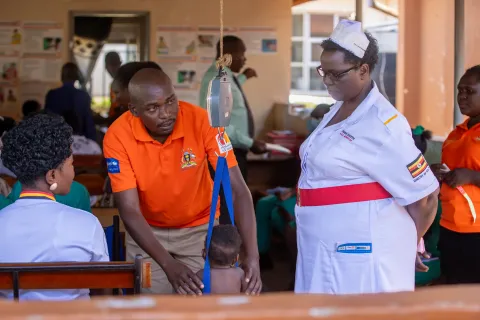
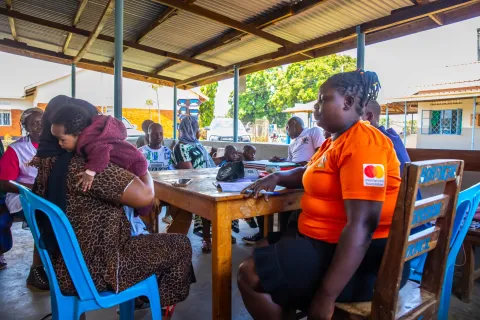
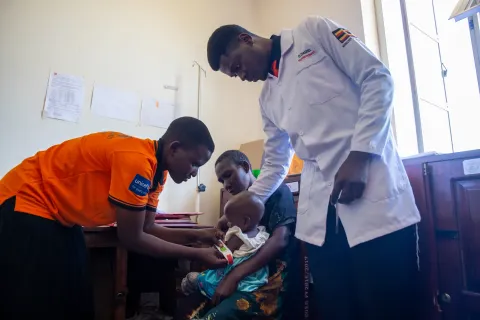
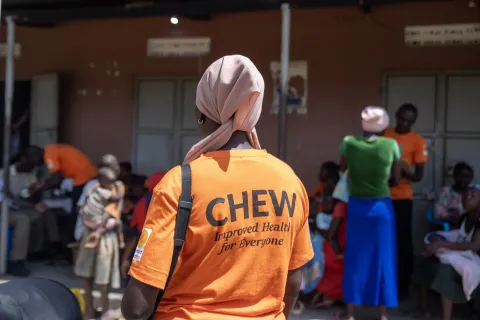
In Kasese District, about 404 community health workers also known as Village Health Team (VHT) members and 350 Local Council one (LC1) leaders have been trained on the prevention of COVID-19 and the benefits of vaccination in their communities. The activity was supported by UNICEF, Save the Children and the Kasese District Local Government with funding from the UN Multi-Partner Trust Fund (UN-MPTF).
Village Health Teams (VHTs) are structures established by the Ministry of Health and are the first level of health service provision in a community. The team members are responsible for mobilizing community members to receive healthcare services.
The orientation was aimed at enhancing the VHTs’ adherence to COVID-19 Standard Operating Procedures (SOPs) put in place by the Government of Uganda, practicing home based care for positive mild cases, and methods of tracking and addressing COVID-19 myths at household level through community sensitization across 19 sub-counties in Kasese District. This was implemented under the Uganda Lifesaving Health services in the context of COVID-19 project.
Kajumba Proscovia, 46, is one of the leaders within Kasese District and a survivor of COVID-19. As a representative of people with disabilities in Bugoye Sub-County, Kajumba was exposed to the virus through the regular community gatherings and interactions with different people within the community as part of her work.
“I never believed that COVID-19 was real before I got infected. I thought the increasing number of deaths I saw on TV were a way of reducing the population like I had heard in rumours,”
“Since it was the season for political campaigns, I thought able bodied people were using the disease to prevent us with disability from campaigning,” she added.
Kajumba’s myths about COVID-19 were however ended when she attended a burial in her community and a few days later she started feeling unwell.
“I had joint and back pain, general body weakness, headache and I started coughing,” she explained.
“Some of my family members became superstitious but I decided to go for a COVID test and the result came back positive to which I wasn’t surprised because I had been exposed to many people during the burial,” she added.
Kajumba’s VHT was informed of her condition and together with the health workers at the nearby health facility, she was provided with information about home-based care, self-isolation, and the medication she could use to ease the pain and discomfort felt in her body.
Kajumba said: “I’m so grateful to the VHT in my community because she advised me on how to observe SOPs while at home, stay away from cold drinks, use garlic and ginger, sunbathe, and isolate myself in order not to infect other family members within the house.”
“At first, I was very scared, and I felt stigmatised because my own family members feared me and my neighbours didn’t want to pass near our house. The VHT gave me psychosocial support for the two weeks I was ill, and I believe this contributed a lot to my healing process.”
Throughout the two weeks Kajumba was home in self-isolation, with regular checks by her VHT who recorded progress on how she was responding to the medication and home-based care. Kajumba went back to the health centre for review as advised after two weeks and she tested negative. However, the chest and joint pain persisted for another two weeks until she gradually regained her sense of smell and taste.
“I appreciate Save the Children, UNICEF and the Government of Uganda for training and empowering the VHTs, health workers and other community resource persons with the right knowledge and skills in such a critical time to support the local communities,”
Save the Children has now engaged 45 Community Resource Persons including chairpersons, local council leaders, religious leaders, and sub county technical staff to support radio messaging for community sensitization on COVID-19 prevention, the importance of vaccination, the vaccination sites within the sub county and the importance of continuing to seek health care amidst the COVID-19 pandemic. With funding from several partners including Luxembourg National Committee for UNICEF, UNICEF is working with the Government of Uganda, district authorities, religious leaders and civil society to heighten the roll out of the COVID-19 vaccines to keep people in Uganda safe.

Kajumba says that after she fully recovered from COVID-19, she was advised by the VHT to go for vaccination which she agreed to do. She is now an advocate for COVID-19 vaccination within her community because she knows that vaccines help one reduce on the risk of severe illness once infected with the virus.
“I am encouraging all eligible persons to take up COVID-19 vaccination and continue to observe SOPs. Vaccines are free, safe and effective and have been approved by World Health Organisation and the Government of Uganda,” urged Kajumba.
According to Kajumba, VHTs are the true unsung heroes because they have helped to save people’s lives at the grassroots level during the pandemic. She however notes that there’s still a lot of stigma as far as the COVID-19 virus is concerned. Continuous sensitization is still required to educate people about the virus and more materials that are favourable for all persons including those with disabilities should be developed for sensitization purposes.