UK Government funded nutrition programs reducing child wasting in Southwestern Uganda
Resolving domestic violence cases, community outreaches, family led MUAC approach, health education and sensitization are major contributors to the reduction of malnutrition cases in Southwestern Uganda

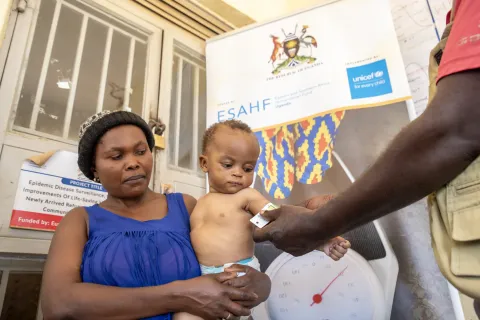
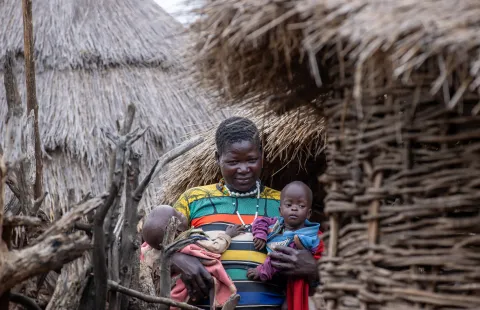
“My grandson was weak. He was six months at that time, but you would mistake him for a 3-month baby. He was sickly and lifeless. I thank the health workers and partners who assessed his nutritional status during a household visit outreach and discovered that he was severally malnourished. His life was saved after being admitted in hospital for treatment of severe acute malnutrition for 3 months,” says 52-year-old Grace Kokureta.
Kokureta is the grandmother of Mathias Ayesiga, who is now 2 years and 4 months old and is visibly looking healthy.
During a media field visit to Kokureta’s home in Rwakijuma Cell, Kyezimbire Village, Kikagati Sub County, Isingiro District, Ayesiga kept on smiling while clinging on his grandmother.
UNICEF in collaboration with district authorities organized a media field visit from 16- 20 December 2024 to Isingiro, Kamwenge and Mbarara districts to witness the impact of programmes funded by the UK Government aimed at promoting good nutrition practices, services and quality food as means to savings lives and preventing child wasting.
Asked where Mathias’ parents are, Kokureta mentioned that her son is completing his undergraduate studies while the mother moved on and left the child with his grandmother.
Isingiro Assistant District Health Officer in charge of Environmental Health, Marion Alowo explained that during community outreaches and home visits, it was discovered that households experiencing domestic violence reported higher cases of malnutrition because often when the parents have disagreements, the mothers neglect taking care of the children.
She also added that in the district and southwestern region, several young mothers have sought employment outside Uganda leaving their children with grandparents who might not be in position to take good care of the children.

“We found that domestic violence is also contributing to cases of malnutrition in some homes. For instance, if a child’s caregiver is a stepmother, the attention they receive is limited. Also, families where the parents have disagreements, less attention is given to the children. We have cases of young mothers who give birth and leave the children with the grandmothers as they search for greener pastures,” added Alowo who doubles as the nutrition focal point in Isingiro District.
Cases of domestic violence are referred to the district’s community development officer for action including counselling and parenting orientation sessions.
Alowo’s explanation was confirmed by Kokureta who said that leaving the children with grandparents strains them because they must cater for two families. Kokureta revealed that most of the domestic violence in the households in her area results from lack of finances, limited access to various eats at home and unemployment.
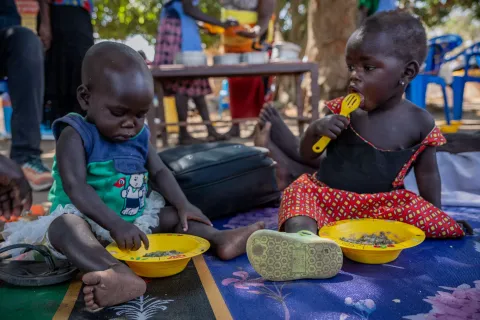
Isingiro District hosts refugees from Democratic Republic of Congo, Somalia, Rwanda, and South Sudan. UNICEF nutrition interventions in Isingiro, Kamwenge, Kikuube and Kyegegwa districts, funded by the UK Government target children under 5 in the refugee settlements and host communities.
According to Alex Mokori, UNICEF’s Nutrition Specialist, the nutrition programmes in Southwestern Uganda are aimed at preventing child wasting and other forms of malnutrition, increasing coverage of treatment services for children with severe acute malnutrition.

Some of the work undertaken under the UNICEF-UK partnership include:
- Supporting planning, implementation, coordination and monitoring of interventions including family led mid upper arm circumference (MUAC) through village health teams for screening and community treatment of Severe Acute Malnutrition (SAM) among young children
- Technical and financial support for last mile delivery of nutrition supplies through the National Medical Stores to regional referral hospitals and the health facilities in the four target refugee host districts
- Technical and financial support for on job capacity building of treatment of services for Integrated Management of Acute Malnutrition (IMAM).
- Support scale up of the integration of community nutrition actions that address stunting reduction in the four districts.
- Strengthening Infant and Young child feeding services at health facility levels on job coaching, mentoring and support supervision
- Strengthening micro-nutrient supplementation of Vitamin A supplementation and Iron and Folic Acid among children, adolescents, and women of reproductive age.
- Technical and financial support to district nutrition coordination committees to strengthen partner coordination for better emergency response in the four districts.
Dalton Babukiika, Senior Nutritionist Mbarara Regional Referral Hospital revealed that other causes of malnutrition in the region are attributed to alcohol consumption, selling of foods and vegetables, inadequate knowledge on how to prepare nutritious foods.
“Some families prefer to prepare quick meals. We have also had challenges with climate change which has affected our agriculture. The seasons have changed which has compromised the harvests,” he added.
Babukiika noted that increased education, food preparation demonstrations, community outreaches, rolling out of the family led MUAC approach, continuous assessment of children for malnutrition through the VHT systems and integration of nutrition programming into other sectors have greatly contributed to the reduction of malnutrition cases. Also, communities are more knowledgeable and can easily detect children who are malnourished, hence increased reporting and timely actions including referrals.
According to the Ministry of Health District Information System 2, the new monthly admissions of severe acute malnutrition cases in Isingiro District in 2024 are as follows: January 141, February 106, March 107, April 134, May 152, June 90, July 114, August 107, September 192, October 289. The average cure rate of the admitted children between January – November 2024 is 84 per cent.