The weight of two
In Karamoja’s Kaabong District, a mother of twins finds hope through a network of community volunteers, referral systems, and life-saving nutrition support.

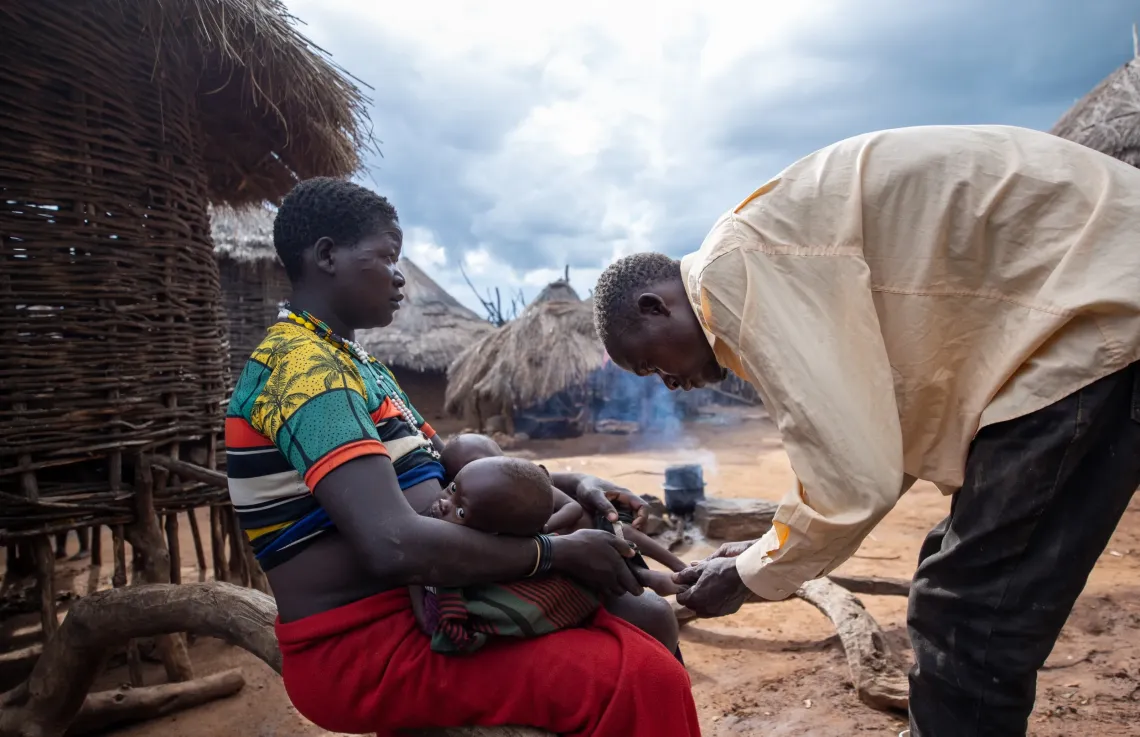
Lokol Regina, a mother of three including twins, did not know the name for what was happening to her children. Her twins, both just over a year old, were not growing the way they should. Their arms were thin. Their faces looked different. They cried more often. And every day, she worried. Already struggling to find enough food for herself and her three children in Leterwa village, Longar Parish, she felt her own body failing them too.
"I felt so bad with what I was told after my children were screened," she says, sitting outside her home in Sidok Sub-county, Kaabong District. "I was struggling to get food. I wasn't feeding them and myself sufficiently. My breast milk reduced."
For many families in Karamoja, hunger is not an occasional hardship. It is a constant worry.
The region faces repeated cycles of drought, poor harvests, crop destruction by wildlife, disease outbreaks and chronic poverty. In Kaabong, where Regina lives, even a single failed harvest can push a family deeper into crisis.
As food became scarcer, Regina watched her children become weaker.
"Right from the time I had these children, I have been praying to God because he gave them to me. I am still sad because they are still unwell. But ever since they started on RUTF (Ready-to-Use Therapeutic Food), they have improved."
For Regina, that improvement began with a knock on her door.
Caught early before it was too late
Kaabong sits in one of Uganda's most food-insecure landscapes. Acute food insecurity is chronic here, shaped by erratic rainfall, crop destruction from wildlife, and a malaria prevalence of 90 per cent. In such an environment, malnutrition among children under five is not an exception. It is a recurring emergency.
The situation is the same across Karamoja's neighbouring districts. In Kotido, health facilities are managing caseloads that mirror Kaabong's: children arriving with multiple illnesses, mothers stretched beyond what their bodies can give, and communities where the distance to any health service is itself a barrier to survival.
What makes the difference for children like Regina's twins is whether they are found in time.
Lochu Gabriel Orinya is 28 and has been a Village Health Team (VHT) member long enough to recognise the signs before a family does. During household visits, he knows what to look for: swelling of the feet and face, swollen abdomens, changes in hair colour, skin that has lost its texture, and other signs that may indicate acute malnutrition.
"The mothers sometimes have no breast milk," he explains. "Food supplies at home are limited, and during the wet season, children are not adequately breastfed and cared for because mothers spend most of their time at the farm."
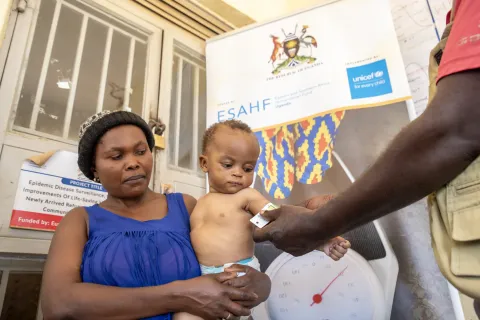
When Gabriel finds a child he is concerned about, he brings out his MUAC tape, the simple colour-coded band that measures mid-upper arm circumference and can identify malnutrition in minutes. If the reading falls in the red or yellow zone, or if other signs of malnutrition are present, he refers the child to the health facility and counsels the mother on feeding.
It was through this community screening that Regina's twins were identified. Every two weeks, VHTs like Gabriel move through households in Longar Parish, screening children, recording findings, counselling caregivers and referring those in need of treatment. For Regina, that visit became a turning point.
A system built for the continuum
The journey from a village home to treatment may seem simple, but in Karamoja it can mean the difference between life and death.
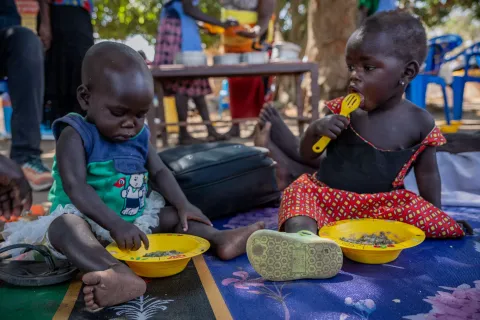
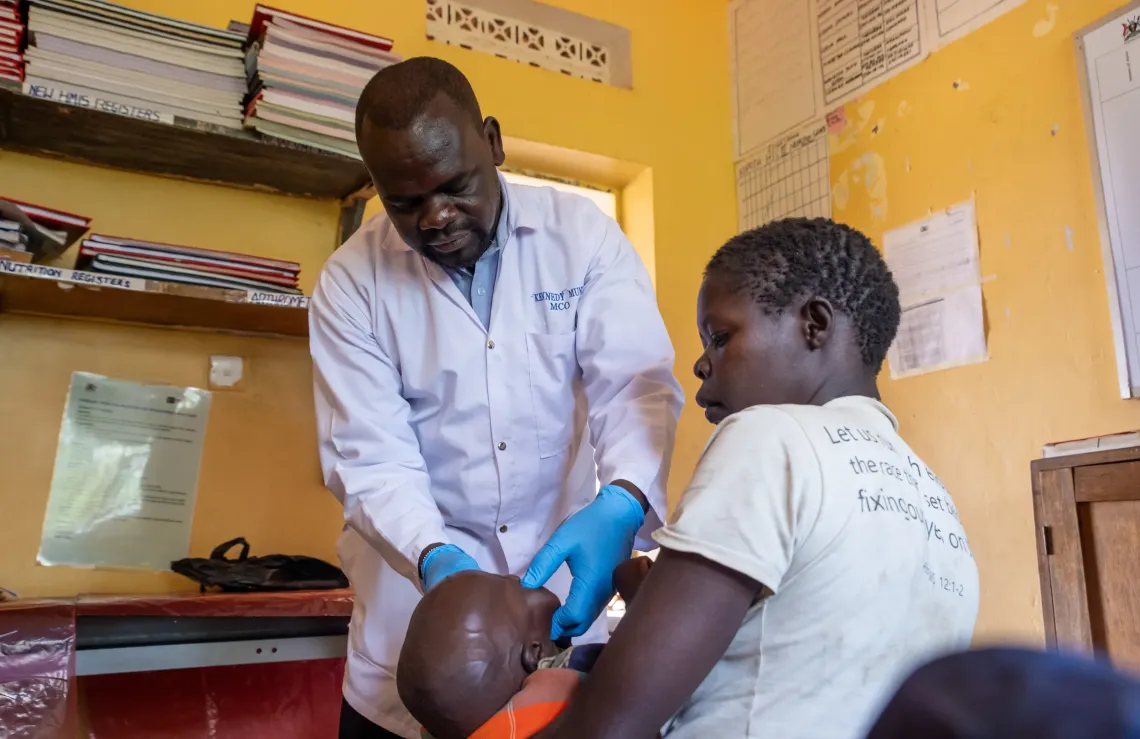
At the Outpatient Therapeutic Care (OTC) unit at Kopoth Health Centre III, where Regina's twins are enrolled, the children receive RUTF every Friday supplied by UNICEF. RUTF, a high-calorie, nutrient-dense paste, is the foundation of Severe Acute Malnutrition (SAM) treatment for children without medical complications. It can be given at home, so Regina does not have to choose between keeping her children in treatment and keeping her household running.
The treatment Regina's twins receive is part of a wider humanitarian response across Karamoja. Funded through the Uganda Humanitarian Fund managed by OCHA. UNICEF is screening approximately 90,000 children under five and treating 15,500 cases of severe acute malnutrition in Kaabong, Kotido and Moroto districts. The World Food Programme (WFP) is treating a further 23,000 children with moderate acute malnutrition and providing nutrition assistance to 8,000 pregnant and breastfeeding women. Between March 2026 and February 2027, an estimated 122,000 children aged 6 to 59 months across Karamoja are expected to require treatment for acute malnutrition.
"At the back of every screening and every carton of therapeutic food is a child whose future depends on receiving care at the right time," says Zacharia Fusheini, Chief of Nutrition at UNICEF Uganda. "Our focus is not only on treating severe acute malnutrition but also on finding children early through community screening, strengthening referral systems, and ensuring that no child is denied treatment because supplies are unavailable or services are too far away."
The response focuses on the districts where malnutrition rates remain most alarming and where shortages of therapeutic foods, food insecurity and limited access to health services continue to place children at risk. To prevent interruptions in treatment during the lean season, UNICEF and WFP are pre-positioning therapeutic and supplementary nutrition supplies at health facilities and community distribution points across the region.
Not every malnourished child in Kaabong has severe acute malnutrition. Many have Moderate Acute Malnutrition (MAM), and the response is designed to support them as well. While children with SAM receive RUTF supplied by UNICEF at OTC centres, those with MAM receive Ready-to-Use Supplementary Food (RUSF) supplied by WFP. Together, these services create a continuum of care: children identified through community screening are matched to the right treatment based on the severity of their condition and continue receiving support as they recover. This helps families access lifesaving care before malnutrition becomes deadly.

The referral pathway is the connective tissue. The VHT screens. The health facility confirms. The OTC or supplementary feeding site treats. The VHT follows up. The design is deliberate, and when it works, it catches children before their condition becomes life-threatening.
"Most children come with multiple conditions," Dr Kenneth Munu, the health facility in-charge, explains. "And more children are becoming malnourished in Kaabong partly because many of the mothers themselves are malnourished. The cycle is interconnected."
Still praying, but no longer alone
Lokol Regina collects RUTF for her children every Friday. She makes the trip, week after week, because she has seen what consistency does. Her children are gaining weight. Their faces are changing again, this time in the right direction.
She still describes herself as sad. Her food situation has not resolved. The elephants have not stopped destroying her crops. And the broader conditions that made her twins vulnerable, the food insecurity, the distance and the isolation, still remain.
But something important has changed. She no longer feels alone. A VHT identified her children. A referral system connected them to care. Health workers welcomed them. And a response built on community screening, health facility treatment and consistent supplies is giving two small children, twins in a village in Kaabong, a fighting chance at something that should be ordinary: growing up. Today, Regina continues to pray for her children.
Regina is finally hopeful and less worries.