The teacher is the centre of reform
“Fund the teachers, the teacher is at the centre of three key aspects of education. The curriculum and its intention, the teacher and the teaching, the learner and the learning.”

If you are a parent or guardian who worries constantly about your children's education, without access to the rooms where decisions and discussions about their future are made, you may be encouraged to know that there are many people in the education sector who are just as concerned, and perhaps even more dedicated, spending countless hours thinking about how to make things better.
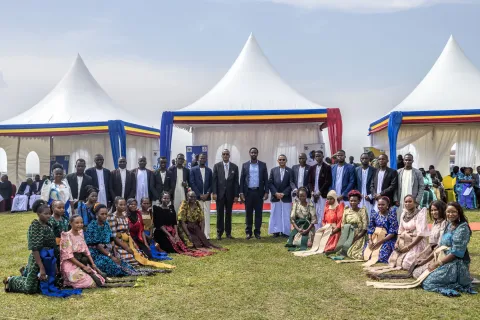
For two days in Munyonyo, Kampala, critical and recognisable faces sat keenly listening to speakers, challenging, questioning and discussing the state of education in Uganda. The room, designed to host more than 400 people, brought together education leaders, curriculum specialists, researchers and development partners debating competence-based learning, employability, character formation, artificial intelligence, the future of work and more. But beneath the diversity of topics, one figure kept reappearing at the centre of every conversation: the teacher.
It was perhaps the most important insight to emerge from the 2nd International Conference on Curriculum Development. While discussions ranged across continents and disciplines, speakers repeatedly returned to the same conclusion: Uganda's education reforms will ultimately succeed or fail in the classroom. Now, that may sound obvious. Yet much of the conversation suggested that education systems often behave as though change happens elsewhere.
Professor Benson Banda from Zambia, the first keynote speaker, a pioneer and implementer of Science, Technology, Engineering and Mathematics (STEM) [EA1] Education knowledge Co-Creation in Africa, challenged delegates to reconsider where real transformation takes place. Curriculum developers design, policymakers direct, assessors evaluate, but teachers sit at the intersection of all three. They are expected to understand the curriculum, interpret assessment standards and translate both into meaningful learning experiences for children. Yet paradoxically, they often receive the least attention in reform efforts.
“Fund the teachers!” he says. “The teacher is at the centre of three key aspects of education. The curriculum and its intention, the teacher and the teaching, the learner and the learning.”

His observation touched a nerve exposing a recurring weakness in education reform across Africa. We know how many students pass examinations. We know how many schools exist. We know what policies have been adopted. But we know far less about what is happening in classrooms. As Banda observed, teaching and learning often remain a "black box". Education systems measure outcomes but rarely understand the daily interactions that produce them.
That gap between policy and practice resurfaced throughout the conference. Uganda's competence-based curriculum was frequently celebrated as a major step away from routine learning and towards critical thinking, collaboration, creativity and problem-solving. Yet the question lingering beneath many presentations was whether systems have invested as much in teachers as they have in reform itself. The general feeling was that with keeping things as they are, we risk having teachers unintentionally fail the very learners they are meant to support.
“You don’t fully know what you want to teach but you are forcing yourself to go to class. Is this morally, right?”
Banda's concern that only a small proportion of teachers have received adequate preparation for some aspects of competence-based assessment was not simply a statistic. It was a warning. Reform is ultimately experienced not in boardrooms or conference halls but by teachers standing before learners every day. As he put it, if the teacher is the patient, they need to go to the intensive care unit, receive treatment and then come back and be useful to the learner.
“I was at a primary school and the teachers said they did not have materials to support the curriculum. The topic was about colour and I told them to look outside, where the environment is full of different colours, red flowers, green leaves, etc, why would we buy chats to show the colours?”
Uganda, like many other African countries, is facing a learning crisis. Learning poverty, the share of children unable to read and understand an age-appropriate text by age 10, is estimated by the World Bank, UNESCO and other organisations at 83 per cent. Quoting this information, the UNICEF Country Representative, Dr Robin Nandy, expanded the argument in an interesting way. While supporting innovation and curriculum renewal, he cautioned against designing education systems for children without listening to either the children themselves or the teachers who work with them. Education, he argued, must remain anchored in what Uganda's children will need twenty years from now. That future cannot be designed entirely from the top down.
His remarks echoed a deeper question that lingered throughout the conference: Are reforms being implemented with teachers, or simply handed to them?

“Do these examinations test students recall or understanding or comprehension? The so-called soft skills, we should stop calling them soft skills because analytical thinking and the ability to collaborate, Ubuntu as mentioned by Professor Banda, are very critical to succeeding in the workplace. Digitalisation, artificial intelligence and so on need to come in, but they need to be approached in a way that does not do harm and instead benefits children. This requires a collaborative approach and whatever we do should narrow inequities rather than deepen them moving forward.”
That question became even more compelling when viewed against one of the conference's most refreshing moments. While experts debated frameworks and theories, students from St Aloysious Girls SSS Masaka offered something different. Through music and poetry, they demonstrated what the reformed curriculum looks like when experienced by learners themselves. Their message celebrated a more practical, innovative and competence-based approach to education. Learning, they suggested, is increasingly about creating, doing and solving rather than memorising and repeating.
“Teachers are not teaching parrots anymore!”
In a way, the students accomplished in a few minutes what education policy documents struggle to do in hundreds of pages. They humanised reform. More importantly, they revealed a new expectation of teachers. The teacher is no longer simply a transmitter of information. The teacher has become a facilitator, mentor and guide. And that idea emerged even more forcefully during Dr Tony Devine's keynote on education in the age of artificial intelligence. Dr Devine is the Vice President, Education at the Global Peace Foundation. His argument was intentionally provocative. For centuries, schools have treated knowledge as the most valuable educational currency because access to knowledge was limited. Teachers possessed information that learners needed. But artificial intelligence is rapidly changing that equation. Knowledge is no longer scarce. Character, judgement and wisdom are becoming more valuable.
“The ground has moved. What you know is no longer enough.”
Whether one fully accepts that proposition or not, it forces an important reflection. If information is increasingly available everywhere, what becomes the unique value of a teacher? Devine's answer was that teachers must become guides for human development rather than merely distributors of knowledge. Their role shifts from helping learners remember information to helping them become the kind of people who can use information responsibly and creatively.

“We are being called to discuss the shift from knowledge to applying wisdom. Artificial Intelligence is a few years old and has accelerated the move from storing information in our brains to applying judgment in using it to do useful things. Creativity and Judgment, you cannot fake that; this is a skill that you have to hold over time.”
Dr Hamis Mugendawala, a discussant, and Senior Manager, Population and Social Development Planning at the National Planning Authority built on this idea while introducing an important caution. Uganda, he argued, should not create a false choice between competence and character. The country needs both. A learner with impeccable character but no competence cannot transform society. Equally, competence without integrity creates a different danger: highly skilled individuals who use their abilities without ethical responsibility. His intervention elevated the discussion beyond curriculum design and into the realm of teacher identity.
If schools are expected to nurture character, creativity, collaboration and leadership, what kind of teachers are required to model those qualities?
Mugendawala's response was straightforward but challenging. Education transformation begins with educator transformation. Teachers cannot cultivate qualities they themselves do not possess. Professional development, therefore, cannot only focus on content delivery. It must also focus on ethics, leadership, mentorship and continuous growth.
By the time the conference shifted to the panel on bridging the gap between education and the world of work, the connection had become clear.
Employers complained about graduates who struggle to solve problems. Industry representatives questioned whether learners are sufficiently adaptable. Panellists worried about graduates prepared for examinations but not necessarily ready for uncertainty, innovation or changing labour markets.
Even here, the discussion kept returning to the classroom.
The challenge, it seems, is not simply whether Uganda has the right curriculum. The deeper question is whether teachers are sufficiently supported to turn the ambitions of the curriculum into reality. In that sense, the conference produced a subtle but meaningful shift in emphasis. The conversation moved away from asking whether Uganda has adopted the right education reforms and towards asking whether it is investing enough in the people expected to deliver them.
For a fly on the wall in this room of great minds, the collective lesson from the conference, it seems, was that curriculum reform is not ultimately a technical project. It is a human one. Technology will evolve, labour markets will change, new policies will emerge, but the enduring relationship at the heart of education remains the one between teacher and learner. And as many speakers reminded delegates, no education system rises above the capacity, commitment and character of its teachers.