Learning between the blackouts
In Uganda’s semi-connected schools, where electricity and internet are unreliable, learners and teachers are struggling to work around the gaps, and the Leaders in Teaching Program is seeking to close them.

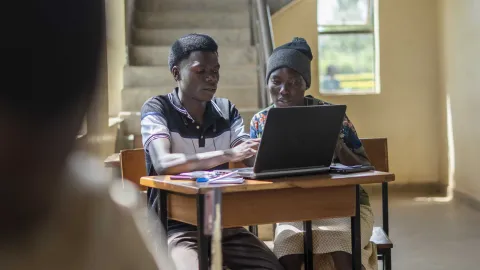
Ten minutes into a Senior Four information and communication technology (ICT) lesson at Alemere Comprehensive Secondary School, the generator hums to a standstill. One by one, the computer screens go blank.
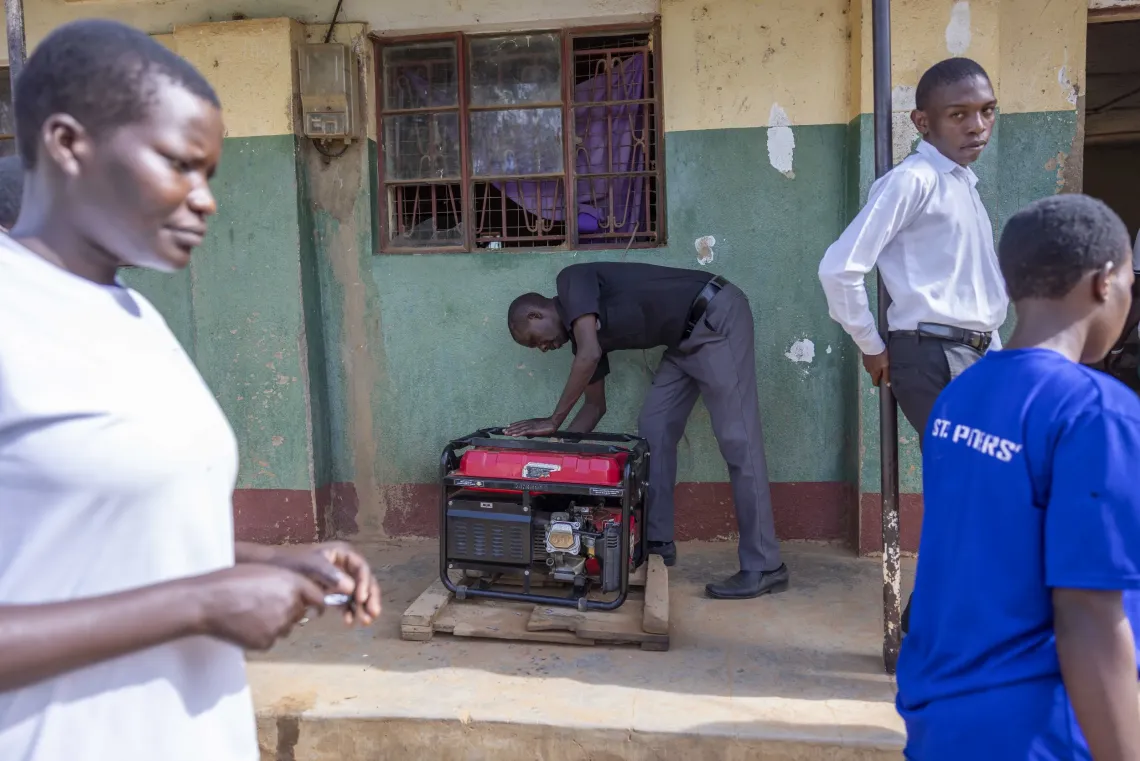
The learners pull the plugs from the sockets, settle back on the long bar stools and start chatting. There is nothing else to do. It is September 2026, and the school in Amolatar District is on the second day of a blackout, a common occurrence in the rainy season. Some solar batteries are no longer working; the rest have run out, and now the generator has developed a mechanical fault. The ICT room slowly empties.
Alemere is a mixed, church-founded school with about 650 learners. Like 41 per cent of Uganda’s secondary schools, it is ‘semi-connected’, according to a 2026 UNICEF assessment. It has electricity and some internet access, but frequent power and network disruptions make it hard for teachers and learners to use technology consistently.
As we walk from the head teacher’s office towards the ICT room, the network on my phone drops from four bars to one, then to nothing. “Our internet only works in certain places, and better on one telecommunications network,” says ICT teacher Susan Akao. The school keeps one router strictly for lessons.
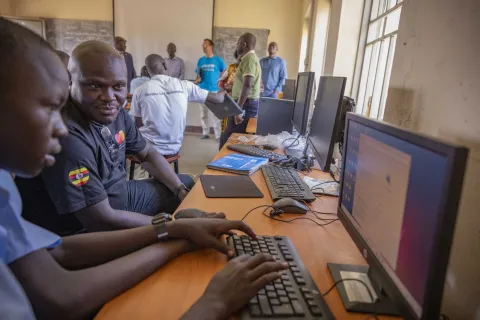
Susan has taught ICT at Alemere for 12 years. She is one of two ICT teachers, both paid by parents rather than through the government payroll. Together, they manage 10 desktop computers for 650 learners, or one computer for every 65 learners. The Ministry of Education and Sports’ Basic Requirements and Minimum Standards recommend one for every five.
“We have many students who are willing but not able to lay hands on a computer, so practical classes are really hard,” Susan says. “We study in shifts.”
For Susan, ICT is more than a single subject. “It affects performance in every subject,” she says.
Using ICT to improve education quality is a key goal of the Leaders in Teaching Program, a flagship initiative of the Mastercard Foundation. Co-led by UNICEF and the Luigi Giussani Foundation, with strategic oversight from the Ministry of Education and Sports, the program is implemented through a consortium of 10 partner organizations working across four pillars: teacher recruitment, effective school leadership, teacher motivation and teacher training.
Teacher Susan has enrolled in a bachelor’s degree in computer education to become a professionally qualified ICT teacher. She has a dream for her school too. Within five years and with support from the Leaders in Teaching Program, she hopes Alemere will become the first ICT innovation hub in Amolatar District.
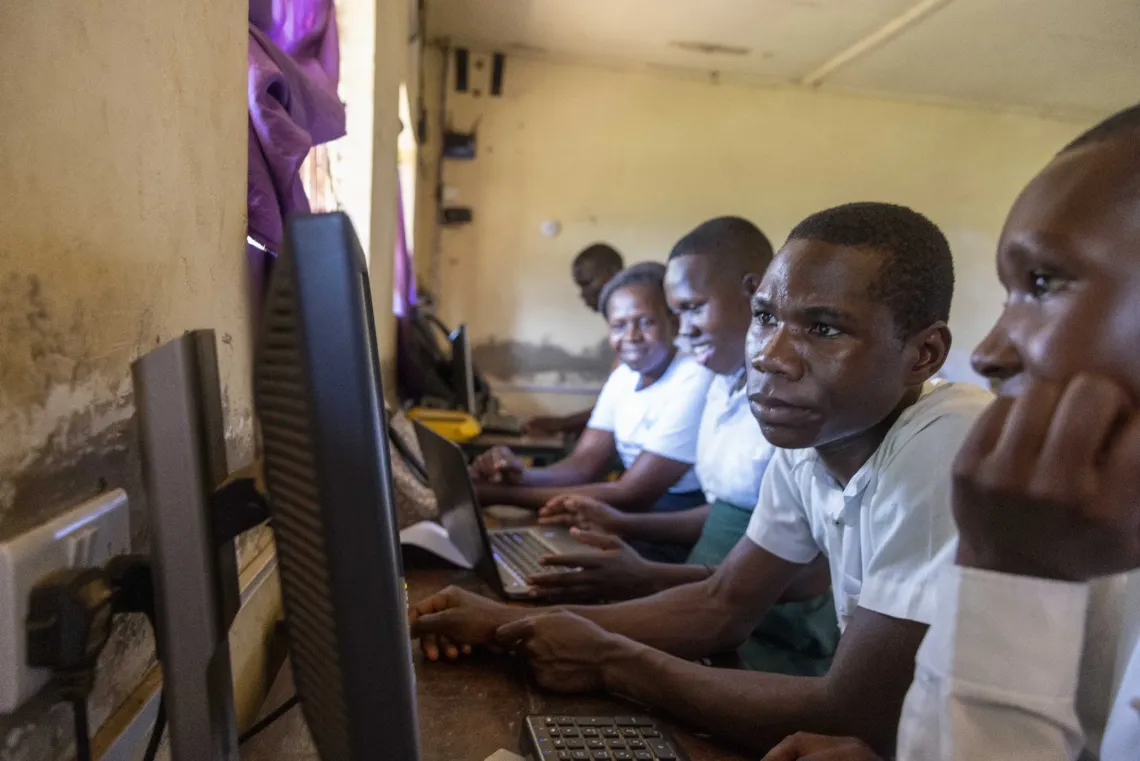
More than 200 kilometres away, Paicho Secondary School in Gulu District holds a similar hope. A few months ago, a rainstorm blew off the roof and destroyed 11 computers, leaving only six to serve 398 learners. Fifteen workstations in the ICT lab stand empty, while the damaged machines sit under a cabinet near the entrance. ICT student and head boy Isaac Madu, 20, notes that some learners stand around the working computers for an entire 80-minute lesson. “If we don’t get the chance to touch a computer, then what will we practice?” he asks.
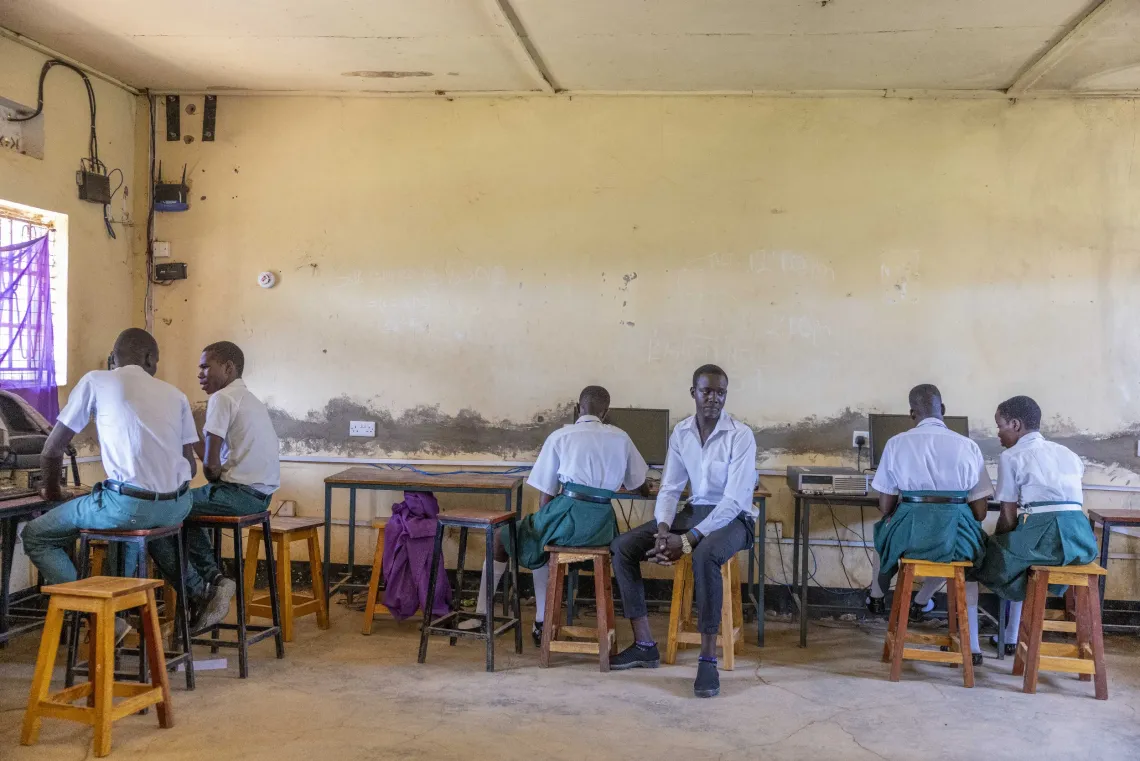
The lab also doubles as a classroom. While Senior Six learners file into the lab, Senior Five learners take their geography lesson under a tree. Some learners have dropped ICT as an elective subject because of the computer shortage, but the aspiring movie director Isaac has stuck with it. “ICT is the only way to live life,” he explains. “There is no other way.”
Abubaker Bbuye, Principal Education Officer at the Ministry of Education and Sports, agrees. “ICT and education are inseparable,” he says. “In a globally competitive environment, we need the right skills to compete.”
Preparing learners for an increasingly digital labour market is another critical component of the Leaders in Teaching Program, which also seeks to strengthen ICT infrastructure and digital learning in 2,091 secondary schools, 10 universities and five teacher training institutes in Uganda. The UNICEF assessment found that semi-connected schools such as Alemere and Paicho are the largest group and hold the greatest potential for rapid progress with targeted support. Through the partnership, UNICEF will set up well-equipped computer labs in 100 schools and universities that can become centres of excellence for training others.
According to Tillmann Guenther, Adolescent Development Manager at UNICEF Uganda, the new competency-based curriculum expects learners to research on their own, mostly online, making ICT essential. “The students are ready,” he says. “Now we need to make sure that the system works.”