Plugging the unplugged
At Pagirinya Secondary School in Adjumani, learners are making ICT work with very little. The Leaders in Teaching Program wants to help them do much more.

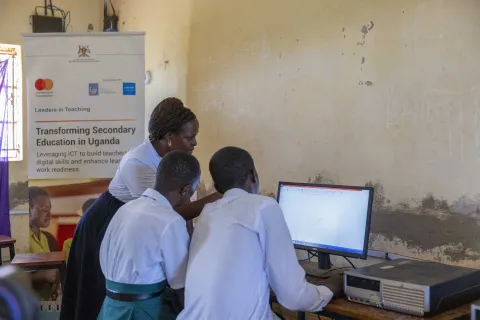
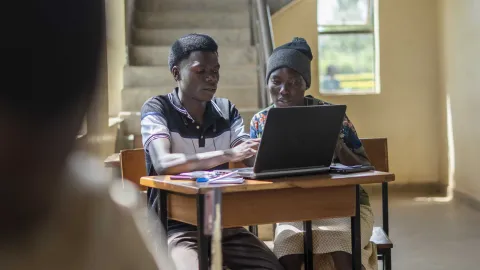
A pile of shoes lies at the entrance to the computer room at Pagirinya Secondary School, Dzaipi Sub County, Adjumani District. Inside, their owners sit barefoot, notebooks open, crowded around a few computers spread across the room.
The shoes stay outside on the teacher’s orders, to minimize dust in the room. Dust is the enemy of a computer, and in this school, every computer counts. When lessons end, the laptops go into a metal storage box for safekeeping.
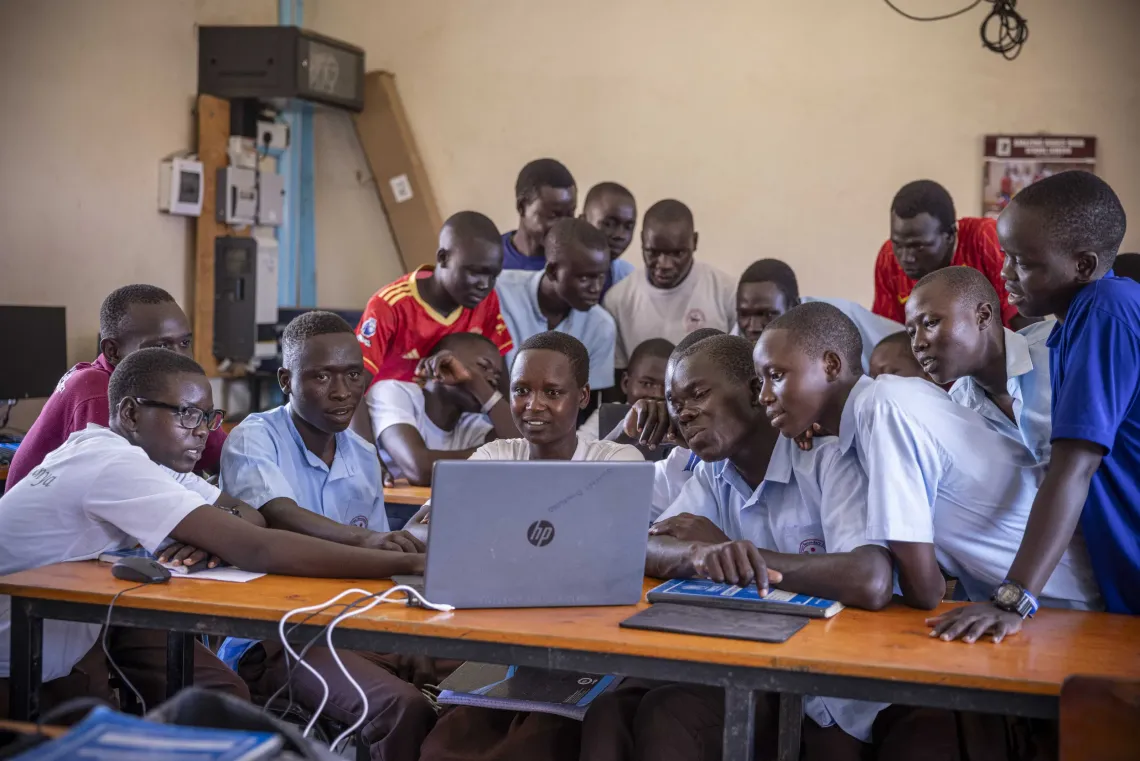
Pagirinya serves 1,684 learners. They include refugees, nationals from surrounding districts, child mothers, children with disabilities and young people catching up through the Accelerated Education Programme. All of them rely on 11 computers. That is about 150 learners for every computer.
A recent UNICEF assessment of 3,257 secondary schools in Uganda found that 39 per cent are ‘unplugged’. They have no internet, often operate on less than five hours of electricity a day, and have a median of 50 learners sharing a single device. Most are rural, and many are in northern and eastern Uganda. Pagirinya’s ratio is three times that median.
With classrooms in short supply, the computer room doubles as a classroom, so learners can only use the computers during their information and communication technology (ICT) lessons. Each lesson lasts 80 minutes. “We study in shifts,” one learner says, “if there is electricity.”
On the chalkboard are notes from the class: ‘What is a hard disk?’; ‘What are the parts of a computer?’; ‘What are applications like Word and Excel used for?’ The learners scribble notes in their books, taking occasional glances at the computer before them.
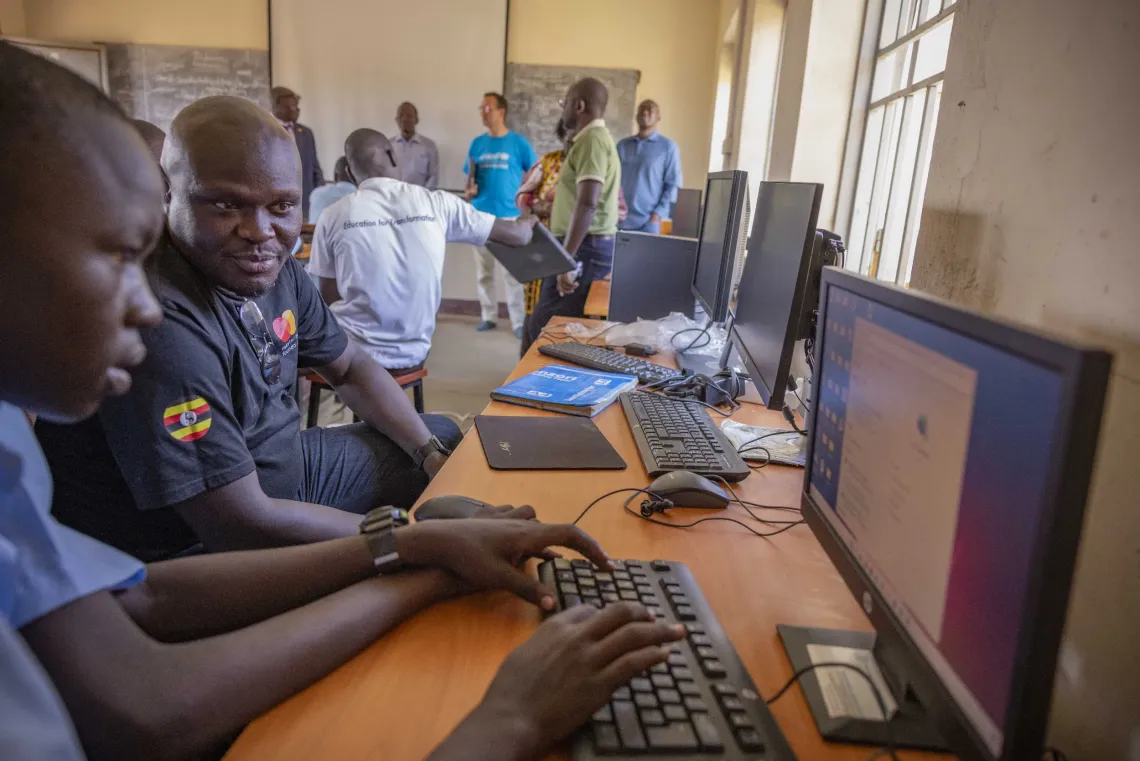
“It would be good for each learner to at least spend some time practicing on a computer, but we only have a few, so our classes are mostly theoretical,” Jonathan Anyanzo, the ICT teacher, says.
When the bell rings to signal the start of another shift, Senior Four learners stream in for their ICT class. About 10 of them crowd around one laptop. Among them is Eunice Alaro*, 17, from the neighbouring Amuru District. She explains why she chose to continue studying ICT when she could have dropped it in the lower classes. “This has become a world of technology; you need ICT for everything.”
The school plans to run the upcoming national ICT examinations for Senior Four and Senior Six in two shifts, for the 54 registered candidates. Their ICT teacher, Jonathan, hopes there will be power on that day, and that the school’s only printer will work.
Jonathan is living proof of what ICT skills can do. Though he earns a monthly salary, after school hours he repairs computers and designs custom software for business owners in Adjumani town, earning an extra income. After completing his secondary education, Jonathan pursued a certificate course in computer science, then a diploma, and is now completing a bachelor’s degree in information technology. “I want to show the students that they too can earn a living from the skills they acquire.”
The school administration and parents share the same ambition. Through the Parents Teachers Association and the Board of Governors, they often chip in.
At a meeting with the school leadership, we scribble in our notebooks as the head teacher explains the school’s struggles and its determination to ensure the children keep learning. James Gama, the Vice Chairperson of the Board of Governors and Chairperson of the refugee community in Adjumani, explains why the parents decided to hire an ICT officer and purchase six computers for the school.
“Today, a computer is like a pen,” he says. “Learning is hard without one.”
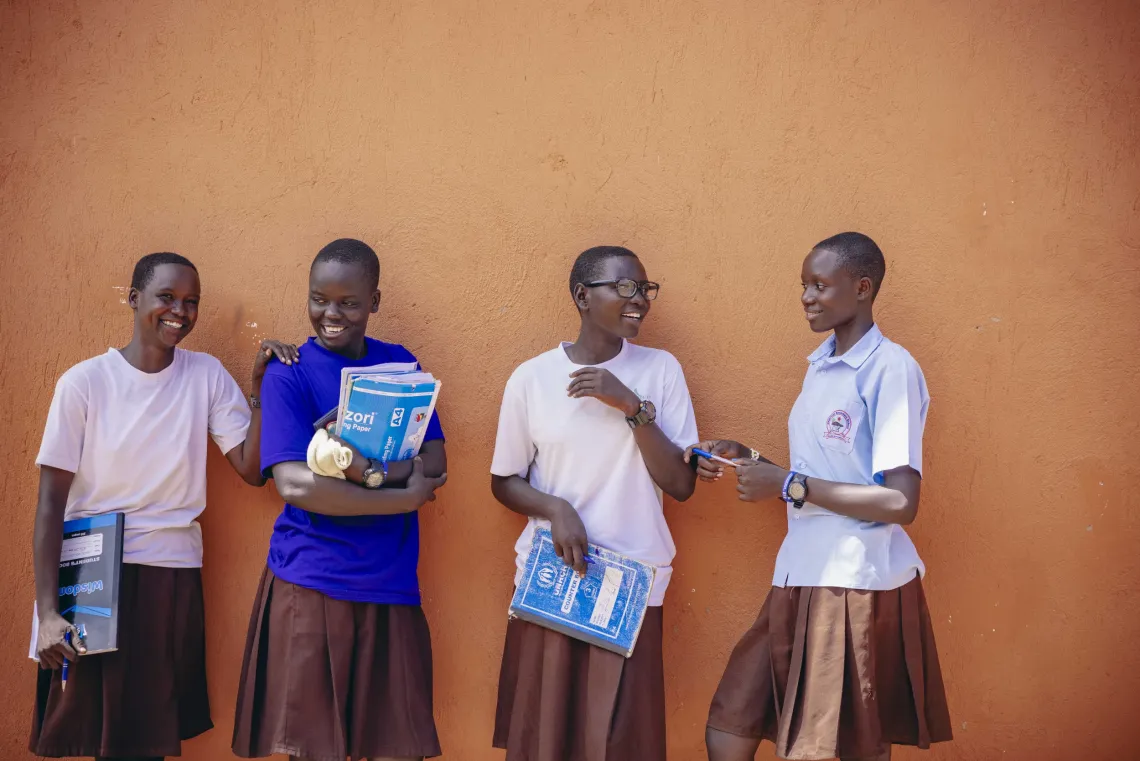
Later, in the computer room, my pen runs out of ink. Senior Four learner, Alaro, stops her revision and holds out her pen. “You can have mine,” she says, so I can keep my interviews going.
Pagirinya is one of 2,091 secondary schools in the Mastercard Foundation Leaders in Teaching Program, which aims to transform secondary education in Uganda. Co-led by UNICEF and the Luigi Giussani Foundation, with strategic oversight from the Ministry of Education and Sports, the flagship program is implemented through a consortium of 10 partner organizations working across four pillars: teacher recruitment, effective school leadership, teacher motivation and teacher training.
UNICEF leads the program’s ICT agenda, strengthening infrastructure, teacher professional development, and digital learning. The goal is to enable teachers and school leaders to use technology to improve learning and help young people gain skills for dignified, fulfilling work. After a technical assessment, Pagirinya will receive a fully equipped ICT lab with at least 10 more computers and support equipment, enabling more learners to use ICT in the classroom and later on in life.
As I leave the computer room, I return the borrowed pen to Alaro and stoop to put my shoes back on. Behind me, the students return to the screens, sharing what little time they have so every learner gets a turn to at least touch the keyboard.