No child left behind starts with seeing the individual child
"A child who learns calculus to build a bridge for the village has learned more."

There is a young girl in my care. On paper, she is doing well. Her report cards suggest she is learning, not as well as I would like, but the report cards show progress. Her teachers appear to have worked hard to ensure she progresses from one class to the next. But at home, I am faced with another reality. The way she speaks, her comprehension, her ability to explain what she has learned often leave me wondering whether she is truly learning or merely being moved through the system.
It is a question many parents quietly ask, I think.
At the end of the two-day International Conference on Curriculum Development in Munyonyo, I shared my concern with Esther Akwii, an Education Specialist with UNICEF responsible for quality education, foundational learning and inclusion. The issue, she said, may not be whether the child belongs in school or even whether she is progressing. The real question is whether the system has taken time to discover where her strengths lie and how she learns best.
"Every child learns differently," Akwii explained. “Some children may struggle with traditional academic concepts but excel in sports, arts, crafts, leadership or other areas that schools often fail to value equally. "If a child is not thriving, she argued, educators must ask not only what the child cannot do or why, but what the child can do and how that strength can become a pathway for learning.”
It was a fitting reflection after two days in a room listening to conversations about our curriculum, Primary Leaving Examinations, character formation and the future of work. The privilege of being in rooms like that is that you are forced to reflect on your own education and the education your children are receiving. How do we build an education system that truly sees every child, my child?
For UNICEF, that question sits at the heart of inclusion.

Not inclusion merely as access to school. Not inclusion merely as disability programming. But inclusion as a commitment to ensure that every child, regardless of ability, background, circumstance or learning style, is given an opportunity to thrive. The conference underscored important issues facing the education sector while pointing to emerging opportunities. On one side stands the familiar system, heavily shaped by examinations, grades and competition. On the other stands an emerging vision of education that focuses on competencies, character, creativity, purpose and the unique potential of every learner. Are we ready to transition? Should we transition? Can Uganda successfully make that transition.
Professor Benson Banda, from Zambia, a pioneer and implementer of STEM Education knowledge Co-Creation in Africa whose keynote provoked some of the conference's deepest reflections, challenged delegates to rethink the purpose of education itself.
"A child who learns calculus to build a bridge for the village has learned more," he argued. "They have learnt who they are and what they are for." Education, in his view, cannot simply be about mastering content. It must help learners understand themselves, their communities and their role in solving real-world problems. “Where is Ubuntu in the curriculum?”
His concern was that many education systems continue producing what he described as learners who are "globally logical but locally irrelevant" and who can recite information but struggle to connect learning to the realities around them. He warned against producing graduates who can name the periodic table but cannot identify the plants growing in their own communities. It was an argument for relevance, but also for inclusion. When education values only a narrow set of abilities or knowledge, many children inevitably get left behind.
Dr. Mary Gorette Nakabugo, the Executive Director of Uwezo Uganda painted a sobering picture of what happens when examinations become the dominant force in education. Drawing on research and decades of scholarship, she argued that high-stakes examinations create what she called a "backwash effect", distorting what happens in classrooms. Teaching becomes focused on passing examinations rather than cultivating understanding, creativity, values and lifelong learning.
Citing work by scholar Jim Spire Ssentongo, she referred to the risk of producing "human parrots" through a system that rewards memorisation and repetition over genuine understanding. She noted that many children sit multiple examinations every term, often from an early age, creating immense pressure on schools, teachers and learners alike. Her warning was not simply about examinations; it was about what gets lost when examinations become the primary measure of success.

Prof. Proscovia Namubiru, the Deputy Vice Chancellor for Academic Affairs at the Uganda National Institute for Teacher Education expanded that argument. The distortions in the system, she observed, are not accidental. They shape what schools value, what teachers prioritise and what parents demand. Subjects not examined become marginalised. Character is spoken about but rarely assessed. Creativity is celebrated in theory but often sidelined in practice.
"Are we teaching for learning or are we teaching for selection?" she asked. "If learning happens for seven years, why should two days of examination determine our children's future?"
Those questions gave way for more questions.
Who succeeds in such a system?
Who gets overlooked?
Who determines what intelligence looks like?
Akwii's reflections offered one possible answer.
She described children whose strengths remain undiscovered because schools are often looking for only one type of success. Some learners may struggle academically not because they lack potential but because foundational gaps were never properly addressed. Others may be carrying challenges from home. Still others may simply require different approaches to learning. Yet the system often expects everyone to learn in exactly the same way at the same time. Impossible.
"The challenge for educationalists is to identify the strength of the learner," she said. "If a child doesn't perform well, it is not the child. It is actually the teacher who is failing to get the child to learn."
For Dr. Tony Devine, the Vice President, Education at the Global Peace Foundation, the age of artificial intelligence is forcing educators to ask different questions. Knowledge, he argued, is no longer enough. In a world where information is increasingly available at the touch of a button, the qualities that matter most are becoming character, integrity, adaptability, relationships and judgement. Employers are increasingly looking beyond qualifications towards people who can solve problems, collaborate effectively and demonstrate strong values.

Dr. Ruth Biyinzika Musoke, the Project Director, Private Sector Foundation, painted a picture of employers struggling with graduates who may possess academic qualifications but lack interpersonal skills, problem-solving abilities and adaptability. She spoke about weaknesses in career guidance, inadequate attention to early childhood development and an education system that too often reacts to change rather than preparing learners for future realities.
"The issue of problem-solving and critical thinking starts early," she argued. Employers, she noted, are increasingly looking for people who can relate to others, think creatively and navigate a rapidly changing world. “In this country, we are not prioritising Early Childhood Development, it does not have enough regulation. Now, you’re also finding parents and teachers switching on the television without guidance and children losing interpersonal skills.”
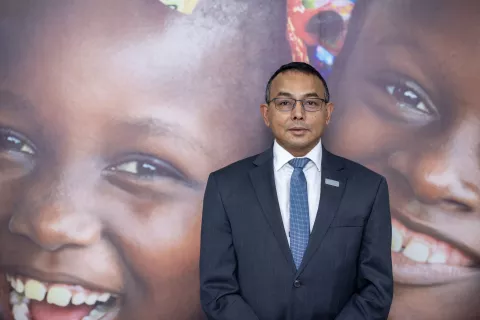
Uganda is young country, by population. As the UNICEF Country Representative Dr Robin Nandy reminded delegates, approximately half of Uganda's population is under 18 years of age, while the majority are under 30. The country's development ambitions depend on how successfully it equips these young people with the skills, values and competencies needed to thrive. Yet learning poverty remains high, with many children unable to read and comprehend age-appropriate text at expected levels.
For UNICEF, this is why curriculum matters so deeply. Akwii described UNICEF's role as working alongside government to provide technical support, strengthen partnerships and ensure that the important issues emerging from discussions like this conference do not end as conference resolutions but become part of actual reform. Particular attention is being paid to curriculum because curriculum touches every child in the education system. The priority for UNICEF remains clear. "No child left behind."
When you think about Inclusion, think larger than before. Yes, by all means, think about the child with a disability, but also consider a learner that’s struggling to read, a gifted athlete for whom classwork is a struggle, a child whose strengths have not yet been discovered, and a child who simply needs a different approach to learn or path to success. One size, as is commonly said, does not fit all. If the conversations in Munyonyo revealed anything, it is that the future of education cannot be built around sorting children into winners and losers. It must be built around helping every learner discover who they are, what they are capable of and how they can meaningfully contribute to society. Inclusion is not about moving every child forward at the same pace. It is about seeing every child clearly enough to help them move forward at all.