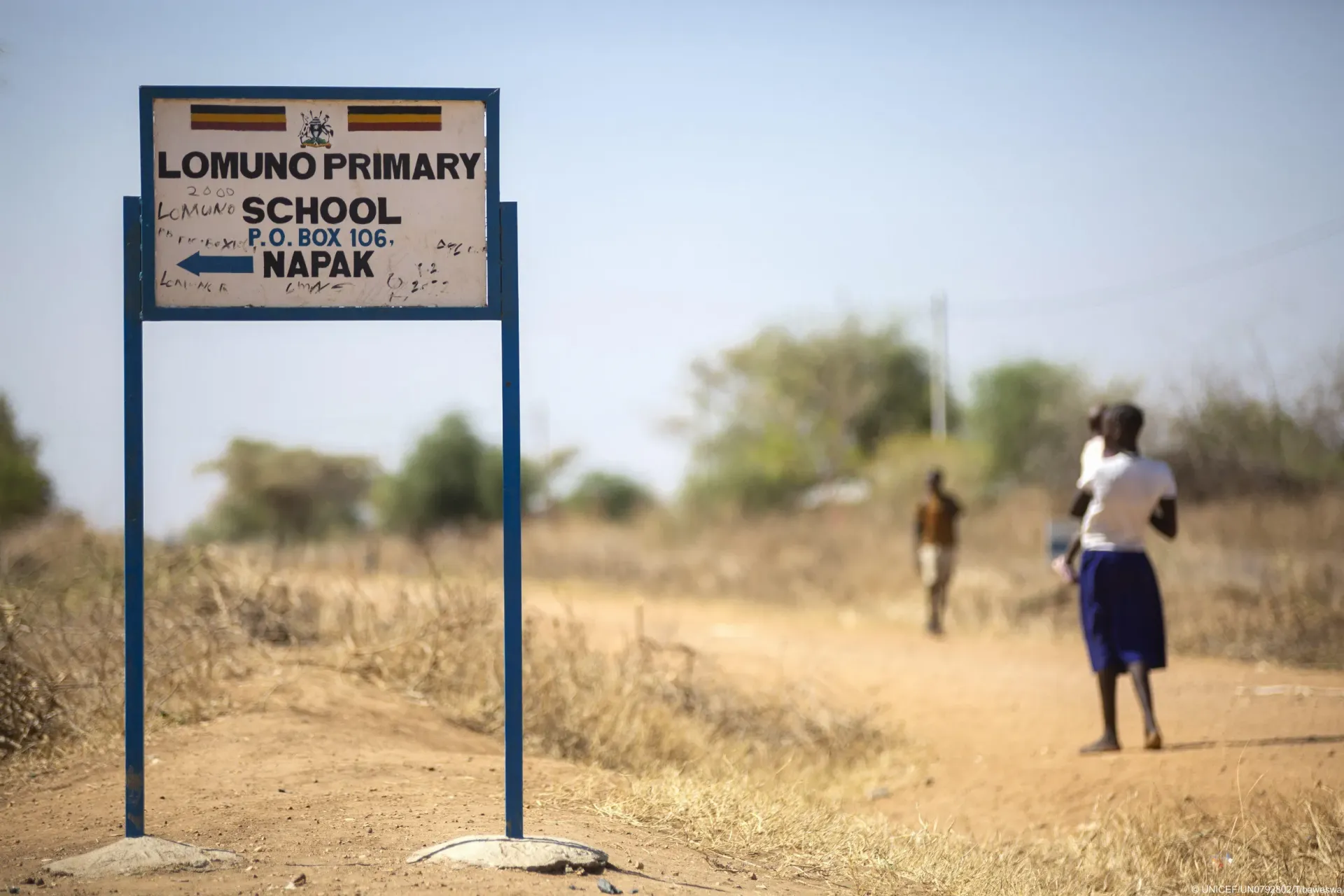
Napak starts paying its own way
With UNICEF’s support, Napak District is raising more of its own resources, and spending it on its children.
When the grants fall short
Most resources a Ugandan district spends on children come from central government grants, decided far from the boreholes, classrooms and health facilities where they are needed. When grants fall short, children's priorities feel it first. In Napak District, a broken borehole means a long walk for water, while a lack of sanitary pads can keep a girl out of school for a week.
Locally raised revenue is the money a council controls on its own. There is never much of it, but it comes with lesser conditions than a central grant, which is always conditional, so the district can steer it towards whatever is most urgent. For years Napak barely collected any. Tax was gathered by hand; the committees meant to oversee it had stopped meeting, the charging policy was out of date, and only a handful of revenue sources were ever touched. Money the district was owed simply went uncollected.
Finding where the money leaks
UNICEF and other partners could have covered the shortfall with a cheque but instead supported the district to go after the reason for the shortfall instead. Working with the Uganda Local Government Association (ULGA) and the Local Government Finance Commission (LGFC), UNICEF, with funding from the Government of Sweden, set out to help Napak collect and manage more of its own money and to keep doing so long after the project had closed.
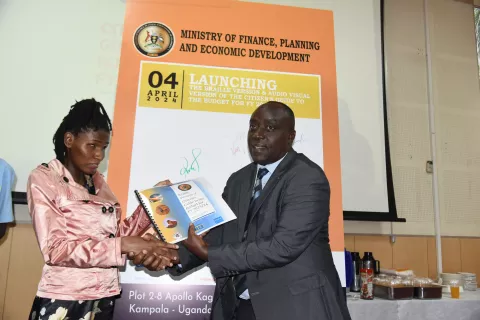
The work was not glamorous. Over two days, in October 2025, at Mt. Moroto Hotel, 38 of the district's leaders and officers, from the Chief Administrative Officer down to sub-county accountants, town clerks and parish staff, sat together to find out where the money was leaking and how to stop it.
The sessions were steered by the retired Chief Administrative Officer who had once taken Gulu District's yearly collection from 200 million Uganda shillings (UGX) (approx. USD $53,000) to a billion (approx. USD $266,000). He did not lecture. He talked about spending at source, under-declaration and the pressure elected leaders put on collectors, the ordinary things that bleed a district dry. UNICEF had already handed over the tools to match the lessons: point-of-sale machines, tablets and desktops to run the Integrated Revenue Administration System (IRAS), which logs every payment and makes it harder to divert.
By the end of the two days the district had a list of money it had been leaving on the table. Telecom masts it had never billed. Savings groups it had never registered. Fees on land sales, tourism sites and property rates are all going uncharged. There was a plan, too, to bring the idle revenue committees back to life, update the charging policy and set targets for every town council and sub-county.
Five months on
Five months later the difference showed up in the books. Writing to UNICEF in March 2026, Napak's Chief Administrative Officer, Abia Robert Owilli, reported a clear rise in local revenue between October 2025 and February 2026. Lotome Sub County, which had never collected a shilling from royalties, brought in 10 million UGX (USD $2,656) in three months, against a budget of 4 million UGX (USD $1,062).
The figure is the easy part to report. What sits behind it matters more. Money a district raises for itself is money it gets to decide on, and in Napak that decision is already being made.
"Napak is now collecting money it used to leave untouched and deciding for itself how to spend it. A district that can fund its own services keeps showing up for its children, long after any single project ends." Tawanda Chinembiri, Social Policy Manager, UNICEF.
Spent on its own children
The district leadership has set aside 5 million UGX (USD $1,328) for soap, pads and medical care for children who were brought back from the streets of Kampala in a collaboration between the Ministry of Gender, Labour and Social Development; KCCA; Napak District; and UNICEF and placed in the primary schools at Lodooi, Nakichelet, Lotome Girls and Lokodiokodio. The initial reintegration of the street children back to Napak was funded by the Spanish National Committee for UNICEF.
Many of them are girls whose parents are still in the city. Napak Town Council is planning to build an incinerator for the girls at Napak Seed School, again from local revenue.
These are small sums, but they are Napak's own, raised by the district and spent on its own children by people the community can hold to account.
Not the first place
Napak is not the first place UNICEF has supported this way. In Adjumani, Kyegegwa, Lamwo and Mubende the same approach has been running a little longer, and the pattern is already clear. Adjumani's own collections rose from about 419 million UGX (USD $111,000) in 2023/24 to around a billion (USD $266,000) the year after, a jump of some 143 per cent. Kyegegwa put an extra 20 million UGX (USD $5,311) of its own money towards primary school furniture, so fewer children have to share a desk, while Mubende used 6 million UGX (USD $1,593) to keep children with disabilities in class at Katente Primary School. Adjumani helped 20 vulnerable children reach secondary school, and Lamwo funded school sanitation, desks, sports and music, dance and drama. Every shilling was raised locally.
Those districts also learned that the machines were only half of it. IRAS tightened the books, but collections rose fastest where leaders stopped discouraging the tax and began explaining it, where targets and results were posted in public and where people could see the money turning into desks and latrines. Kyegegwa was the first to display its revenue figures openly and to report progress by WhatsApp, and other districts soon borrowed the habit. It is the same lesson Napak is now living: the system works when the leadership and the community move with it.
Leaning less on Kampala
The recommendations coming out of the workshop all pull the same way. Take the training to every lower local government. Send officers to learn from districts that already collect well. Keep using IRAS until openness becomes the habit. Reward the sub-counties that do best. Bit by bit, Napak leans a little less on what arrives from Kampala and a little more on what it can raise and account for at home.
"The progress made so far shows the importance of partnerships in building sustainable local government systems. In a region as stretched as Karamoja, this is what counts. A one-off gift is spent and gone, but a district that can raise its own money keeps choosing, year after year, to spend it on its children," Abia Robert Owilli notes.