“Can a child be poor?”
Ending Multidimensional child poverty through a multisectoral approach

“Can a child be poor?”
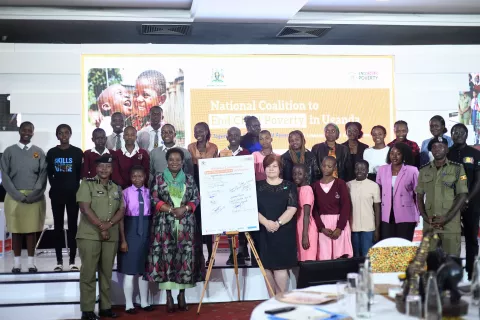
More than one person in the room posed this question at the start of a National Multisectoral Capacity Building Workshop on Eradication of Child Poverty in Uganda from 10-14 November 2025. Organised by the Ministry of Gender, Labour and Social Development, with support from UNICEF Uganda, the workshop convened 70 representatives from government Ministries, Departments and Agencies, UNICEF, the civil society, academia, think tanks, faith-based organizations and the private sector to discuss the nature and extent of child poverty, and how to end it in Uganda.
The discussions were premised on the Uganda Bureau of Statistics 2024 report on Multidimensional Child Poverty in Uganda. Measured using a consensual approach that obtained the views of the public on what a child needs, multidimensional child poverty goes beyond income-based poverty, to the multiple deprivations a child suffers because they cannot afford or access what society deems essential. This includes having at least three meals a day, two sets of clothing, being able to visit a health facility when ill and get all prescribed medications, owning at least two pairs of shoes, and other necessities in health, quality education, safe water and sanitation, decent shelter and information.
When it was revealed that nearly half (44 per cent) of Uganda’s children are multidimensionally poor, passionate discussions ensued on how to end child poverty. While various proposals were made, one stood out loud and clear.
“Eradicating multidimensional child poverty requires an integrated, multisectoral, whole-of-society approach linking government, civil society, the private sector and development partners,” said John Bosco Oryema, the workshop facilitator and a lecturer at the Department of Economic Theory and Analysis, Makerere University.
This same approach is the lifeblood of the National Coalition to End Child Poverty in Uganda, which was launched in November 2024 by the Government of Uganda and other coalition members with support from UNICEF. The National Coalition is the Uganda chapter of the Global Coalition to End Child Poverty, and is the very first of its kind globally. Co-chaired by UNICEF and Save the Children, it brings together various child actors to network, raise awareness, advocate and take action towards ending child poverty, to achieve a Uganda where all children grow up free from poverty, deprivation and want. Other founding members include the Ministry of Gender, Labour and Social Development, Child Fund, the Economic Policy Research Centre and AfriChild.
In agreement with the ‘whole-of-society approach’, Moses Sichei, UNICEF Uganda Chief of Social Policy, communicated the agency’s commitment to strengthening systems to protect children, with a key task being to advocate for expanded and well-funded social protection programmes as a strong safety net for the most vulnerable in Uganda.
What children think about child poverty
As the workshop progressed, the participants commemorated the International Day on the Eradication of Poverty. A panel discussion comprising the Jinja Chapter of the Children Parliament in Uganda focused on the manifestations, causes, consequences, and proposed solutions to end child poverty, which further amplified the need for a ‘whole-of-society approach’ to tackling child poverty.
“When I see a child working at a sugarcane plantation, then I know that is poverty. Businesses should stop employing children.” Mukisa Emmanuel, 11 years, Primary Six.
“The private sector should provide affordable basic services like health and education.” Namutebi Patronella, 13 years, Primary Six.
“Parents should provide food for children at school.” Nabulo Abiya, 13 years, Primary Six.
The Chief Guest, Fred Ngabirano, Commissioner for Youth and Children, representing the Permanent Secretary at the Ministry of Gender, Labour and Social Development, noted that though government takes the lead, ending child poverty is everyone’s responsibility. He urged all stakeholders to join the national coalition, which would drive all efforts to end child poverty in the country.
By the end of the workshop, over 17 new members had signed up to join the coalition. The participants also developed a clear action plan outlining actions to be taken by different sectors and formed a seven-member committee to oversee the next steps in moving from paper to action. The key proposals included decentralizing child poverty eradication to local government level, prioritizing human capital development from early childhood, focusing on wholesome mindset change, strengthening interoperable data systems and leveraging the influence of religious and cultural institutions to fight child poverty, focusing on the household level.