Glimmer of hope for adolescent girls in Acholi and West Nile as UNICEF rolls out CashPlus
Made possible with funding from the European Union
Every year across rural Uganda, a scenario as old as time plays out; countless adolescent girls encounter formidable obstacles in their quest for education. Challenges such as poverty, early marriages, teenage pregnancies, and entrenched cultural beliefs have made the completion of secondary school a distant aspiration for many. Recently, the European Union and its partners the Ministry of Education and Sports, UNICEF, KfW, Enabel and Spotlight Initiative launched CashPlus a subcomponent of the Gender for Development Uganda (G4DU) programme. This initiative is reshaping this narrative and offering these girls the possibility of a hope-filled path.

In remote regions of West Nile and Acholi, ensuring that daughters receive an education is an uphill battle for many families. With severe financial constraints, parents often prioritize immediate survival needs such as food, shelter, and medical care over education. This is where the CashPlus initiative comes in. This programme provides direct cash assistance to families, helping them cover supplies and other educational expenses. In so doing, it ensures that education remains a priority and does not fall by the wayside.
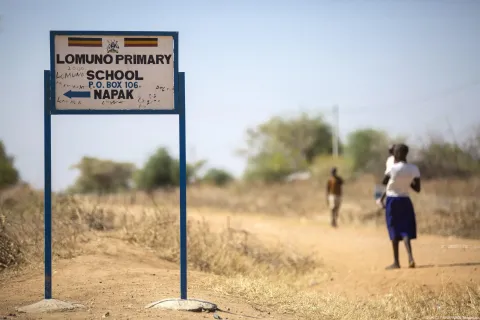
However, even with this financial support, the path to education is fraught with obstacles. Some girls, like Innocent Atimango of Palabek Secondary School in Lamwo District, face an exhausting commute to get to school. Innocent rises at 6 a.m. to begin her 10-kilometre walk to Palabek Secondary School, arriving by 8 a.m. This journey is not just a daily routine but a symbol of the broader struggles girls in the area face in their pursuit of education. Innocent also battles a chronic illness and a misshapen jaw, which subjects her to relentless bullying. Despite these overwhelming challenges, her determination remains resolute, driven by a desire to escape the cycle of poverty that binds her family to subsistence farming. With the support of the CashPlus Programme, her daily journey has taken on an optimistic bounce, symbolizing not just a route to school but also a tangible hope for a brighter future.
While Innocent’s personal journey highlights the individual struggles faced by many girls, the broader impact of the CashPlus initiative is already becoming evident in schools like Parombo Secondary School, in Nebbi District where attendance rates have surged as a result. The headmistress, Sister Maria Scovia Kengaiga, reports a notable improvement in school attendance, with 80 per cent more girls attending this term.
"This initiative will change the lives of our children in many ways. First, it will enable them to attend school consistently without being sent home due to unpaid dues, allowing them to focus on their studies and improve their performance. Additionally, once the dues are paid, parents can concentrate on providing other essential needs for their children. This will also help prevent dropouts, as some students were previously forced to work in the local factory to raise money for their dues.”

The Refugee experience
For many girls in Uganda, attending secondary school is a challenge, however, for refugee students, the hurdles are even more pronounced. Poverty, displacement, and escalating school fees often appear insurmountable and have made the completion of secondary school a distant aspiration for many. Recently, the European Union and its partners the Ministry of Education and Sports, UNICEF, KfW, Enabel and Spotlight Initiative launched CashPlus a subcomponent of the Gender for Development Uganda (G4DU) programme. This initiative is reshaping this narrative and offering these girls the possibility of a hope-filled path.
The G4DU programme offers these girls a chance to overcome such obstacles, ensuring they can pursue their educational aspirations.
In refugee settlement schools like Rhino Camp Secondary School in Madi-Okollo, the costs of uniforms, school requirements and meals are steep, reaching up to Ushs 350,000 (US $100) per term. This is in sharp contrast with primary school, where students only paid Ushs. 2,500 (US $0.68) per term.
Betty*, a 15-year-old refugee who spoke anonymously, said that although she is passionate about finishing school, the amount her widowed mother must pay to keep her in school is insurmountable. As a result, Betty often goes without meals because her mother cannot meet all the dues.
Amal Nancy, another young refugee from South Sudan attending Palabek Secondary School in Lamwo District, was on the verge of abandoning her education due to her family's financial hardships. Residing in the Palabek Refugee Settlement, where the relentless heat makes engaging in income-generating activities, such as agriculture, difficult, her family was already stretched thin as their small stall dwindled away. Her mother faces the dual challenge of managing a family of seven children while caring for Nancy’s younger brother, with sickle cell disease. Medical expenses often depleted their finances, making it infeasible for Nancy to continue her education.
On one of the numerous occasions when Nancy was sent home from school, she returned to find her mother at the hospital caring for her brother. Their small stall was empty, and income from selling firewood barely covered basic needs. Despite these overwhelming challenges, hope arrived through CashPlus, which provided financial assistance that enabled Nancy to return to school. Though challenges persist, Nancy is now focused on her studies, determined to break the cycle of poverty and build a brighter future.

Community impact
Parents of beneficiaries at Parombo Secondary School, such as Faridah, Zainabu, Okumu Anthony, and Anita Beru, all from Nyarogalo West Village, face unique challenges. Beru, mother to 16-year-old Nicole Pimeri, struggles financially due to expenses related to Nicole's eye problems, which also affect her academic performance. Zainabu, who is recovering from a stroke she suffered five years ago, dreams of a brighter future for her daughter, Bint Kassim, despite financial constraints and Okumu Anthony, a father juggling multiple responsibilities, is particularly eager to transfer his daughter, Ajolorworth Bakita, from the day school section to the boarding section, which is now possible because he can now meet boarding school charges. "I feel like a big burden has been lifted off my shoulders now that CashPlus will help my daughter avoid future traps and temptations. There are lots of evils that happen as girls go to and from school every day. She will be saved from teenage pregnancy and early marriage." Okumu also highlights the programme's role in easing financial strains within the community, "For example," he says, pointing at Zainabu, "This cash has helped her because she was utterly helpless. I don't think her daughter would have continued school. Nowadays, girls are a blessing."

Catalyst for positive change
The G4DU - Cash Plus initiative cash disbursement officially kicked off at Angal Secondary School in Nebbi District. Here, ecstasy was the theme, as cheers and ululations filled the air. Parents, students, and the school’s staff were visibly excited. “This is monumental for us all,” Isapamungu Doreen, a mother to 15-year-old Bakita Nerwot, said through excited tears. “I am completely penniless; I sometimes dig for people, but I have an arthritic knee. How was I ever going to put my daughter through school?” she wondered.
Among the beneficiaries at the same school is 14-year-old Joy *, a girl who was sexually assaulted and fell pregnant during her Primary Seven vacation after registering for the programme. Despite facing stigma and ridicule, she can now continue her education uninterrupted, a decision made possible by the Ministry of Education’s policy that allows pregnant girls to remain in school. For her, CashPlus represents a second chance; without this support, she would have been forced into an early marriage with her defiler.
Several of the initiative’s beneficiaries are either total orphans or children from single-parent households. These girls are among the most vulnerable, confronting not only educational barriers but also severe financial hardships that prevent them from accessing quality education.
Speaking on the cash distribution exercise, Tawanda Chinembiri, UNICEF Uganda Social Policy Manager highlighted that UNICEF’s primary goal is to ensure that every child, whether a boy or a girl, survives, thrives, and transitions successfully into adulthood.
"We aim to see girls enrolling in school and staying there and completing their education. Through the Gender for Development Uganda (G4DU) programme, funded by the European Union and implemented in partnership with the Ministry of Education and Sports and other agencies, we are facilitating this journey by providing adolescent girls in lower secondary school with financial and complementary services."

"We are already seeing remarkable progress in regions like Northern Uganda and West Nile, where enrolment has significantly increased. Our current focus is for these girls to stay in school, avoid early pregnancy, and complete Senior Four. We are also engaging parents to prepare for their daughters’ continued education. The response has been overwhelmingly positive. Communities are committed, schools are responsive, and the girls are motivated. This is what it looks like when promises to girls are kept," he added.
The CashPlus Programme will support 5,000 adolescent girls across seven districts: Nebbi, Madi-Okollo, Yumbe, Adjumani, Lamwo, Kitgum, and Oyam. These regions, located in Northern Uganda and West Nile, face significant educational challenges due to widespread poverty, early marriages, and deeply entrenched cultural barriers. According to the World Bank, the poverty rate in northern Uganda reaches as high as 40 per cent, with even higher figures in the Acholi sub-region, including Kitgum and Lamwo. In Nebbi, 22 per cent of children aged 6 to 15 are out of school, with girls being disproportionately affected (23.9 per cent) compared to boys (20 per cent).
Tihinduka Francis, a representative from the Department of Social Protection at the Ministry of Education and Sports, made a passionate plea across all the schools as UNICEF distributed the cash, urging parents to continue supporting their daughters beyond the financial aid. “This initiative is meant to give you a push, but you are expected to be proactive in shaping your future,” he said. He encouraged the girls to rise above societal pressures, avoid negative influences, and seize the opportunities before them.
While financial aid is pivotal, it alone is insufficient. Many girls face societal pressures that threaten to divert them from their educational paths. This is where the “Plus” component of the CashPlus comes in. The mentorship aspect of the G4DU Programme is indispensable. Trailblazers Foundation collaborates with UNICEF Uganda, to oversee the well-being and education of the vulnerable girls. The girls are paired with peer mentors who guide their personal development, career planning, and strategies for overcoming life's challenges.

The CashPlus Programme will support 5,000 adolescent girls across seven districts: Nebbi, Madi-Okollo, Yumbe, Adjumani, Lamwo, Kitgum, and Oyam. These regions, located in Northern Uganda and West Nile, face significant educational challenges due to widespread poverty, early marriages, and deeply entrenched cultural barriers. According to the World Bank, the poverty rate in northern Uganda reaches as high as 40 per cent, with even higher figures in the Acholi sub-region, including Kitgum and Lamwo. In Nebbi, 22 per cent of children aged 6 to 15 are out of school, with girls being disproportionately affected (23.9 per cent) compared to boys (20 per cent).
While financial aid is pivotal, it alone is insufficient. Many girls face societal pressures that threaten to divert them from their educational paths. This is where the “Plus” component of the CashPlus comes in. The mentorship aspect of the G4DU Programme is indispensable. Trailblazers Foundation collaborates with UNICEF Uganda, to oversee the well-being and education of the vulnerable girls. The girls are paired with peer mentors who guide their personal development, career planning, and strategies for overcoming life's challenges.