Going far together: Uganda launches National Coalition to End Child Poverty
‘…to go far, go together’.

Though there is contention about the single origin of this quote, there is acknowledgement about its universal truth. It is the same truth reflected in a gathering of over 150 children, representatives of government, development and humanitarian agencies, the private sector, civil society and academia, to embark on a journey of ending child poverty in Uganda.
On Tuesday 5 November 2024 in Kampala, Uganda became the first country to launch a national coalition to end child poverty. Coordinated by the Ministry of Gender, Labour and Social Development in partnership with UNICEF, the Economic Policy Research Centre, Child Fund, AfriChild and Save the Children, the coalition seeks to network, raise awareness, advocate and take action to ensure survival, development, protection and participation of children as anchored in the United Nations Convention on the Rights of Children.
During the launch, the need for coalition was clear in the sheer weight of the child poverty statistics. While presenting the findings of a 2024 report on Multidimensional Child Poverty in Uganda, Linda Nakato, Research Fellow at the Economic Policy Research Centre, revealed that nearly one in two of Uganda’s children under 19 years are in a state of multidimensional poverty. This is described as living in households whose expenditure is less than UGX 152,065 per month, and being deprived of seven or more necessities including health, food and nutrition, housing, sanitation, education, recreation and culture, clothing and footwear. The Uganda Bureau of Statistics Report further reveals that half of children who are poor are unable to read or write, over half are unable to visit a health centre when ill and more than 6 in 10 cannot afford three meals a day. It is such statistics that the national coalition to end child poverty in Uganda plans to reverse. A panel of in- and out-of-school children at the launch highlighted the key triggers of multidimensional child poverty in Uganda, as big and unplanned family sizes, unemployment and low quality of education. Twelve-year-old Oketcho Innocent of Kasubi Church of Uganda Primary School, noted that poor children who don’t have what they need for everyday life are at risk of adopting negative coping mechanisms such as substance abuse, teenage pregnancy, and even school drop outs, thus perpetuating the cycle of poverty.
“Let children be children,” he said.
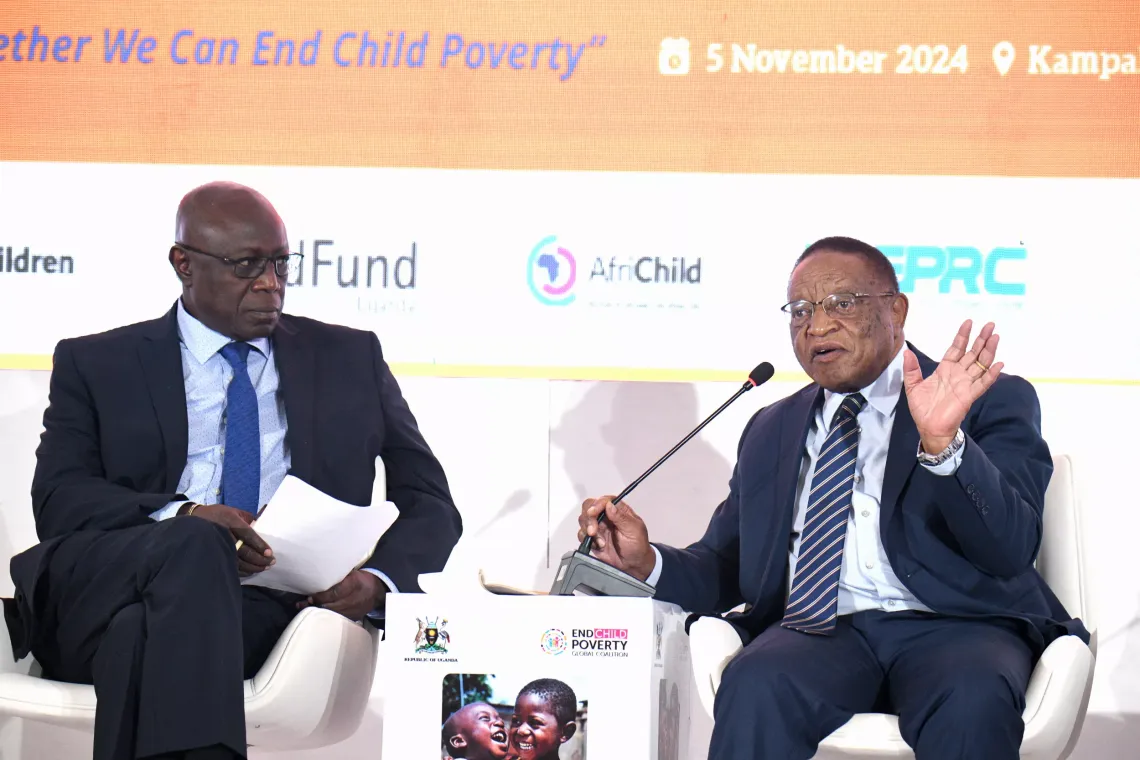
Prof. Ezra Suruma, a senior economist and senior presidential adviser who was among one of the panellists at the launch of the coalition emphasized the need to break this cycle of poverty, by creating more opportunities for employment to enhance household income, which will increase children’s access to education, health and other rights. He stressed the requirement for government to intentionally activate social protection programmes to enable all Ugandans live in dignity and abundance, especially children.
Whilst formally launching the coalition, Hon. Betty Amongi Akena, the Minister of Gender, Labour and Social Development noted that because child poverty affects the entire nation, ending it requires a diverse coalition of partners to raise awareness, advocate and support national action to alleviate poverty and meet the aspirations of the SDG agenda.
The minister also expressed government commitment to the national coalition, noting that collective effort is the first step in downgrading multidimensional child poverty in the country, from the current 44 percent to zero.
“Multidimensional poverty requires a multi-sectoral approach,” she concluded.