A model household thriving through knowledge and resilience in Kotido
"Every morning I wake up early to clean the compound before the children prepare for school," she explains. "I make sure they eat before leaving home because children cannot learn well when they are hungry."
In Oyapua Village, Yeele Parish, Lokwakial Sub-county in Kotido District, the Amicha family stands out in a region worn down by drought and food insecurity. A granary of stored grain stands beside their grass-thatched home; the compound is swept clean, and handwashing is a household habit. These are deliberate actions aimed at keeping their children healthy.
The household has four children, three of them at a nearby primary school. All four are healthy and growing well.
The June 2026 Integrated Food Security Phase Classification places Kotido in Acute Malnutrition Phase 4, or Critical. Across the district, 22,820 children need treatment for acute malnutrition, and the rate of global acute malnutrition, at 15.4 per cent, sits above the emergency threshold.
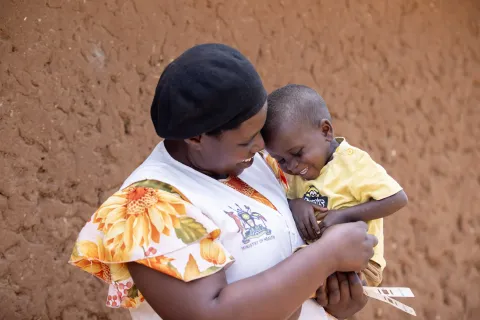
Maritoni, a mother in the household, takes pride in how the children are cared for and fed.
"Every morning I wake up early to clean the compound before the children prepare for school," she explains. "I make sure they eat before leaving home because children cannot learn well when they are hungry."
The family keeps four cows and two goats, which provide milk for the children.
“We milk them every day, and I happily share the milk with my co-wives so that all the children benefit,” says Maritoni. “During this dry season we also sell firewood for about 3,000 Uganda shillings (US$ 80 cents) to buy other food for the family.”
Amicha, the head of the household and village chairperson, believes water would help more families do the same.
“If we had reliable access to water, many families would grow cassava, sweet potatoes and vegetables all year,” he says. “People want to farm, but without water they cannot produce enough food.”
“We visit families to promote hygiene, proper child feeding and food preservation,” Simon Peter, the VHT member explains. “The Amichas store food after harvest and make sure their children are fed and monitored. That is why their children remain healthy.”
VHTs do more than identify malnourished children. They also encourage growth monitoring and immunisation and follow up children in outpatient and inpatient therapeutic care.
“As a village leader, I want to be an ambassador for healthy living,” Amicha says. “Many diseases and nutrition problems can be prevented through good hygiene, proper feeding and seeking health services early.”

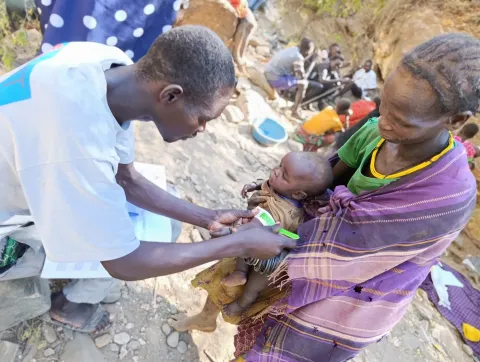
Simon Peter Lochu, their Village Health Team (VHT) member, trained and supported by UNICEF with support from the Uganda Humanitarian Fund (UHF) says the household shows how far positive practices can carry a family through food scarcityWhenever Maritoni takes her youngest for Mid-Upper Arm Circumference (MUAC) screening at community outreaches, she also joins the food demonstrations.
There, caregivers learn to prepare balanced meals from what is available locally: sorghum, beans, cowpeas, vegetables, milk and wild greens.
"I learned that even when food is limited, we can combine different foods to make meals more nutritious for our children," says Maritoni.
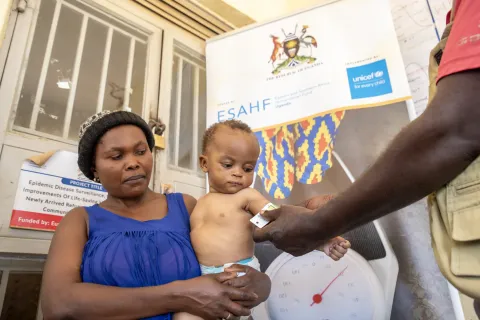
“When caregivers come for MUAC screening, we do not only measure the children,” the VHT member says. “We use that time to teach nutrition, hygiene and the importance of seeking treatment early.”
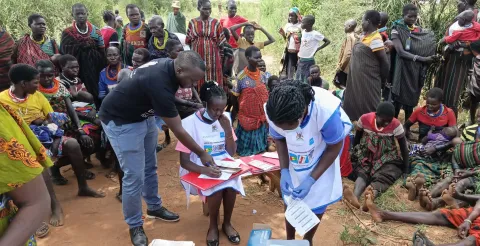
This community work is led by Government of Uganda, through the Kotido District Local Government and the District Health Team, supported by UNICEF in partnership with the UHF. Integrated outreaches, RUTF supplies, nutrition education, household visits and food demonstrations bring these services closer to families.
Tonny Achoma, the Senior District Health Educator for Kotido, says the family’s experience shows what sustained behaviour change can do at household level.
“Families that keep good hygiene, preserve food, feed children regularly and seek health services early are better able to protect them from malnutrition and disease,” says Achoma. “With UNICEF support, we are helping families find solutions that work in difficult seasons.”
For the Amichas, small actions have been added up. Healthy children, a clean compound and preserved food stocks show what knowledge, planning and community support can hold together in a hungry season. Their household is now a model for neighbours.
Still, Amicha believes more households need help to get there, starting with water.
"I appeal to our Government through the District Local Government for continued food assistance, at least for the next six months, for the most vulnerable households while communities recover from the effects of prolonged drought," says Amicha.