Kasese District’s battle against mpox disease.
Trained commercial sexual workers, now change agents in the mpox response.

Kasese District in western Uganda, renowned for its touristic beauty, was suddenly marred by a crisis in July 2024. The district became the epicenter of Uganda's mpox outbreak, with two confirmed cases in Bwera Hospital. This unanticipated news cast a shadow of fear and uncertainty over the community. Families were understandably overwhelmed, and children, often the most vulnerable in such situations, faced the added burden of stigma and isolation.
However, amidst the growing concern, the Ministry of Health, in collaboration with vital partners like UNICEF, World Vision, the Uganda Red Cross, and Baylor, swiftly mobilized to address the crisis. Their efforts extended beyond providing resources, focusing on preventing further spread, and rebuilding community systems to detect and counter the newly confirmed outbreak.
Dr. Amon Bwambale, the District Health Officer, vividly recalls the initial impact of the outbreak: "Children from the affected homes were ostracized by the community. They were seen as a threat, and their fundamental rights to safety and dignity were severely compromised."
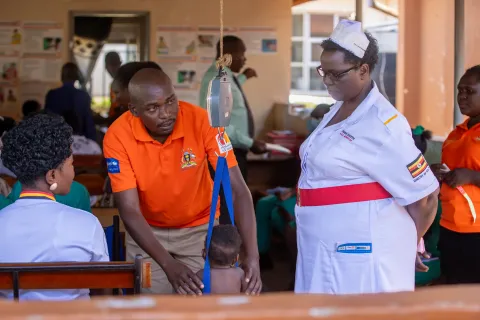
Recognizing the urgent need to address this, the district health team took decisive action. They engaged with village health teams and parasocial workers, conducted comprehensive training sessions for media personnel, and collaborated with the Rwenzururu Kingdom to sensitize the community about mpox and empower them to report suspected cases.


Mr. Zephernous Mubingwa, the Kasese Deputy Resident District Commissioner in Charge of Busongora County and head of the District Task Force against mpox, highlighted the crucial role of community engagement: "After the training, the media disseminated daily situation updates, effectively informing the community. This proactive approach yielded positive results, with only eight confirmed cases and no reported deaths."
With funding from Mastercard Foundation, UNICEF's intervention was swift and multifaceted. Agnes Mbambu the Kasese District Health Educator described UNICEF’s support as “Timely and effective!” regarding Risk Communication and Community Engagement for the Mpox Response.
Following the identification of Uganda’s first mpox case in Kasese District, UNICEF extended financial and technical support to mitigate the spread of the disease. Part of this support was to increase awareness about the disease and promote recommended practices such as hand washing, avoiding physical contact and reporting any suspected cases to the health facility.
Through this support, the district was able to activate key community structures and engage most at-risk audiences such as commercial sex workers (CSWs), truck drivers, and boda boda (motorcycle) riders.
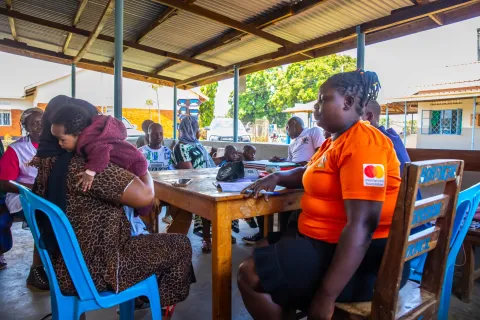
Reflecting on the district's training, Anne, a CSW at Mpondwe, shared how it empowered her and her peers to confidently identify signs and symptoms of the disease. This knowledge not only benefited them, but they were also able to cascade it to their peers.
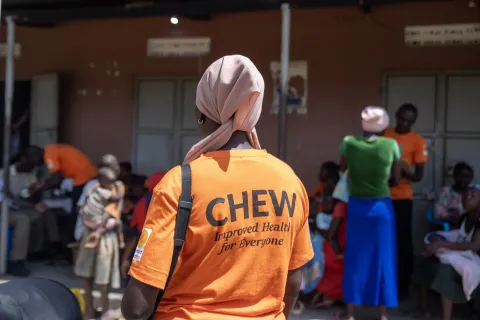
“The district team trained 36 of us and we were able to cascade the knowledge we acquired to 76 of our peers,” she noted. Now this team of 112 has become change agents in Mpondwe and its neighboring areas.
Mpondwe is a busy town that serves as the border to Uganda and the Democratic Republic of Congo. This team has reached out to numerous truck drivers and individuals at the border point, sharing mpox prevention messages, and this has been key in interrupting the transmission chain of the disease.


UNICEF also reinforced local teams with the necessary tools and expertise to effectively respond to the outbreak. Comprehensive sensitization campaigns were launched to educate the community about mpox, dispel harmful myths, and mitigate the stigma associated with the disease. A multi-pronged approach, encompassing posters, radio messages, and community dialogues, proved instrumental in combating misinformation.
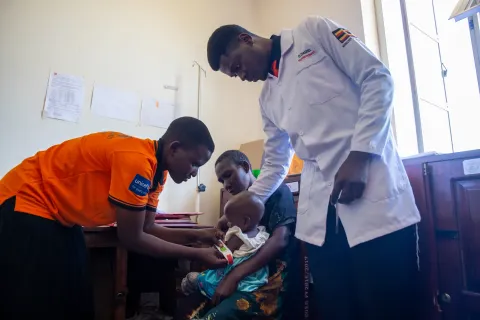
Furthermore, Infection Prevention and Control (IPC) measures were prioritized to safeguard both patients and healthcare workers. "We provided essential supplies such as handwashing equipment, gloves, facemasks, and other crucial items to ensure the protection of patients from reinfection and the safety of healthcare workers," emphasized Mr. Peter Opwanya, the WASH Specialist at UNICEF's zonal office for western Uganda.
Protecting the most vulnerable members of the community, especially children, was at the forefront of government’s efforts. Mr. Bagumira Faisal, the Kasese District Senior Probation and Social Welfare Officer, and his team of parasocial workers, with unwavering support from UNICEF and funding from the Mastercard Foundation, worked tirelessly to ensure the safety and well-being of children from affected families. They provided vital counseling services, shared messages on Prevention of Sexual Exploitation and Abuse (PSEA), facilitated access to essential services, and closely monitored the distribution of relief items to prevent any potential exploitation.
"We understand the importance of safeguarding the best interests of children," Faisal emphasized. "Our unwavering priority is to ensure their safety and well-being, as well as the well-being of the entire affected community."
UNICEF played a pivotal role in creating safe spaces for children and their families to receive care without fear of judgment. These spaces provided a much-needed sense of security and support, allowing individuals to heal and recover.
"UNICEF has been an invaluable partner in promoting child protection," Faisal acknowledged. "They have consistently ensured that no child is left behind, even during this challenging crisis."

Thanks to the concerted efforts of the government, UNICEF, other partner organizations, and the unwavering commitment of the community, Kasese is gradually recovering from the mpox outbreak. The fear that once gripped the sub region is slowly being replaced by hope and a renewed sense of community spirit.
While the immediate threat may have subsided, the government with support from its partners like UNICEF remains committed to supporting Kasese and other affected communities. Their ongoing efforts focus on strengthening healthcare systems and empowering the community to effectively address future outbreaks and ensuring that every child is protected, informed, and empowered.
Mr. Zephernous Mubingwa aptly summarized the collective effort: "In times of crisis, the strength of the community and the power of collaborative partnerships are indispensable. Together, we can overcome even the most daunting challenges and build a brighter, healthier future for everyone."