Feeding my hope amidst these rocks
In Moroto’s mining hills, a mother works each morning while caring for her children’s health

By the time the morning sun hits and hardens the stones on the slopes of Mount Moroto, Adong is already at work.
Most days, she climbs the mountain with other women to dig and crush rocks in search of gold. Back at home, the crops are drying in the fields. On the mountain, she hopes to find enough gold to buy food for her family.
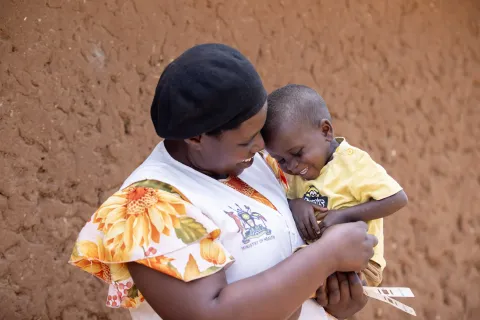
She looks frail and exhausted. She keeps going anyway, her youngest son held close, shielded from the dust and the heat by a colourful wrapper.
“My name is Adong, and I am a mother of five. I came to the mountains to provide for my family. I know the conditions are harsh for a baby here, but I had to bring him because he is still breastfeeding. The other four children remain under the care of their grandmother.”
Adong lives in Rupa Sub-County, a mountainous area in Moroto District where the nearest health facility is far away. The quarry where she works is in Katikekile sub county, Matheniko County, about 22 kilometres from Moroto Municipal Town Council. Reaching a clinic means walking a long distance and losing a day’s income. For a mother feeding five children, that is a very difficult choice.
Karamoja is in the middle of a long hunger. The Integrated Food Security Phase Classification estimates that around 473,000 people in the region, roughly a third of its population, are facing high levels of acute food insecurity that started in March 2026 and is anticipated to stretch into February 2027. All nine districts are classified as in crisis. Moroto is among the five where conditions are most severe.
Children are the most affected. In Moroto, one in five children under five is acutely malnourished, the highest rate in Karamoja. Many children are not screened, counted or treated because their mothers cannot reach a health centre or cannot afford to stop working long enough to seek care.
On 17 June 2026, a nutrition outreach team from Kakingol Health Centre III made the climb instead.
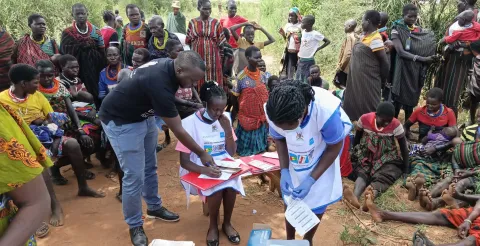
With support from UNICEF and funding from the Uganda Humanitarian Fund, the team worked with the Village Health Team at the quarry. They set up services where the women were already working. That morning, mothers were able to access nutrition screening and immunisation in one place. UNICEF’s Social and Behaviour Change team also spoke with mothers, answered their questions and encouraged women like Adong to seek care, despite the distance, uncertainty and hunger that often keep them away.

Health workers often walk long distances from nearby health facilities to provide these services. Sometimes, they even camp overnight. At some outreaches, more sick adults turn up more than children, showing how far many communities are from health care.
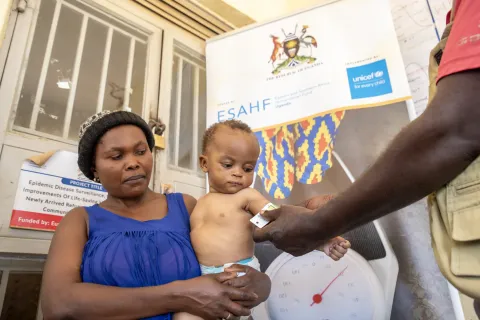
Adong came forward with her son and waited as a health worker measured his upper arm using a mid-upper arm circumference (MUAC) tape to check for signs of malnutrition
The result was green, an indication that her baby was healthy.
The nurse encouraged her to continue breastfeeding and to start giving her baby solid foods. Soon after, he received his first two immunisation shots. In one morning, on the hillside, he was screened and vaccinated.
“I never went to school. I cannot read or write. I am very grateful for this service, even if my face does not show it.”
The children at home
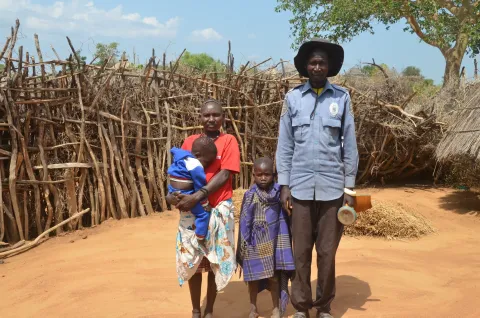
While Adong is at the mine with her baby, she is also thinking about her four older children at home, where their grandmother is caring for them.
“We are all hungry. The rains have delayed this year. We came to the mountains to earn money to buy food. The crops are drying up.”
Her baby is healthy partly because she is still breastfeeding him. But this is hard for her. She is thin, hungry and tired, yet she has little choice but to keep working.
Adong’s story reflects the reality for many families in Karamoja sub region. In Katikekile, the mining site is more than a workplace. It is where mothers, young men, babies, traders and hardship come together. The outreach showed that when hunger, distance and daily work make it difficult for families to reach care, essential services must be brought closer to them.
By the end of the morning on Wednesday of 17th of June 2026 , 67 children under five had been screened at the mining site. Eleven were referred for treatment for severe acute malnutrition.
For Adong, the visit meant her son was checked, found healthy and protected, without her missing a day of work. It showed what is possible when services reach children in time.
When services come closer, Adong does not have to choose between work and her child’s health.
No mother should have to make that choice.