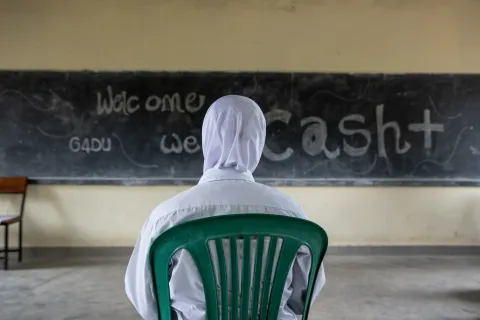
Empowered by i-UPSHIFT, a young woman transforms her life, breaking free from past limitations.
“I can now earn my own money,” Rahima says proudly. “I pay school fees for my daughter at Sunrise Nursery School—something my mother couldn’t do for me.”

For Salwa Farida, 20, the journey began with silence. “I dropped out of school in 2022 while in Primary Four,” she says. Her voice, though soft, carries the weight of years spent grappling with poverty. Despite attending a Universal Primary Education (UPE) school, Salwa’s family could not afford even the modest UShs.14,000 (US$3.8) in school development fees. “Sometimes, we’d eat only once a day,” she adds. “Life was hard after my mother separated from my father. She married another man, but we still struggled.”
Feeling hopeless, Salwa resigned herself to life at home. But in 2023, opportunity came knocking—literally. A mentor from the UNICEF-supported i-UPSHIFT programme visited her village, seeking school dropouts to join a life skills initiative. With little to lose, Salwa enrolled.
The programme is funded through the Canadian National Committee for UNICEF.
“We were taught to identify problems in our lives and how to solve them,” she explains. “I learnt about self-awareness, goal setting and decision-making. That gave me the strength to start dreaming again.”
It wasn’t long before Salwa and her group of five were selected among the best performers and awarded a seed capital grant of UShs.360,000 (US$98). Their chosen business? Knitting and design—specifically, tablecloths and decorative home accessories.
“We saw youth unemployment as a major problem in our community,” she says. “Starting a business felt like a way we could help ourselves and others.” Today, Salwa and her group are producing sets of twelve tablecloths that sell for UShs.120,000 (US$33). They dream of expanding into school sweaters but lack the capital to buy a UShs.2.5 million (US$680) knitting machine. “We have the skill. What we need now is to be supported to grow,” she says.

For Salwa, the impact is already real. “I now buy food for my family. I buy my clothes. I’m even teaching my younger siblings how to knit,” she says with pride. “I have a big dream—to be one of the biggest suppliers of school sweaters and tablecloths in West Nile and Uganda.”
Salwa’s story is echoed by Yasmin Nazir, 20, who once saw her future fade after a teenage pregnancy forced her out of school. “I dropped out in Senior Two in 2023,” Yasmin shares. “I was going to discos with friends. Then I got pregnant, and the father of the baby disappeared. My parents are poor. There was no one to help me.”
She had been attending Bright Star Secondary School, but the cost of school fees and supplies proved too much. “I kept getting sent home. I missed exams. Eventually, I just gave up,” she says.
That was before she met i-UPSHIFT mentors Draru Alersa and Asibuku Twalib, who introduced her to life skills training. “They taught us that dropping out wasn’t the end,” she says. “We learnt how to identify community problems and develop solutions.”
Together with four other girls, Yasmin formed a group that focused on youth unemployment. Their innovation? Making Kuta—local food covers woven from pine leaves and adorned with colourful ribbons. “People use them at home to cover food,” she explains. “They’re functional and beautiful.”
The group was among five selected at a boot camp and received a grant to start their small business. Today, they sell kuta between Shs.40,000 (US$10.8) and Shs.50,000 (US$13.6), depending on size. “This business changed my life,” Yasmin says. “I’m no longer idle. I make money every week, I buy what I need, and I train other school dropouts.”

In just 18 months, Yasmin’s group has grown its initial seed capital of Shs.360,000 (US$98) to Shs.2.1 million (US$571). They now dream of opening a full-fledged craft centre. “We want to add soap-making, employ more girls, and expand. But we need better tools and more capital,” she says.
Like Yasmin, Andru Rahima, 25, also found herself forced out of school after tragedy. “I dropped out of Victory Secondary School in 2020 after my father died,” she recalls. “My mother couldn’t pay school fees for me and my siblings. We barely had enough to eat.”
Desperate for stability, she married young—but life with her husband was harder than expected. “He couldn’t provide. Sometimes we went hungry,” she says. Eventually, she returned home.
That’s when she encountered the i-UPSHIFT mentors. “They taught us how to map out problems, identify causes, and design solutions,” she says. Rahima’s group focused on making kuta, another local version of food covers, and received the standard seed capital of UShs. 360,000 (US$98). Using local materials, they began production.
“I can now earn my own money,” Rahima says proudly. “I pay school fees for my daughter at Sunrise Nursery School—something my mother couldn’t do for me.” Her dream is to one day open a craft centre to employ more young women like herself.
These stories are just a glimpse into the transformative impact of i-UPSHIFT, a joint initiative by UNICEF and the International Labour Organization, with funding from the Canadian National Committee for UNICEF launched in 2022. The programme equips adolescents with life skills and entrepreneurial tools, helping them build sustainable, youth-led businesses. Through workshops, mentorship, and funding, participants are encouraged to think critically, work collaboratively, and transform community problems into solutions.
“These girls are not just surviving. They are thriving,” says Asibuku Twalib, an i-UPSHIFT mentor. “Before the training, many of them were too afraid to speak up. Now, they are leading businesses and inspiring others.”
Florence Baako, Senior Community Development Officer for Yumbe Town Council, agrees. “This project is not just about income generation. It’s about dignity. It’s about giving young people the skills and confidence to shape their own futures.” Funding through the Canadian National Committee for UNICEF has contributed to these achievements.