Crossing lakes to immunize children
New quipment provided by GAVI is helping Uganda's health workers reach children in hard-to-reach areas

The hidden children of Uganda
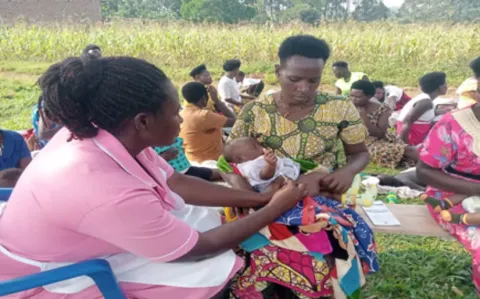
Among the scattered islands of Lake Victoria in Kalangala District, there are children whose names are absent from any official register. One such child, barely two years old, lives in such isolation and has never received a single vaccine. Health workers technically refer to her as a "zero-dose child", a term used for children who have never received any of the life-saving vaccines provided free of charge by the Government of Uganda. She is not alone. Across Uganda, thousands of children grow up without the basic protection that vaccines offer. This is not a result of parental neglect, but rather the inability of health workers to reach them.
Progress and persistent inequities
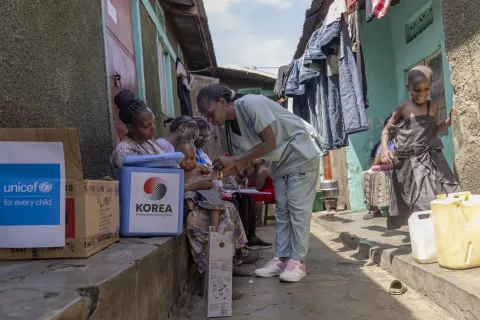
Uganda has made significant strides in its vaccination efforts, now protecting children against 15 diseases, including cervical cancer, diarrhoea, diphtheria, haemophilus influenzae type b, hepatitis B, measles, meningitis, pertussis, pneumonia, poliomyelitis, rubella, tetanus, tuberculosis, yellow fever and, more recently, malaria. However, this national progress masks a more challenging reality. In the country's most difficult-to-reach areas, many children are still missed. These areas include islands like Kalangala, mountain communities in Kasese, refugee settlements in Terego, and pastoral regions in Kotido, where families move seasonally with their cattle, making it hard for health workers to keep up with immunisation and health services.
The barriers to vaccination
A 2025 Gavi Uganda Zero-Dose Learning Hub report, titled Identifying and Reaching Zero-Dose Children in Uganda: Implementation, Effectiveness, and Costs of Targeted Interventions, highlighted that only one in five caregivers felt that vaccination services were easy to access, and just one in ten had ever received a reminder about a child’s upcoming vaccine. Despite this, seven out of ten expressed a desire for their children to receive all the recommended vaccines. The key issue is not parental reluctance, but rather the inability of the health system to reach these families.

The daily challenges faced by health workers
To appreciate the demands on Uganda's frontline health workers, consider the journey of a nurse in Kalangala. To vaccinate a child on a remote island, she requires a stable boat, a life jacket, and a vaccine carrier with ice packs to maintain the necessary temperature during a challenging journey to cross the lake. An overnight stay may be required, necessitating a tent and sleeping bag, as well as rain gear for the return journey. In Kasese, nurses need sturdy boots and helmets for traversing steep, rocky paths. In Terego, where refugee families move frequently, building trust is challenging, and children may relocate before the next outreach visit. Until recently, many health workers operated without the necessary tools, improvising where possible or being unable to travel at all, directly resulting in children missing vital vaccinations.
New equipment to address the challenges
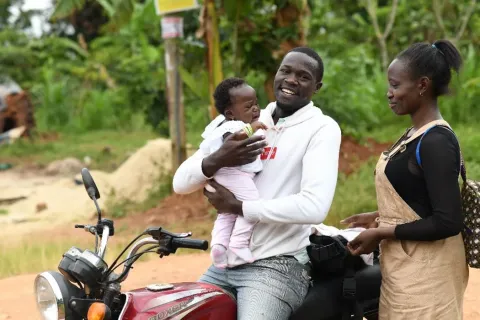
On 11 March 2026, Uganda's Ministry of Health distributed equipment valued at over US$ 9 million to health workers nationwide. This was funded through Gavi's Health Systems Strengthening grant and the Equity Accelerator Fund. The comprehensive package included 642 motorcycles with full protective gear for last-mile delivery, transportation for outreach, and follow-up of infants who have dropped off the immunisation schedule. Additionally, 1,165 refrigerators were provided to strengthen the cold chain, along with protective field gear: 2,022 life jackets, 1,095 mountain-climbing helmets and gumboots, 1,095 sleeping bags, 90 portable tents, 2,022 raincoats, and more than 3,238 umbrellas. Each item directly addresses a specific barrier that has previously prevented health workers from reaching children.
Commitment to equity
At the flag-off event in Kampala, Minister of Health Dr Jane Ruth Aceng reaffirmed the government's dedication to ensuring that no child is left behind due to their location. She acknowledged that communities in places like Kalangala, Kasese, Kotido, and Terego face unique and serious barriers, which are not just logistical but also equity challenges. "The government is determined to close these gaps, addressing them district by district, community by community, and child by child," she emphasized.

UNICEF Representative Dr Robin Nandy emphasised the focus on equity, noting that the provision of motorcycles and safety equipment through the Equity Accelerator Fund empowers health workers to reach communities with the greatest access challenges. He also pointed out that UNICEF's involvement extends beyond procurement, including delivery, installation, and training to ensure effective use and maintenance of the equipment.
Visible impact and ongoing efforts
In Kalangala, the Equity Accelerator Fund has been active for just over a year, and the effects are already noticeable. Dr Bitakaramire Hillary, the District Health Officer, reported that reaching families on the outer islands was previously extremely difficult, but in the past year, more children have been reached in areas that were once nearly inaccessible. Although there is still significant progress to be made, the new equipment offers a genuine opportunity to continue improving access.
The Zero-Dose Learning Hub report found that in communities where health workers intensified their efforts and followed up with missed children, the proportion of zero-dose children was nearly halved, dropping from one in eight to one in fifteen.
Looking ahead
The girl on the remote island in Kalangala represents tens of thousands of children across Uganda, whether in fishing villages, mountain communities, refugee camps, or city slums. Their chance of being vaccinated is determined not by policy, but by the ability of a health worker to physically reach them. While the new equipment launched on 11 March 2026 will not immediately reach every child, for every health worker now equipped with a motorcycle, life jacket, or tent, a child somewhere stands a better chance than before. For a child who has never received a single vaccine, that improved chance marks the beginning of everything.