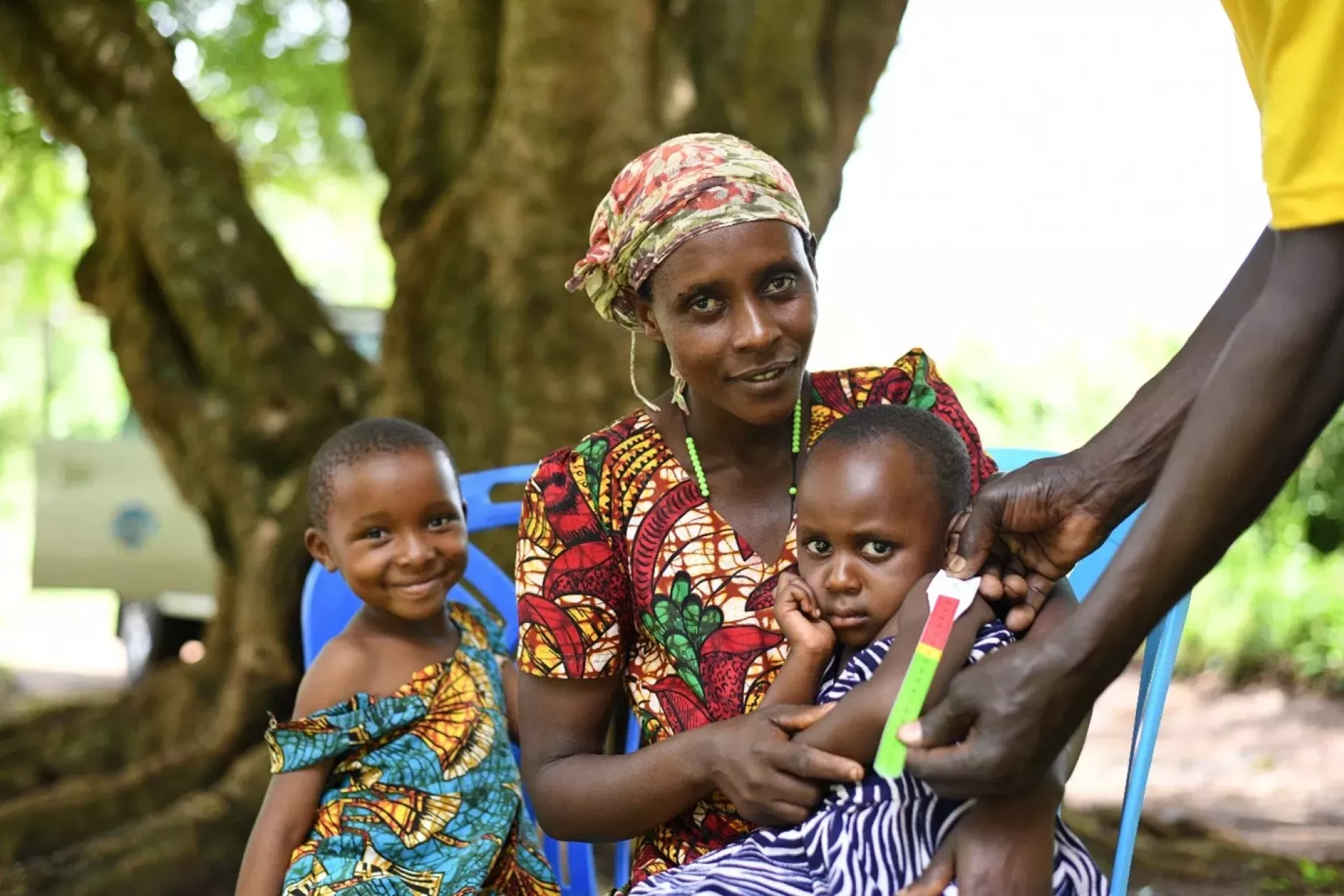
Care groups allow mothers to take the lead for their children’s nutritional status.
UNICEF's nutrition interventions funded by UKaid echo within the communities, profoundly impacting the lives of children, adolescents, and women.
In the refugee districts of Kamwenge, Kyegegwa and Kikuube, UNICEF's nutrition interventions funded by UKaid echo within the communities, profoundly impacting the lives of children, adolescents, and women.

Alimpa Julia Bamuturaki, a lead mother from a host community in Kyangwali, Kikuube District, demonstrates to members of her care group how to prepare ekitobero (multi-mix) porridge, enriched with an egg and avocado to enhance its nutritional density and absorption. As part of her duties, she oversees a group of mothers, guiding them on best child feeding practices, establishing kitchen gardens, and using MUAC tapes at home. Her passion lies in changing the attitudes of her colleagues.
Paska Aluba a nutritionist at UNICEF says that care groups allow mothers to take the initiative of their children’s nutritional status.
“A typical care group has about 10 to 15 mothers. The lead mother is trained at the regional level. When she returns to the community, she passes on knowledge to the members of her care group, who in turn disseminate information to their peers. It is a cost-effective way of cascading knowledge into the community,” Aluba says.

Agnes Kwebiha, a Village Health Team (VHT) member, helps a mother put her child on a Salter scale. UNICEF has supported the capacity building of the Village Health Teams through trainings. The VHTs then go into the communities, sensitising mothers and screening the children for malnutrition. Once they are screened and found to have any challenges, they are referred to health centres. If the malnutrition is moderate, they are counselled and sensitised on best nutrition practices.

Albert Mugabi, a nutritionist from Kikuube District, explaining to mothers the best nutrition practices in a Care Group using a counselling chart. UNICEF provides literacy materials and growth monitoring equipment like growth monitoring charts, Salter scales, and MUAC tapes. These help the VHTs to sensitise and screen for malnutrition at community level.

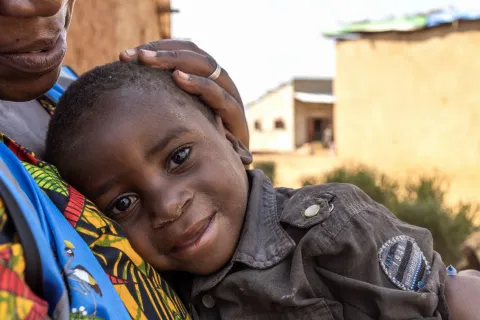
Katusiime Annet in Rubaba Village with her two children, Daphne Ainembabazi, 5 and Gift Tukumushaba, 3. Katusiime is one of the beneficiaries of the UNICEF assisted initiatives in the village. She says after Tukamushaba, her youngest was born, she had low birth weight, but luckily the VHTs visited her, gave her RUTF and counselled her on best nutrition practices which helped Tukamushaba to return to optimal health within a month.

VHT coordinator Francis Nkwangire in Rubaba Village shows the mothers at a Village Health Committee meeting how to use the MUAC tapes correctly to assess the nutrition status of the children. mothers are encouraged to conduct proactive and preventive measurements to prevent malnutrition by using the MUAC tape at home.

Beatrice Bonabana, an elderly caregiver with her grandson Godwin Mukonyezi at a health meeting in Rubaba Village. Kamwenge District nutritionist Emma Tumusiime says one of the key causes of stunting is dropout rates and teenage pregnancies.
“When the girls are not ready or unable to take care of their young children, they are abandoned to the care of elderly caretakers who are too old to adequately care for young children. Incidencies of young children left in the care of elderly caretakers are quite common,” he says.

A mother in Rubaba Village proudly displays eggplants harvested from her kitchen garden. This initiative is aimed at proactively curbing malnutrition. The kitchen garden includes a variety of green vegetables such as tomatoes, dodo, Sukuma wiki, and pumpkin for carbohydrates, as well as beans for protein. The inclusion of these different vegetables ensures that children receive a balanced diet.

Seven-year-old Ian Natumanya, who was brought for treatment for malaria, has his height measured by a nurse to check for stunting as his mother looks on. Agonza John, the nursing officer at Kishagazi Health Centre II, says all the children who come for any kind of treatment at the facility are screened and assessed for nutrition deficiencies using MUAC tapes, height measurement board, and Salter scales that UNICEF provides.

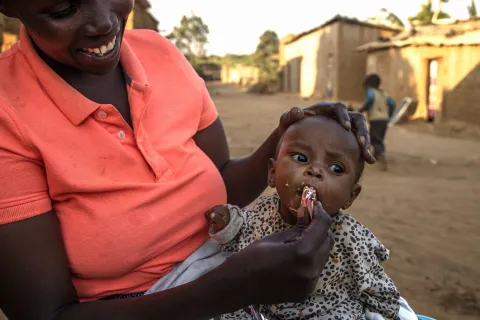
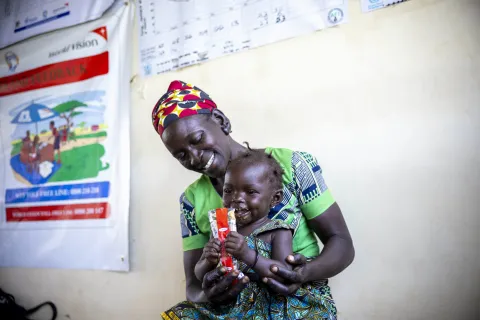
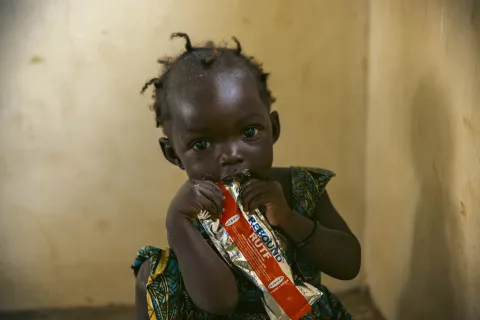
One-year-old Kato Mawazo, brought to Bwirizi Health Centre III in Kyaka Refugee Settlement by his 65-year-old grandmother, Shemiyati Bulato, for treatment for malnutrition, undergoes an appetite test before receiving RUTF, a ready-to-use therapeutic food supplied by UNICEF for the treatment of malnutrition at the health centre. Mawazo was referred to the health centre from the community by a lead mother after he was discovered to be in the yellow nutritional status.

Nsiime Baraka, a lead mother at Bwiriza Health Centre III in Kyaka II Refugee Settlement, explains to the mothers how to include different ingredients in their cooking to make nutritious meals. Efforts are made to mobilize mothers in the community and create baby-mother-friendly spaces where children can play while receiving health and nutrition services. These spaces serve as venues for activities and services that support child wellbeing.

Derrick Musimenta, aged two and a half, receives vitamin A at Butoole Primary School in Kikuube District during an Integrated Child Health Day drive. These drives offer a range of services, including micronutrient supplementation and immunization, with a specific focus on reaching vulnerable populations such as school-going children and those in the community. One significant aspect of these campaign days is the integration of nutrition services with health services, emphasizing the importance of an integrated approach to child health.