Arming Ugandan journalists for the next health crisis
Mastercard Foundation and the Government of Sweden support UNICEF to conduct public health emergency media trainings.

For journalist Calvin Otim, a news correspondent for Vision Group based in Lango Region, the surge of information during a public health crisis feels like trying to drink from a firehose.
On one side are official reports filled with technical jargon; on the other, a flood of social media rumours, myths, and outright conspiracy theories. Separating fact from fiction and then translating it into a story that could save lives is a tough task.
"You're battling the clock, you're battling misinformation, and sometimes, you're battling for access to the experts," Otim shares. "It's one thing to get a press release; it's another to turn complex data into a story that my grandmother in the village can understand and act upon.”
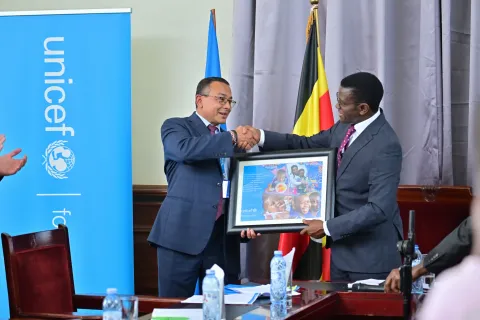
This challenge, faced by journalists across Uganda, prompted a timely intervention. This past July, the Ministry of Health (MoH) partnered with UNICEF, WHO, and the African Centre for Media Excellence (ACME) to roll out a series of intensive media trainings on reporting public health emergencies. With funding from the MasterCard Foundation and the Government of Sweden, the initiative aimed to equip the media to ably report on crises like Ebola, mpox, and other threats.
Otim was one of 113 journalists who attended sessions across four districts: Kabale, Kasese, Gulu, and his own region of Lango. For him, the training was a turning point in breaking down barriers with officials.

"Before, getting a straight answer from a health official could feel like navigating a maze. But this training put us in the same room. For the first time, it felt like we were becoming partners, not adversaries."
This sentiment was shared in Kabale, where Victor Turinawe of the Kigezi Guardian found the session on improving relations with health stakeholders most valuable. "One of the biggest barriers has been the relationship between us journalists and the health stakeholders," he noted. "I believe that with this guidance, we will achieve a good working relationship."
The workshops were a potent mix of knowledge and skills. While technical experts from the MoH and UNICEF demystified the science, ACME's trainers focused on turning that knowledge into compelling stories. For many, it was a return to fundamentals.
"My key highlight was simply learning the definitions and differences between epidemics and pandemics," said Irene Kirabo of Uganda Radio Network in Fort Portal. "Getting to network directly with experts from UNICEF and the Ministry of Health was invaluable."
For others, the training shifted their entire perspective on news judgment. “My understanding has been enhanced," noted Simon Wokorach from The Cooperator in Gulu. "Initially, I would not consider malaria as an emergency health concern, but that has changed now. Understanding the background of the different diseases will enable me to report more accurately."


The impact was immediate. In Lira, Milton E. Akwam of TND News reflected on how the training exposed gaps in his previous work. "I now understand my role as a journalist in declaring an outbreak. Before, some of my stories lacked details and relevant sources," he admitted. "Going forward, I will use the resources and contacts from this training to publish more informative, data-based articles."
Adong Joanita, also of TND news, agreed it was a transformative experience. “The training was very informative. I learned a lot that I didn’t know, and I would urge more journalists to participate,” she says. “It changed my mindset about how I used to think about health emergencies and enhanced my reporting skills.”
For Otim, the sessions on misinformation were crucial. "The modules on handling rumours and conspiracy theories were a game-changer," he says. "It armed us with a framework for verification and responsible reporting, showing us how to stop panic."
The initiative recognized a critical need. A needs assessment found that some journalists lacked basic information on key health emergencies and highlighted a high rate of attrition, stressing the need for continuous engagement.
As the Lira session wrapped up, Otim left with a renewed sense of purpose.
"When the next health scare comes, and it will, I won't just be a reporter chasing a headline," he concludes firmly. "I'll be a frontline defender against misinformation. This training has given us the tools, the contacts, and the confidence to serve our communities."