UNICEF provides learning materials to help more than 30,000 refugee children continue their education in Nyarugusu camp in Kigoma Region
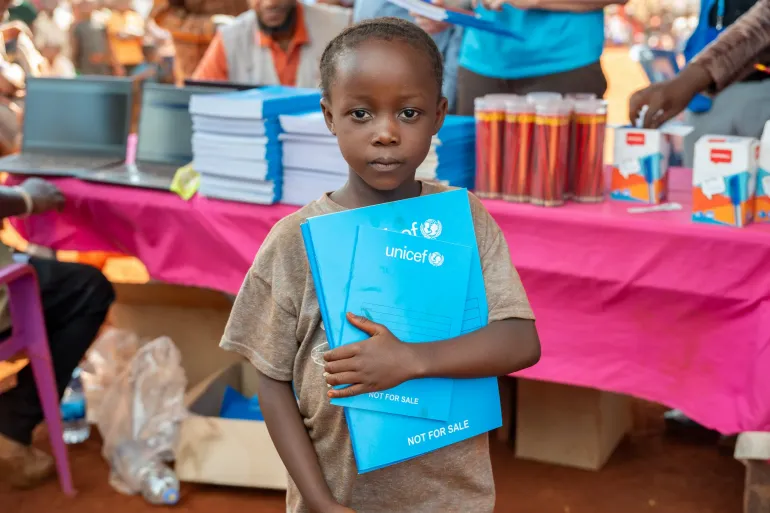
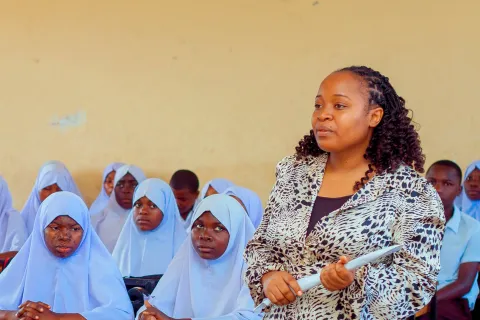
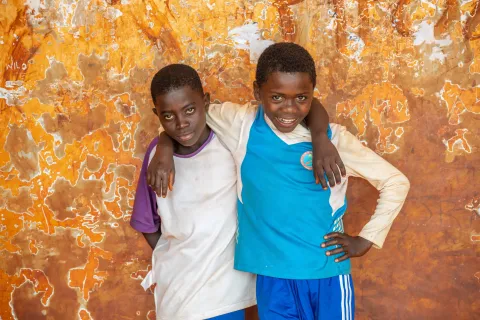
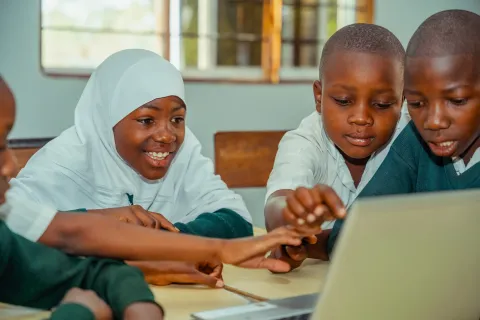
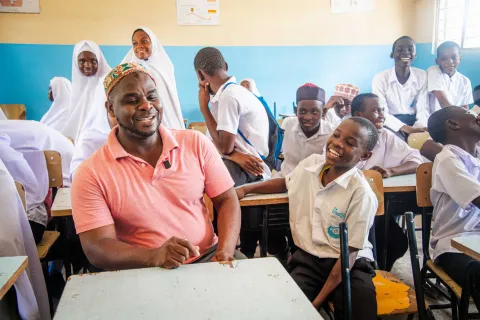
Kigoma, 23 September 2026 – UNICEF, in collaboration with the Government of the United Republic of Tanzania, UNHCR, and education partners, is distributing essential learning materials to 30,863 refugee children, including 15,313 girls, across 17 schools in Nyarugusu Refugee Camp. The supplies will help children participate fully in lessons and continue their education despite the challenges associated with displacement.
The learning materials include exercise books, pens, pencils, and mathematical sets. Their distribution comes as schools reopen and children return to their classrooms, helping to reduce immediate barriers to participation and giving learners the basic tools they need to continue their education with confidence.
“Every child has the right to quality education, wherever they are. For refugee children, education provides much more than knowledge. It offers stability, protection, hope and a pathway to the future,” said Elke Wisch, UNICEF Representative to Tanzania. “By providing these learning materials, we are helping children return to their classrooms ready to learn, while supporting them to develop the skills and confidence they need to pursue their aspirations and contribute to their communities.”
As of 31 August 2026, Tanzania hosted 131,929 persons of concern, including 90,642 refugees and asylum seekers residing in Nyarugusu Camp. Children make up 57 percent of the camp’s population.
Although 30,863 refugee children are enrolled in schools in Nyarugusu, many continue to face barriers to learning. These include shortages of teaching and learning materials, challenges in accessing timely examinations, limited numbers of qualified teachers, and overcrowded classrooms.
The Government of Tanzania, through the Ministry of Home Affairs, leads efforts to provide education services for refugee children in Nyarugusu Camp. UNICEF, UNHCR and implementing partners support schools, teachers and learners with essential materials and coordinated interventions intended to improve access to quality education.
UNICEF is working with the Government of Tanzania, UNHCR and education partners to advocate for every refugee child to access, continue and complete quality education. UNICEF also supports the provision of essential teaching and learning materials, coordination on teacher support and examinations, learning continuity, and efforts to identify sustainable and cost-effective solutions for refugee education
While the distribution addresses an immediate need, learning materials alone cannot resolve all the challenges affecting refugee education. Sustained, predictable financing is needed for teachers, appropriate classrooms, examinations and certification, and safe, inclusive learning environments that allow children to progress through the full education cycle.
UNICEF is calling for continued dialogue on sustainable education options and learning pathways for refugee children, particularly those who have spent many years in Tanzania. Such options should protect children’s right to education, support learning continuity and provide clear pathways for progression and certification.
Stronger collaboration is also needed among the relevant education authorities in Tanzania, authorities in refugees’ countries of origin, UN agencies and education partners to address curriculum continuity, examinations, certification and transition. These efforts should be supported by coordinated resource mobilization and predictable financing for essential education services.
The reopening of schools provides an immediate opportunity for government, UN agencies, development partners and donors to align their efforts around the most urgent education needs. Many children in Nyarugusu have spent a significant part of their childhood in displacement, and disruptions to their education can have lasting consequences for their learning and future opportunities.
“A notebook or pencil may appear small, but for a child it can open the door to learning, opportunity and hope,” Ms. Wisch added. “UNICEF will continue to stand with the Government, partners, teachers, parents and communities so that every child, including every refugee child, has the opportunity to learn, thrive and reach their full potential.”
Media contacts
About UNICEF
UNICEF promotes the rights and wellbeing of every child, in everything we do. Together with our partners, we work in 190 countries and territories to translate that commitment into practical action, focusing special effort on reaching the most vulnerable and excluded children, to the benefit of all children, everywhere.
For more information about UNICEF Tanzania and its work for children, visit www.unicef.org/tanzania.