Yousef’s story: a dream written in words
On this World Children's Day, UNICEF continues its dedication to safeguarding children's rights and assisting those impacted by conflicts, striving for a more promising future for every child

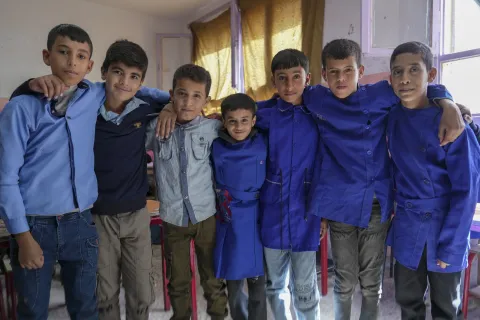
Saqba, Syria - “I have never stayed in a school for more than two weeks before fleeing the area in search of safety," said Yousef, a 13-year-old boy residing in Saqba town in Rural Damascus. He recalled the multiple displacements he experienced during the years of conflict and how he was forced to drop out of school.
Yousef, originally from Beit Nayem village, eventually settled with his father, mother and brother in Saqba town.
When the violence respited, Yousef tried several times to return to school. However, it was difficult for him, as he was falling behind his peers, and his struggles with reading and writing hindered his progress. “I couldn’t remember the letters or numbers, so I kept dropping out of school,” he said.
Two months ago, Yousef’s father passed away from a heart attack.
Yousef had no choice but to take on various jobs to help support his family, working in furniture making, painting, and grocery stores. “I used to carry heavy loads on my shoulders and return home exhausted. I could no longer play or do anything other than work,” he said. “I wished to go back to learning, like other children,” he added.
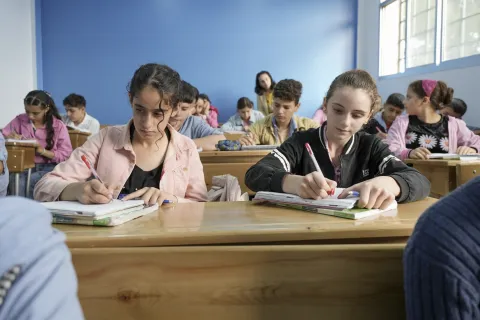
In October 2024, a friend of Yousef’s mother introduced her to a UNICEF-supported self-learning centre in their town that helps dropout children fill gaps in their education. She immediately visited the centre and enrolled Yousef to resume his education.
“I stopped working so I could focus on my studies. I’ve made huge progress in a short time. I’ve learned all the letters and can now read,” Yousef said. “I used to get lost because I couldn’t read the directions. That will never happen again!” he added happily.
Yousef faced learning difficulties, so in addition to attending self-learning classes, a UNICEF-supported specialist works with him individually to guide his progress. “The teachers are so kind and patient. They always encourage me to keep learning,” he said.


Spending most of his time at home studying and doing homework, Yousef scored high marks on his first quiz. “I’m the top of my class, and all the other children want to be my friends. I’m very proud of myself!” he added.
He also finds time to help his mother at home and play with friends in the neighbourhood. "I know children have many rights, like the right to play and learn," Yousef said. "I got those rights when I started going to this centre," he added.
Yousef now attends both individual and group lessons to learn quickly, with the goal of returning to school soon.

“Most children in my town need help, but their families can’t afford private classes. If I were in charge, I would open more and more learning centres like the one I’m attending now, to help all children return to learning!” he said.
On weekends, Yousef spends time with his 15-year-old working brother, teaching him how to read and write. “I don’t want him to stay illiterate, so I share everything I learn at the centre with him,” he said.
Yousef hopes to record the stories his father used to tell him once he becomes proficient in writing. “I want to keep them alive in my memory, and one day share them with my children,” he added.

Though his childhood was deeply disrupted, Yousef has regained the ability to dream through education. He wishes to become a dentist one day, so he can treat people in need without charging them any money.
“Children should take their learning seriously, as there is no bright future without education," he concluded.
Since January 2024, UNICEF has reached about 30,000 children across Syria, with the self-learning programme to help them continue their education. The activities were funded by the Global Partnership for Education (GPE); Education Cannot Wait; the German Federal Ministry for Economic Cooperation and Development (BMZ) through the KFW Development Bank; EU Humanitarian Aid (ECHO); the Foreign Commonwealth and Development Office (FCDO); the Governments of Australia, Japan, Finland, and Kuwait; and UNICEF National Committees for Japan and Ireland.