UNICEF supports mine risk education for children in Mabrouka camp

ENabled Marking international mine awareness day, over 600 children in Mabrouka camp in north-eastern Syria engaged in mine risk education at a UNICEF-supported child friendly space

Masoud Hasan
a boy holds a UNICEF brochure
UNICEF/ Syria 2018/ Delil Souleiman
24 May 2018

#ENabled Marking international mine awareness day 

Over 600 children in Mabrouka camp in north-eastern Syria engaged in mine risk education at a UNICEF-supported child friendly space. After fleeing Deir-ez-Zor and Ar-Raqqa governorates, many families are returning to their homes. Over 95,000 children and adults have returned to their homes in Ar-Raqqa since last October, only to be faced with tremendous risks. Hazards range from landmines, to booby traps and unexploded remnants of war that could have devastating consequences on the lives of children and their families. At least 658 people were reportedly injured and more than 130 killed in explosive hazards - a shocking average of six blast wound incidents per day. To protect children against these risks, UNICEF supports mine risk education programmes to teach children and adults how to identify, report and protect themselves against explosive hazards. At schools, children engage in recreational and educational activities and receive brochures with important messages on safe behavior.

The programme also includes awareness-raising sessions in collective shelters, clinics and community centres, to ensure maximum reach. Last year alone, over 1.8 million children and 100,000 caregivers received life-saving information through the UNICEF-supported mine risk education programme. UNICEF’s Mine Risk Education programmes are funded by the governments of Germany, Luxembourg and the United States.

two girls walking during a play session
UNICEF / Syria 2018 / Delil Souleiman Aya, 12, and her friend engage in a game to learn how to protect themselves while walking in mine-infested areas, at a UNICEF-supported child friendly space in Mabrouka camp. Aya and her family were displaced due to fighting in Deir-ez-Zor and sought shelter at the tented camp almost 8 months ago. “Our neighbor, who was my friend, was killed by a landmine as her family was fleeing,” recalls Aya. “I feel safe with the information I learned today,” she adds.

Our neighbor, who was my friend, was killed by a landmine as her family was fleeing, I feel safe with the information I learned today,

Aya, 12
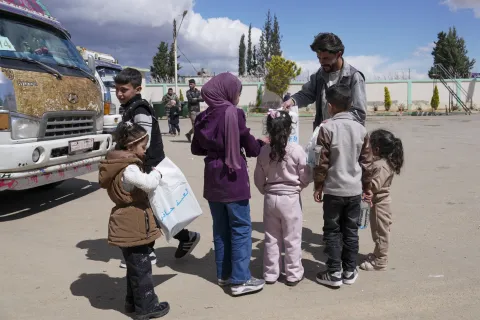
a unicef staff teaching children in a camp
UNICEF / Syria 2018 / Delil Souleiman Ahmad, 29, has been volunteering with the UNICEF-supported mine risk education programme for two years. He goes from one collective shelter to another, teaching children on mine risk through interactive activities and awareness sessions. “So many children have been killed or maimed by explosive hazards in the area,” says Ahmad. “I teach children not to touch any toys, food or money they see on the ground, everything can be a risk,” he adds.

I teach children not to touch any toys, food or money they see on the ground, everything can be a risk,

Ahmad, a UNICEF-supported mine risk education programme volunteer
a boy holds a UNICEF brochure
UNICEF / Syria 2018 / Delil Souleiman Hussam, 12, participates with his peers in an awareness-raising session at the UNICEF-supported child friendly space in Mabrouka camp, north-eastern Syria. UNICEF also distributed informative stories to help children remember the steps of identifying and protecting themselves against explosive hazards. “I learned to try and stay away from destroyed areas and rubble because they have the highest risk of mines,” says Hussam.

I learned to try and stay away from destroyed areas and rubble because they have the highest risk of mines,

Hussam, 12
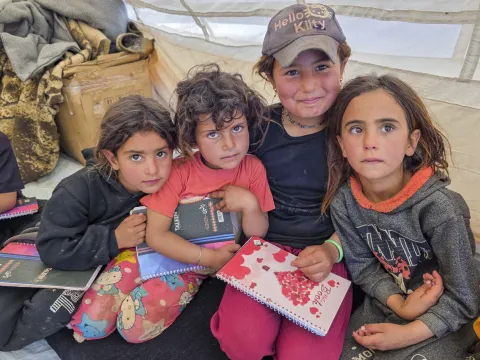
a girl holds a brochure
UNICEF / Syria 2018 / Delil Souleiman Aya, 10, participates with her peers in an awareness-raising session at the UNICEF-supported child friendly space in Mabrouka camp, north-eastern Syria. “I learned the different kinds of explosive hazards and how to identify them and report them to an adult,” says Aya proudly. Together with her family, Aya has been displaced three times over seven years of conflict.

I learned the different kinds of explosive hazards and how to identify them and report them to an adult,
Aya, 10