A second chance
Mohamed’s journey from despair to determination

Rural Dar’a, Syria – At thirteen, Mohamed carries a quiet strength that belies his years. Sitting inside the small tent he calls home; he recalls the days when playing with his siblings and cousins felt more like a reminder of his limitations than a source of joy. “I always felt inferior,” he admits. “I thought I was not as good as them. But today, after I started my learning journey, I felt that gap disappear. In my last exam, I even scored higher than some of my classmates.”

Mohamed’s story begins long before he ever picked up a schoolbook. Six years ago, he was just a child following his father Darweesh to the fields, where he worked harvesting crops. His father’s voice grows heavy as he recalls that day. “I was busy with the harvest, and I didn’t notice that Mohamed wandered off to the roadside. Then, suddenly—an explosion!”
Darweesh pauses, taking a deep breath as if pushing back the memories. “He found a box near the sidewalk. He thought it was a toy. But it turned out to be an unexploded remnant of war.”
The blast took Mohamed’s right arm instantly. His left hand was severely injured, costing him several fingers. His father shakes his head. “At least they saved his arm.”

Originally from Shahba City in As-Sweida governorate, Mohamed’s family fled their home in 2017 when the bombardment grew too intense. They sought safety in rural Dar’a, settling in a makeshift tent in Dar’a city.
“We couldn’t afford rent,” Darweesh explains. “So, we just set up a tent and tried to survive. I started to work in the fields, earning just enough to put food on the table.”
Life in the camp is relentless. Water is scarce, electricity unreliable, and the tent offers little protection against the extremes of summer and winter.


Each morning, while his father leaves for work, Mohamed takes their small flock of sheep to graze. “It’s my job to help—to make sure my family has food, to support my father.”
Two years ago, Darweesh sat beside his son Mohamed, tracing letters in the dirt with his fingers. He had made a decision—if school was out of reach, he would bring learning home.
“The nearest school is an hour's walk away. It was just too dangerous to send children alone on that road,” Darweesh says, glancing at his son. “I always felt guilty that he was missing out on school. So, I did what I could—I taught him the basics, the Arabic letters, and numbers.”

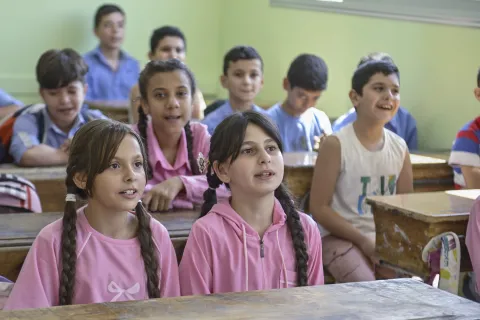
But for Mohamed, the world of learning truly opened a year ago when a UNICEF-supported mobile education team arrived at his camp. The self-learning programme, designed for out-of-school children, was a second chance for children like him—children who had lost years to war and displacement.
“When I heard the news, I was overwhelmed,” Mohamed says, his eyes lighting up. “Finally, I had a chance to catch up. I made a schedule—morning lessons first, then herding the sheep. Before dark, I would spend two hours reviewing my lessons and doing my homework.”

Now, Mohamed is not just learning—he’s teaching. Every evening, he patiently sits with his younger brothers, guiding them through the Arabic alphabet and helping them prepare for the school days ahead.


Watching his son, Darweesh’s face softens with pride. “After the accident, he struggled. He was sad and withdrawn. But since he started learning, he has changed completely. He is determined, eager, always ready to help others.”

With a new chapter unfolding in Syria, the family has decided to return to their hometown next summer. The road ahead will not be easy, but Darweesh is resolute. “Our home is widely damaged, but I want to take my children back. They have lost so much time already, and they need to be in school.” Listening quietly, Mohamed finally speaks up, his voice filled with confidence. “Now I can read easily and calculate big numbers. I am ready to go to school.”
And with those words, a new journey begins.
In 2024, in partnership with the Global Partnership for Education (GPE), Education Cannot Wait (ECW), the German Federal Ministry for Economic Cooperation and Development (BMZ) through the KfW Development Bank, the European Civil Protection and Humanitarian Aid Operations (ECHO), the Foreign Commonwealth and Development Office (FCDO), the Arab Gulf Programme for Development (AGFUND), the Government of Japan, and UNICEF National Committee for Ireland, has reached more than 34,000 children through the self-learning programme to help them continue their education.