Malnutrition among children and mothers on the rise in Deir ez-zor
UNICEF provides families access to essential health care and nutrition service

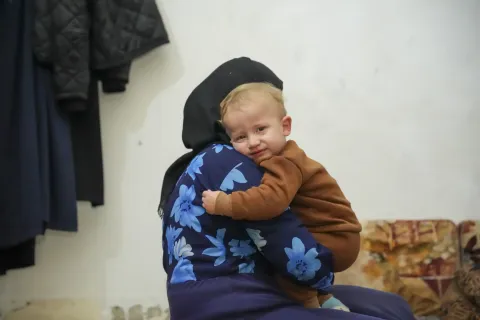
Deir ez-zor city, Syria: “Seeing my only boy’s health deteriorate every day was the hardest thing for me. I don’t want to think about those days,” said Ateka, 24, the mother of 2.5-year-old Ghassan, with her eyes filled with tears.
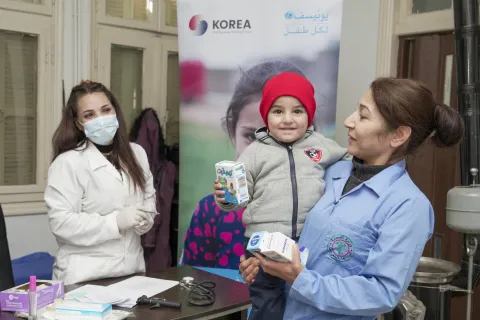
Ateka noticed Ghassan was weak and unable to walk or interact as his peers. “I was scared to death. I didn’t know what to do,” she explains. Her relatives advised her to visit the UNICEF-supported health and nutrition clinic in Deir ez-zor city. Ghassan was diagnosed with severe wasting. Children with wasting are too thin and their immune systems are weak, leaving them vulnerable to developmental delays, disease and death.
Ghassan started receiving treatment at the clinic in September 2022. The clinic provided him, among other children suffering from severe wasting, energy dense peanut-based paste. The ready-to-use therapeutic food (RUTF) is rich in essential nutrients, minerals and vitamins and it helps children recover. After five months, Ghassan was able to walk and interact with his family.

UNICEF/Syria/2023/Rami Nader

UNICEF/Syria/2023/Rami Nader
“The clinic is far from my house, but I love coming here,” Ateka said happily.
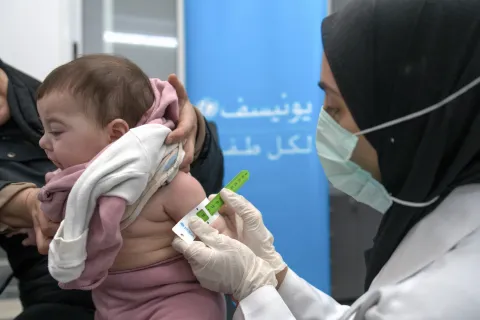
The clinic also offers primary health care consultations and nutrition screenings for children and pregnant and lactating women. It similarly provides multiple micronutrient supplements to the recovered and healthy children to prevent micronutrient deficiencies and stunting.
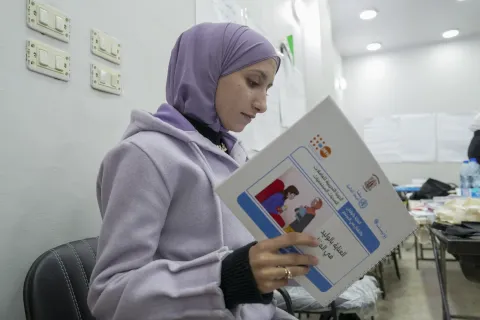
“Mothers’ commitment is key. Ateka was so keen to help her baby, she followed our instructions carefully and did very well with Ghassan,” said Sheikha. She is one of nutrition workers with the UNICEF-supported team. The team consists of a paediatrician, nutrition and health workers, nurses, and administrative staff.

UNICEF addresses malnutrition in all its forms, undernutrition (stunting and wasting), micronutrient deficiencies, overweight and obesity, with a comprehensive life-cycle approach. Since stunting causes irreversible physical and mental damage to children, UNICEF provides all needed support to prevent it by early detection and treatment.
“We encourage families to bring their children for nutritional screening regularly to identify early malnutrition symptoms and avoid any irreversible damage could happen to their children,” Mohamad, another nutrition worker said. “We can prevent stunting by providing different nutritional supplements to vulnerable children,” he added.

Hiba, 21, is nine months pregnant. She was diagnosed with severe wasting and is being treated at the clinic. She is recovering, but still struggling with anaemia. “My husband doesn’t have a permanent job. I know I have to follow a rich and diverse diet, but it is not possible,” she said. “Without the free services at the clinic, I wouldn’t be able to recover,” she added. Hiba receives nutritional supplements from the UNICEF-supported team. The team also follows up with her to make sure Hiba recovers and delivers a healthy baby.
To provide a full package of health services to the vulnerable mothers and children in the area, UNICEF works also with United Nations Populations Fund (UNFPA) to provide access to family planning services, including gynaecology and obstetrics.

Salam, 55, the paediatrician, who oversees the clinic’s health services, explained: “We provide a wide array of health care consultations and needed medicine to families. Most people suffer from respiratory problems due to the harsh winter, unavailability of fuel to heat, poor diets and many other reasons.”
Deir ez-zor governorate in eastern Syria has witnessed an intense conflict for years now. It has badly affected public infrastructure, including health systems. Additionally, Deir ez-zor has suffered from drought and a loss of agricultural production due to decreased rainfall. As a result, families have found themselves adopting to painful coping mechanisms, such as under eating and excessive debt, and are barely able to secure diverse diets for their children.
UNICEF is helping families by supporting fixed and mobile health care clinics to serve the governorate. These clinics provide lifesaving health and nutrition services.
Since the beginning of 2022 till March 2023, UNICEF across Syria has provided through health and nutrition clinics some 2.1 million primary health care consultations for children and women of childbearing age, more than 1.6 million children and pregnant and lactating women are screened for acute malnutrition, and over 8,000 children admitted for treatment for severe acute malnutrition. Additionally, UNICEF reached more than 1.4 million caregivers including pregnant and lactating women counselled or reached with awareness on appropriate infant young child feeding counselling.
Contributions from the Bureau for Humanitarian Assistance (BHA/USAID), United Nations Central Emergency Response Fund, Governments of Australia, Canada, Denmark, and Japan, Kuwait Fund for Arab Economic Development, Polish National Committee for UNICEF, the Syrian Humanitarian Fund, and UNICEF’s Global Humanitarian Thematic Fund, made these interventions possible.