A stronger start after returning home
UNICEF supports families in Syria to protect children’s nutrition and wellbeing

Kafr Zeita, Hama – When the fighting subsided, Walaa, 27, decided to return to Kafr Zeita with her family. It was a decision driven by hope, but the reality that awaited them was stark. Their home was no longer standing.
After years in a displacement camp in northern Idleb, Walaa, her husband Zakaria, and their five children had nowhere of their own to go. They moved into a neighbour’s house, knowing it was only temporary. “We are safe,” Walaa says, “but we are always searching for where we can stay next.”

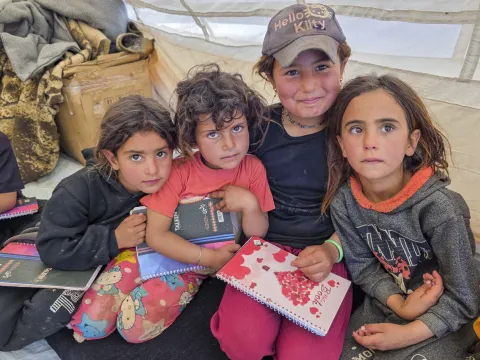
Walaa’s days revolve around her children. Her four daughters, Hanin, 8, Rahaf, 7, Yasmine, 5, and Bisan, 2, are back in school. Her youngest, Abdulrahman, is one year old and still breastfeeding. Zakaria works whenever he can, earning a small daily wage that barely covers basic needs.
In the early months after returning, even those essentials were hard to secure. Food and water were scarce, and when available, unaffordable. The family borrowed money to cope, accumulating debt with no clear way out.
When a UNICEF partner visited the neighbourhood, Walaa did not expect immediate support. “I thought it would be another visit and nothing more,” she recalls.
Soon after, she received a message confirming she would receive cash assistance.
“It arrived when everything felt impossible,” she says. “It changed everything.”

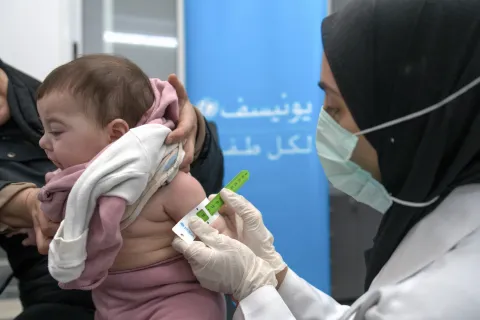
With the support, Walaa prioritised nutritious food for her children – fruit, eggs, and meat – and ensured she herself was eating properly while breastfeeding. For Abdulrahman, the change was immediate. His energy increased. He began to gain weight. His health improved.
“One day, I gave him a banana,” she remembers, smiling. “It was the first time in his life.”


Alongside the cash assistance, Walaa received counselling on optimal breastfeeding and complementary feeding, strengthening her confidence in caring for her son, and she soon began sharing that knowledge with other mothers around her.
“Your work matters. It reaches people when they need it most.”
For Walaa, the support restored more than access to food. It restored a sense of control and dignity at a time when both felt lost. “I couldn’t finish my education,” she says. “But my daughters will. I do everything I can for them.”
She believes families in her community need opportunities to earn a stable income, alongside reliable access to water, health care, and education. But she also knows how much timely support can mean.
“Your work matters,” she says to UNICEF. “It reaches people when they need it most.”
Across Syria, UNICEF continues to support families with young children through cash assistance and preventive nutrition services, helping parents protect their children’s health during the most critical years of life, and giving families like Walaa’s the chance to move forward with hope.
Since the beginning of 2025, UNICEF has reached nearly 87,000 people through its broader Integrated Social Protection Cash+ programme. This support helps ensure that vulnerable children receive the care they need to grow and thrive. These efforts were made possible with vital contributions from the European Civil Protection and Humanitarian Aid Operations (ECHO), the Foreign Commonwealth and Development Office (FCDO), the Governments of France, Australia, Spain, Estonia, and Canada, the Syrian Humanitarian Fund (SHF), and the United Nations Central Emergency Response Fund (CERF).