In Ar-Raqqa, a rehabilitated school brings back hope to children

UNICEF rehabilitates school in Ar-Raqqa and brings back hope to children

Basma Ourfali
students in rehabilitated classroom school
UNICEF/Syria 2018/ Khuder Al-Issa
03 June 2018

After years of conflict and fighting, a sense of normalcy is slowly returning to parts of Ar-Raqqa governorate. Families are going back to safer areas hoping to rebuild their lives, despite challenging conditions. One of these areas is Debsi Faraj, a village on the eastern border of the governorate, where around 300 families have returned over the past months. Among them is 27-year-old English teacher Amira, “we came back to our home in Debsi Faraj seven months ago,” says Amira. “Our house was completely looted. The whole town was unrecognizable, it was so destroyed.” The vestiges of years of fighting can be still seen today; a public square not yet fully cleared from rubble, overturned cars blocking streets, the village’s sole ATM standing ajar with its front blasted open. Many basic have yet to restart.

Our house was completely looted. The whole town was unrecognizable, it was so destroyed.

Amira, 27, English teacher

Yet, the Debsi Faraj community persisted and getting children back to school was one of their priorities. The local school complex was partially destroyed by the fighting, so the local community provided an apartment that was turned into classrooms and children crammed into two small spaces to attend lessons. “Our children are eager to learn despite the poor learning environment in the village,” said a local school principal. Meanwhile UNICEF, with funding from the Government of Norway, got to work rehabilitating local schools in south-eastern Ar-Raqqa. “When we came to the school last September it was in a terrible state,” explains UNICEF Education Officer Osama Antabi. “The building was damaged by the fighting. I walked into a lab and found a whole row of computers riddled with bullets.” Over the following months, Debsi Faraj school and 15 others in the countryside of south-eastern Ar-Raqqa governorate were rehabilitated.

Children stands at the newly rehabilitated school buildings
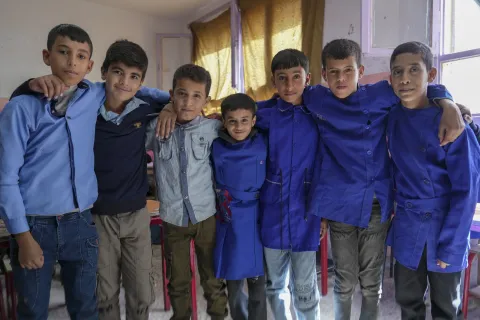
UNICEF/Syria 2018/ Khuder Al-Issa Children at the newly rehabilitated school buildings in Debsi Faraj village in eastern Ar-Raqqa. Around 300 families have returned to the village after years of conflict. UNICEF, with funding from the Government of Norway, rehabilitated 16 schools in the countryside of south-eastern Ar-Raqqa governorate. The schools were equipped with teaching materials and the students provided with school bags, stationary and textbooks. Approximately 295,000 people from Ar-Raqqa governorate were displaced by military operations in 2017. While Ar-Raqqa city remains unsafe for returns, families are returning to other parts of the governorate.
UNICEF staff members with Children playing in front of the newly rehabilitated school buildings
UNICEF/Syria 2018/ Khuder Al-Issa Children play in front of the newly rehabilitated school buildings in Debsi Faraj village in eastern Ar-Raqqa. Around 300 families have returned to the village after years of conflict. UNICEF, with funding from the Government of Norway, rehabilitated 16 schools in the countryside of south-eastern Ar-Raqqa governorate. The Schools were equipped with teaching materials and the students provided with school bags, stationary and textbooks. Approximately 295,000 people from Ar-Raqqa governorate were displaced by military operations in 2017. While Ar-Raqqa city remains unsafe for returns, families are returning to other parts of the governorate.
Children play in front of the newly rehabilitated school buildings
UNICEF/Syria 2018/ Khuder Al-Issa Children play in front of the newly rehabilitated school buildings in Debsi Faraj village in eastern Ar-Raqqa. Around 300 families have returned to the village after years of conflict. UNICEF, with funding from the Government of Norway, rehabilitated 16 schools in the countryside of south-eastern Ar-Raqqa governorate. The Schools were equipped with teaching materials and the students provided with school bags, stationary and textbooks. Approximately 295,000 people from Ar-Raqqa governorate were displaced by military operations in 2017. While Ar-Raqqa city remains unsafe for returns, families are returning to other parts of the governorate.

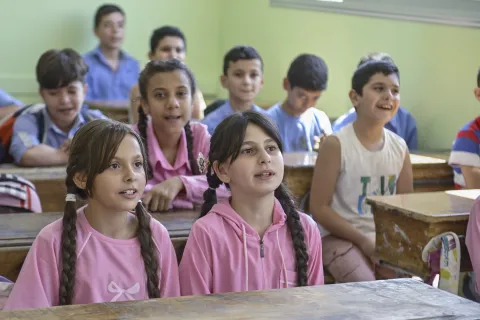
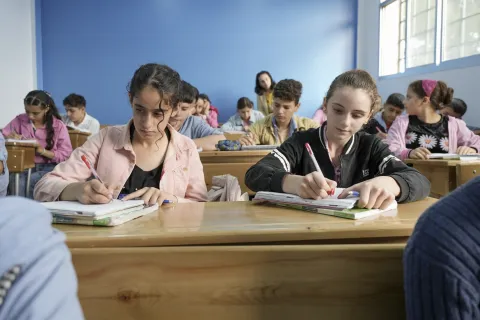
One by one, they opened their doors to students once again. The Schools were equipped with teaching materials and the students provided with school bags, stationary and textbooks. For those who have missed out on learning over the past years UNICEF also provided accelerated learning opportunities to catch-up on their education.

“There are no schools in our village and we want to go to school so our parents sent us to live with our grandparents,”

Ahmed,10
a boy sitting in a rehabilitated classroom happily
UNICEF/Syria 2018/ Khuder Al-Issa The brother Ahmed, 10, and Amer, 8, both attend first grade Arabic classes at the newly rehabilitated school buildings in Debsi Faraj village in eastern Ar-Raqqa. They live with their grandparents at Debsi Faraj village. Around 300 families have returned to the village after years of conflict. UNICEF, with funding from the Government of Norway, rehabilitated 16 schools in the countryside of south-eastern Ar-Raqqa governorate. The Schools were equipped with teaching materials and the students provided with school bags, stationary and textbooks. Approximately 295,000 people from Ar-Raqqa governorate were displaced due to military operations in 2017. While Ar-Raqqa city remains unsafe for returns, families are returning to other parts of the governorate.

Amongst those attending accelerated learning classes is 13-year-old Naser. Even though he still has to work to support his family, he’s eager to catch up with lost years of learning. “Sometimes when I have to help my father with tending the cattle I take permission to skip a class,” says Naser. “But I keep coming back to school. I want to keep going until I graduate.”

“But I keep coming back to school. I want to keep going until I graduate.”

Naser, 13
a happy student in rehabilitated classroom school
UNICEF/Syria 2018/ Khuder Al-Issa Naser, 13, at the newly rehabilitated school buildings in Debsi Faraj village in eastern Ar-Raqqa. Even though he still has to work to support his family, he’s eager to catch up with lost years of learning. Naser joined an accelerating learning program to catch up with his peers. “I prefer going to school and be with my friends but there is no one else to support my father.” UNICEF, with funding from the Government of Norway, rehabilitated 16 schools in the countryside of south-eastern Ar-Raqqa governorate. The Schools were equipped with teaching materials and the students provided with school bags, stationary and textbooks

Sometimes when I have to help my father with tending the cattle I take permission to skip a class,

Naser, 13

15-year-old Doua is also one of the students who came back to the school when it re-opened. Doua and her three siblings lost their father three years ago in the war and their mother died of cancer a year ago. Today, they live with their grandparents. “After all that has happened I am even more determined to finish my education,” says Doua. “This June I will do my 9th grade national exams and will complete my studies to become a nurse or a doctor. We desperately need them here.”

“This June I will do my 9th grade national exams and will complete my studies to become a nurse or a doctor. We desperately need them here.”

Doua, 15
a happy student in rehabilitated classroom school
UNICEF/Syria 2018/ Khuder Al-Issa Doua, 15, at the newly rehabilitated school buildings in Debsi Faraj village in eastern Ar-Raqqa. Doua and her three siblings lost their father three years ago because of the conflict and their mother died of cancer a year ago. Today, they live with their grandparents. “After all that has happened I am even more determined to finish my education,” says Doua. UNICEF, with funding from the Government of Norway, rehabilitated 16 schools in the countryside of south-eastern Ar-Raqqa governorate. The schools were equipped with teaching materials and the students provided with school bags, stationary and textbooks.
girl stands next to blackboard in rehabilitated school
UNICEF/Syria 2018/ Khuder Al-Issa Doua, 15, at the newly rehabilitated school buildings in Debsi Faraj village in eastern Ar-Raqqa. Doua and her three siblings lost their father three years ago because of the conflict and their mother died of cancer a year ago. Today, they live with their grandparents. “After all that has happened I am even more determined to finish my education,” says Doua. UNICEF, with funding from the Government of Norway, rehabilitated 16 schools in the countryside of south-eastern Ar-Raqqa governorate. The schools were equipped with teaching materials and the students provided with school bags, stationary and textbooks.

After all that has happened I am even more determined to finish my education,

Doua, 15

But the work is still not yet finished; one of the school buildings at Debsi Faraj was so extensively damaged that another assessment is being undertaken to decide whether it still can be salvaged or if it needs to be torn down. Nevertheless, in a village with hundreds of children eager to go to school, the rehabilitation of half of all the schools is a strong sign of hope and renewal.

A partially rehabilitated school building within the school complex by UNICEF
UNICEF/Syria 2018/ Khuder Al-Issa A partially rehabilitated school building within the school complex at Debsi Faraj village. The unrehabilitated part of the building is being assessed to either be further rehabilitated or to be torn down if structurally unsound. UNICEF, with funding from the Government of Norway, rehabilitated 16 schools in the countryside of south-eastern Ar-Raqqa governorate. The Schools were equipped with teaching materials and the students provided with school bags, stationary and textbooks. Approximately 295,000 people from Ar-Raqqa governorate were displaced by military operations in 2017. While Ar-Raqqa city remains unsafe for returns, families are returning to other parts of the governorate.