“We will sleep tight”
16 million reasons for hope in the fight against malaria in Sudan
As night falls in Sudan, many parents stay awake listening to the sound of mosquitoes.
For families already displaced by conflict and struggling to access healthcare, a single mosquito bite can carry dangerous consequences.
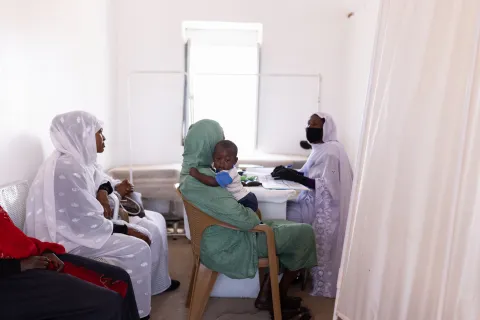
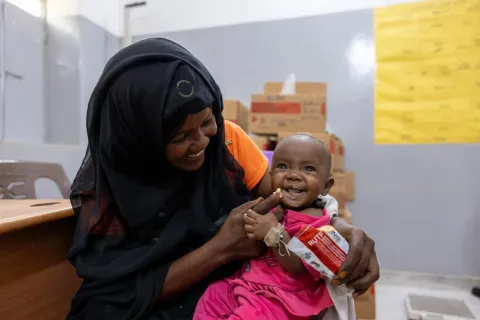
Children like Tenzil are among the most vulnerable. Malaria remains one of the leading threats to children’s lives in Sudan, especially as conflict, displacement and overcrowding increase the risk of disease outbreaks.
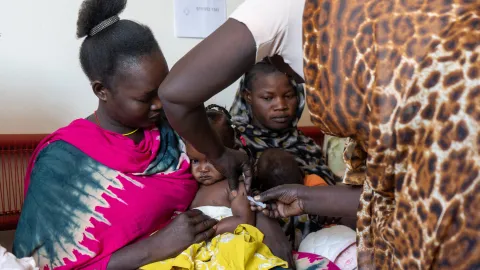
With health services disrupted across many parts of the country, prevention has become more urgent than ever.
“Since we fled Khartoum, we haven’t had a single net,” says Amina, a mother. “When it got unbearable, I’d borrow one from the midwife in the camp. I had to return it later—we called it a 'loan."
A mass national response

To help protect children and families, UNICEF, with support from the Global Fund and in partnership with Sudan’s Federal Ministry of Health, Sudanese Red Crescent Society, Patients Helping Fund, Auttach Association and SAHARI organizations launched one of the country’s largest malaria prevention campaigns in recent years.
Across three phases, the campaign aims to distribute 16 million insecticide-treated bed nets across Sudan — each one providing a simple but lifesaving layer of protection.
Despite insecurity, access challenges and large-scale displacement, health workers and community volunteers continued travelling from house to house, determined to reach families before the peak malaria season.
"These nets came at the right time. When it rains, our village floods and mosquitoes are everywhere. Now, my children and I will be protected.” Awadia a mother of four.
Reaching families in displacement

In Al Fao camp in Gedaref State, displaced mothers stand in long lines beneath the heat, holding registration cards and carrying young children in their arms.
“Now my children can sleep peacefully. No more crying at night from mosquito bites. These nets will protect our health,” says Badiya, a mother living in a displaced site.
For many families, receiving a bed net brings relief.
It means children can sleep more safely at night.
It means one less worry for parents already carrying so many burdens.
In overcrowded settings where water systems are strained and health facilities are overstretched, malaria prevention is often the strongest line of defence.
Nets for families in Darfur

Fatima sits patiently under a makeshift shelter in Daba Naira camp in Tawila. Voucher in hand, she awaits her turn to receive bed nets during the final phase of the campaign.
The camp is now home to thousands of children and families that fled the fighting in Al Fasher. For these families, rebuilding their lives under extremely difficult conditions, the nets are more than protection. With the rainy season approaching and malaria cases expected to increase, the nets will provide critical relief and protection for families at risk.
"The nets will protect us from insects, mosquitoes and diseases,” Fatima says.
Scale and impact

The campaign reached communities across Sudan, including areas heavily affected by conflict and displacement.
Phase 1 supported more than 1.7 million households in White Nile, Blue Nile, Gedaref, North Kordofan and parts of South Kordofan.
Phase 2 expanded to Kassala, Sennar, Gezira and four Darfur states — bringing protection to millions more families ahead of the rainy season.
Phase 3 extended to North Darfur— bringing protection to millions more families.
Each insecticide-treated net can protect several family members for up to three years.
Each net helps reduce the risk of uncomplicated and severe malaria, especially for young children and pregnant women.
And each net helps ease pressure on fragile health services already stretched by conflict and disease outbreaks.
More than a net

For many parents, the message is simple:
“We will sleep tight.”
Across Sudan, families continue to face violence, displacement and uncertainty. But as the rainy season approaches, millions of children now have stronger protection against one of the country’s deadliest diseases.
Through the partnership between the Federal Ministry of Health, the Global Fund, UNICEF and partners— and through the efforts of frontline workers and communities themselves — families are gaining a vital tool to help keep children safe.
Every child deserves protection from preventable disease.
Every child deserves to sleep safely at night.