Healthcare within reach
Bringing lifesaving care closer to children in White Nile

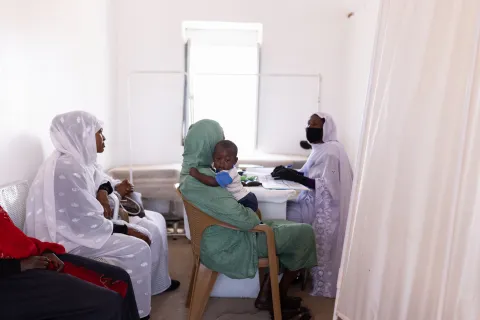
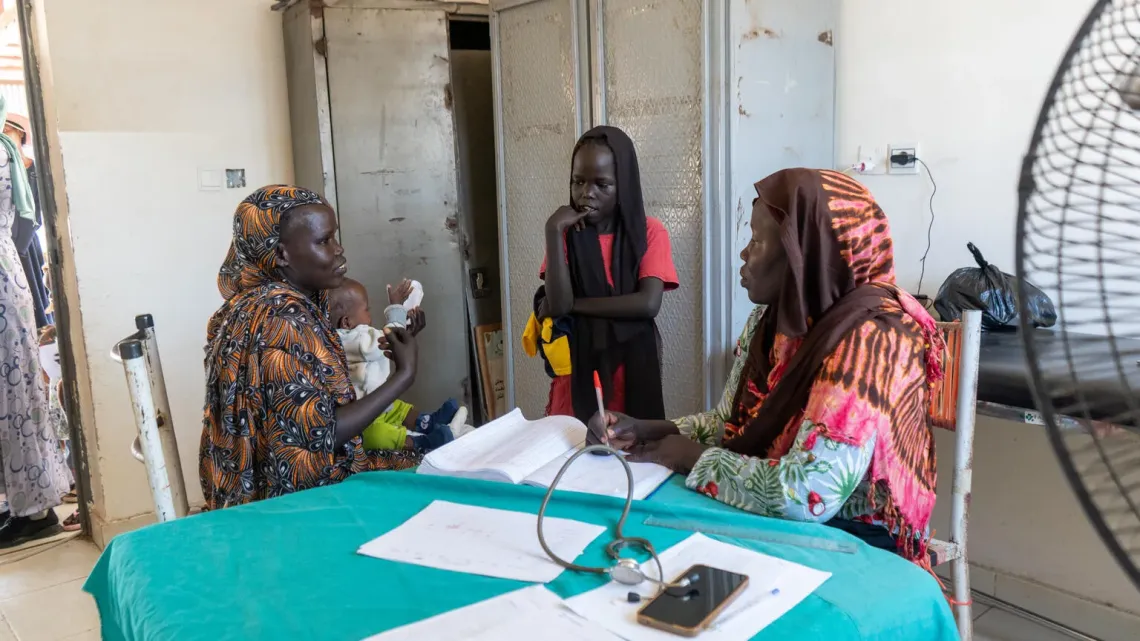
Sitting on a long bench woven with colourful strings, Zahra waits patiently alongside other mothers at Al Kashafa health centre in White Nile State. Around her, children fidget, play—or lie quietly, too weak to move.
For Zahra, every visit is an act of devotion. It takes her nearly two hours to reach the facility- the closest one to her home- but she makes the journey for one reason: to Keep her children healthy and safe.
As the day begins, health workers prepare their stations, carefully transferring vaccines into cooler boxes and setting up weighing scales, height boards and nutrition supplies. It is a familiar routine in a place where access to healthcare can mean the difference between life and death.
Today, Zahra is here for her nine-month-old daughter, Amina.
“Today I came for her measles vaccination,” Zahra says, gently holding Amina in her arms. “She also received all her earlier doses here.”
Before vaccination, Amina is weighed and screened for malnutrition using simple but effective mid-upper arm circumference (MUAC) tape. The coloured band quickly shows whether a child is growing well or needs urgent care. Amina’s result falls in the green zone. Her weight matches her age. Zahra exhales with relief.

Displacement and growing pressure on services
Zahra is one of hundreds of thousands of refugees who fled to White Nile when the conflict broke out in April 2023. As violence spread, families sought safety wherever they could find it. Today, White Nile hosts nearly half of all refugees in Sudan.
While many families like Zahra’s remain safe, the continued influx has placed immense strain on essential services—health, nutrition, water and sanitation. Overcrowding, disease outbreaks and poor sanitation conditions have forced many refugees to move from camps into already congested gathering sites, where displaced and host communities now live side by side.
Yet even under this pressure, support is reaching those who need it most.
With support from the Bureau of Population, Refugees, and Migration (BPRM) of the U.S. Department of State, UNICEF, together with partners, is supporting government efforts to sustain essential health services—so children and mothers can continue to access lifesaving care.


At Al Kashafa health centre, families receive a comprehensive package of services, including routine immunization, nutrition screening, malnutrition treatment, infant and young child feeding counselling, and medical consultations. Pregnant and lactating women also receive critical care—benefiting hundreds of families from both refugee and host communities.
“This centre has made things much easier for us,” Zahra says.
“Whenever I come here, I find all the services. They receive us and they treat us.”
A health facility close to home
In a country where the health system has been affected by war, a functional health facility like Al Kashafa- equipped with essential medicines, vaccines, nutrition supplies and dedicated frontline health workers, is a lifeline.
“Before this centre, we used to go to Al-Jabalain,” Zahra recalls. “The distance was very far.”
For other mothers, timely access has been lifesaving.
At another nearby health facility, Amina sits beside her two-year-old daughter, Asha, in a stabilization centre. Just two weeks earlier, Asha had been admitted with severe diarrhoea and vomiting. Her body was swollen. She was too weak to walk.
“They gave her injections and milk,” Amina says.
Thanks to the timely therapeutic care and treatment, Asha is now recovering. In just a few days, her strength has begun to return.
With health facilities now close to home and services up and running, mothers like Amina can seek care early- before a child’s condition becomes life-threatening.
Reaching children with lifesaving care
Across White Nile, UNICEF’s support is helping reach thousands of children and mothers in refugee and host communities with lifesaving services, including:
- Treatment for severe acute malnutrition (SAM) through outpatient therapeutic programmes (OTPs), stabilization centres (SCs) and mobile clinics.
- Infant and Young Child Feeding (IYCF) counselling.
- Integrated nutrition campaigns delivering essential services such as active case finding and nutrient supplementation.
- Nutrition screening for children under five, vitamin A supplementation, and iron and folic acid (IFA) for mothers.
- Delivery of ready-to-use therapeutic food (RUTF) and therapeutic milk, including in high-burden and hard-to-reach areas.
For families who have already lost so much, access to healthcare close to home offers something precious: reassurance, dignity—and a chance for their children to survive and grow.