The powerhouse of motherhood
The compassion and resilience of frontline workers create hope for mothers in Golo, Central Darfur

- English
- العربية
“When we are called to provide counselling, we cannot say no. I am a mother of five. When I look at their children, I imagine my youngest daughter. What if she were the one fighting to survive?” says Fadeela.
She is one of the women in her community forming a circle of care around mothers and children and ensuring healing begins somewhere, even in displacement.
Nothing is stronger than a mother’s love. Yet in crisis, nothing is more exposed or vulnerable.
After the violent conflict in Al Fasher, thousands fled to Tawila with only what they could carry. Many arrived traumatized, grieving, hungry and with nothing left of the lives they once knew. Some continued their journey to Golo, hoping distance would ease the memories of loss.
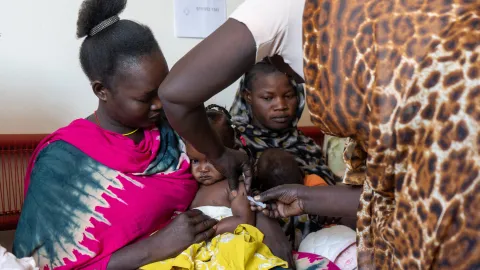
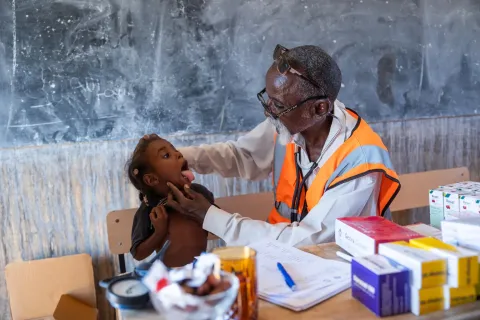
In the heart of several displacement settlements, the Golo Jadeeda Health Centre stands as a lifeline. Supported by UNICEF and implemented by Save the Children, it provides integrated health, nutrition, and mental health and psychosocial support services whose needs go far beyond the physical.

“Mothers arrived in large numbers from nearby camps. Many children were severely malnourished, some swollen with Kwashiorkor,” explains Nidal Elias.
She walks half an hour to work each day, carrying her one-year-old son, Shamikh, and her unborn baby.
“Right now, we are treating 31 cases of severe acute malnutrition, and more than 200 have been transferred to the supplementary feeding programme. Four children have already recovered.”
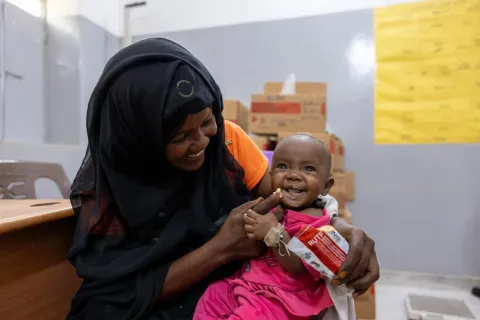
These frontline workers are mothers themselves, women who carry the weight of their own struggles while holding others together. Arafa Abdel Mawla registers women arriving for screening while her eight-month-old son, Afrahim, rests on her back. “I want everything for him. These children have nothing. That is why I come every day to support their mothers because I am one.”
The men too are playing their part. “If a mother is in shock or suffering psychologically, she cannot take care of her child. We must help her mind heal before her body can start healing as well,” explains Saddam Yahia, MHPSS Officer.
Something amazing happens when the survivors start healing. They start supporting other incoming mothers. It is a magnificent cycle of compassion, powerful enough to break the vicious patterns of pain.

Mothers carrying the weight of survival
Awatif Mohamed remembers a simple but content life before the war. She and her husband worked hard to raise nine children. Now, displaced in Golo Al Jadeeda for eight months, she is raising them alone. Her husband has been missing for more than a year.
“When we fled, I carried four blankets on my head all the way from Al Fasher to Zamzam and then to Golo. We could not carry much, but I knew my children would be cold.” Her voice softens: “Everything that could happen has already happened to us. We need help. We need peace. We want our simple lives back.”
For Gisma Yagoub survival meant escaping Al Fasher after losing both parents to the conflict. Her baby, Mustafa, was severely malnourished upon arrival. “My milk is very little. I could not breastfeed him regularly. But after four sessions at the centre, he is getting stronger.” She returns every week for screening and nutrition support.
Celebrating motherhood and protecting it
Motherhood sustains life even in the harshest moments. In Golo Jadeeda, frontline workers and mothers are holding each other through unimaginable challenges.
Every displaced mother is fighting a battle no one should face alone for food, for safety and for the chance to hold her children through another day. The resilience of the frontline workers is extraordinary, but resilience is not enough. They need the world to stand with them now.